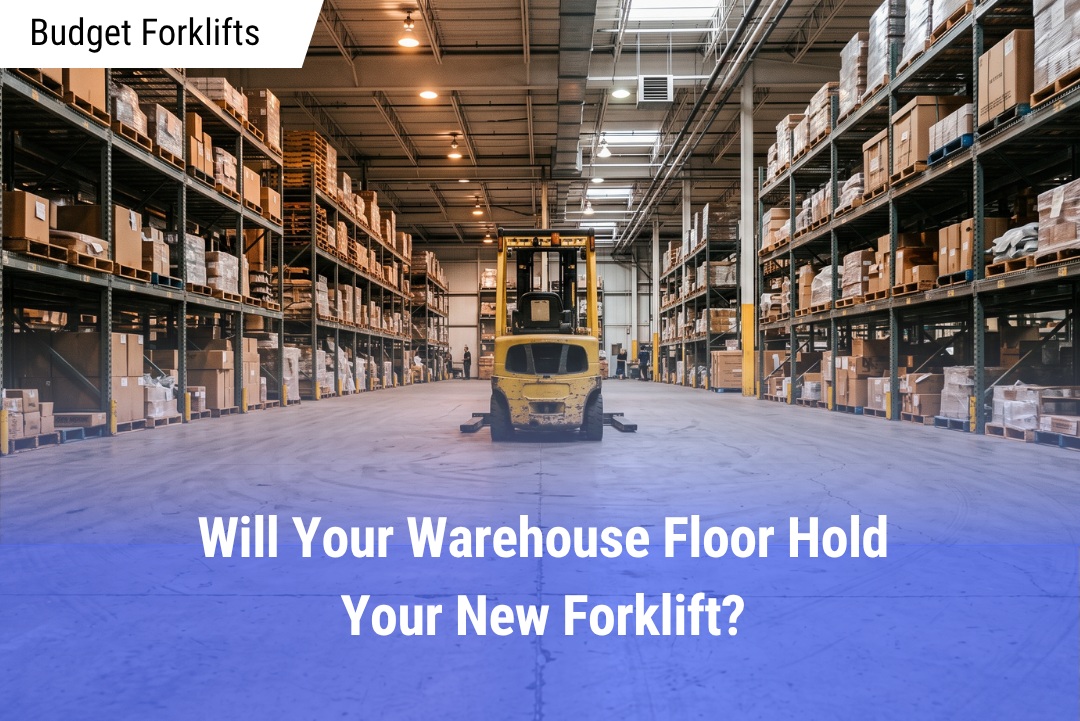
Most warehouse floors were poured for whatever equipment was moving through the building at the time, not for whatever you’re about to buy. If you’re upgrading to a heavier truck, that gap between “what the floor was built for” and “what you’re about to put on it” is worth checking before delivery day, not after the first crack shows up.
Table of Contents
Will my existing floor actually hold the forklift I want to buy?
In most cases, an older warehouse floor was engineered for the lightest or oldest equipment ever used in the building, and nobody re-checks that rating when a heavier truck comes in the door. OSHA’s own guidance on forklift operating surfaces lists a collapsing floor as a distinct hazard category, right alongside skidding and tip-overs, and it specifically instructs operators not to travel over a surface that can’t support the weight of the truck, its load, and its operator.
We’ve seen this play out with a customer who upgraded from a 4,000 lb electric unit to a heavier IC pneumatic-tire truck to keep up with growing pallet volume. The new truck arrived, worked fine for a few weeks, then hairline cracking started showing up near an expansion joint by the loading dock, an area that had never carried anything heavier than a pallet jack before. Nothing failed catastrophically, but it turned into an unplanned repair bill that a five-minute floor check before delivery would have avoided. If you’re moving up in weight class, that’s exactly the kind of spot worth walking before you sign, especially if you’re weighing a new vs. used forklift comparison where the used option happens to be a heavier machine than what you’re replacing.
How thick does a warehouse floor need to be for a forklift?
The honest answer is that it depends on the truck’s actual weight, not its rated lifting capacity, because it’s the truck’s own weight plus the load that gets concentrated onto a handful of small tire contact patches. Per PE-authored engineering guidance on warehouse slab design, floor thickness for forklift traffic is calculated from the truck’s axle load, wheel spacing, tire contact area, and the strength of the soil underneath, using design charts built specifically for this kind of point loading. Here’s roughly where different forklift weight classes tend to land, as a starting point for a conversation with a structural engineer or the building owner, not a substitute for one:
| Forklift class | Typical truck weight (unloaded) | Slab range commonly specified |
| Light electric, cushion tire (3,000 to 5,000 lb capacity) | 4,000 to 8,000 lb | 4 to 6 inches, standard commercial mix |
| Mid-size IC or electric, pneumatic tire (5,000 to 8,000 lb capacity) | 8,000 to 12,000 lb | 6 to 8 inches, standard industrial mix |
| Heavy-duty or reach truck (10,000 lb capacity and up) | 12,000 to 20,000+ lb | 8 to 12 inches, engineered heavy-load mix |
These figures are rough starting points, not a substitute for an actual floor assessment, since subgrade quality, existing reinforcement, and joint spacing all move the number. Before you assume your building falls into one bucket or another, it’s worth pulling up how much weight a forklift can actually carry for the specific model you’re considering, since the number on the sales sheet and the number on the truck’s own data plate don’t always match once attachments are factored in.
Of the customers who ask us about floor capacity at all, most of them are making the jump from a light electric unit into that mid-size pneumatic-tire range, somewhere around 5,000 to 8,000 lb capacity. That’s usually the point where an older building’s floor starts to matter, since it’s the first time the truck’s weight has really changed rather than just its lift height or mast type.
What happens if a forklift is too heavy for the floor?
Most people picture a dramatic single event, a slab suddenly caving in under one heavy pass. In practice, it’s usually slower and less dramatic than that. The engineering term for it is fatigue, and it comes from the same wheel crossing the same joint or thin spot hundreds or thousands of times, not from one overloaded pass. The same slab design guidance referenced above lays out fatigue loading directly, noting that concrete stressed above roughly 45 percent of its flexural strength will accumulate damage over repeated cycles even if no single pass ever comes close to failure on its own. We’ve seen a version of this firsthand.
A customer had been parking a heavily loaded pallet jack in the same spot near a doorway threshold for weeks at a time on an older, thinner section of slab. There was no crash and no single bad moment, just a visible dip and eventual cracking that only showed up once the pattern repeated for long enough. By the time it was caught, the customer needed to patch and re-pour that section before bringing in a heavier reach truck to replace the aging counterbalance unit. It’s the kind of damage that’s easy to miss because it doesn’t happen all at once.
Can an older warehouse floor be reinforced for a heavier forklift?
Sometimes, yes. Common fixes include adding a bonded overlay slab, restricting the heavier truck to specific aisles that were poured to a higher spec, or simply reinforcing the joints and load transfer points where wheel traffic actually crosses them most often. None of that is a weekend project, and it’s not something to guess at. It starts with getting an engineer or a floor survey to confirm what the existing slab can actually take, since guessing wrong here is expensive in both directions: overbuilding wastes money, and underbuilding cracks a floor you just paid to fix.
Reinforcing a floor is also a real cost and timeline to weigh against your other options. We’ve had customers who were eyeing an 8,000 lb reach truck for an older brick-and-timber building back off that plan once the floor’s age became a real question mark, and choose renting a smaller electric unit for their seasonal demand instead of paying to reinforce a slab for a truck they might not need year-round. If your volume genuinely fluctuates, comparing long-term versus short-term rental or reviewing typical forklift rental costs can be a faster answer than a floor upgrade, especially if you’re not sure the heavier truck is a permanent need. On the other hand, if you’re planning to own the truck for years, working through how to choose the right forklift for your warehouse before you buy, rather than after, is what keeps the floor conversation from becoming an afterthought.
Frequently Asked Questions
Does a forklift’s data plate tell you what the floor needs to support?
It tells you the truck’s rated lifting capacity and load center, but not its own weight, which is actually the bigger factor for floor loading. Check the plate for the truck’s own operating weight, or ask the seller directly if it isn’t listed, before comparing that number against your floor.
Is a floor’s load rating the same thing as a forklift’s capacity rating?
No, they measure completely different things. A forklift’s capacity rating is how much it can lift, while a floor’s load rating is how much weight the slab itself can carry per square foot or at a concentrated point, and the two numbers need to be compared against each other rather than confused for one another.
Who do you actually call to check a slab before buying?
A structural engineer or a concrete floor survey company can pull the original building drawings or test the existing slab directly. If the building has been through any other equipment upgrades before, the property manager or building owner may already have that information on file.
Does tire type change the pressure a forklift puts on the floor?
Yes. Cushion and hard tires concentrate weight onto a smaller contact patch than pneumatic tires, which spread the same weight over a larger footprint, so two trucks with identical weight can put very different pressure on the same floor depending on tire type.
Conclusion
The floor under your forklift rarely gets a second thought until it cracks, and by then the fix is more expensive than the five minutes it would have taken to check beforehand. If you’re upgrading to a heavier truck, especially anything moving into that 6,500 lb-plus pneumatic-tire range, it’s worth pulling the truck’s actual operating weight off the data plate, walking the areas where it will travel most, and asking a straightforward question before you sign: has anyone checked what this floor can actually take? That single step is the difference between a forklift that works quietly in the background for years and one that turns into a concrete repair bill in its first season.