Choosing the right forklift for your warehouse comes down to four things: how heavy your loads are, how high you need to lift them, how wide your aisles are, and what kind of power source fits your environment. Get those four right and the rest of the decision falls into place.
If you’ve ever called us at Illinois Industrial Equipment and asked “which forklift do I need?”, you know the first thing we ask isn’t “what’s your budget?” It’s “walk me through your warehouse.” The building tells us almost everything. So that’s where we’ll start.
What Does Your Warehouse Layout Actually Look Like?
Your floor plan is the most important spec sheet you have, more important than any forklift brochure. Before you look at a single model, you need three measurements:
- Aisle width (the deciding factor for forklift type)
- Ceiling height and any low obstacles (dock doors, sprinkler lines, overhead beams)
- Highest rack level you need to reach
Those three numbers will rule out more options than anything else you do. A 5,000 lb electric counterbalance looks great on paper until you realize your aisles are 9 feet wide and it needs 12 to turn around comfortably.
We had a customer in the south suburbs who ordered a sit-down counterbalance for a warehouse that turned out to have 8.5-foot aisles. The truck arrived, couldn’t make the turn at the end of the rack row, and sat on the dock for a week while we sourced a reach truck swap. Measure first. Order second.
How Do You Match Forklift Type to Aisle Width?
The aisle width determines your forklift class before load capacity or budget even enters the conversation. Here’s how it breaks down:
| Aisle Width | Forklift Type | Notes |
|---|---|---|
| 12 ft+ (wide) | Sit-down counterbalance | Most versatile, easiest for operators |
| 10–12 ft (standard) | Stand-up counterbalance or reach truck | Reach trucks extend forks without turning the full truck |
| 8–10 ft (narrow) | Reach truck | Standard choice for high-density racking |
| 5–7 ft (very narrow) | Turret truck or order picker | Maximum storage density; requires wire guidance |
Counterbalance forklifts are what most people picture when they say “forklift”: the classic sit-down truck with forks in front and a counterweight in the rear. They’re right for wide aisles, dock loading, and general material handling. If your layout can accommodate them, they’re the simplest, most operator-friendly option. If you want to see how two of the biggest counterbalance brands stack up head-to-head, our Toyota vs Hyster forklift comparison breaks down the real differences.
Reach trucks are the right call once aisles tighten up. They extend their forks forward into the rack without the whole machine having to turn, which is what lets them work in narrower footprints. For most warehouses running 8 to 10 foot aisles with high racking, a reach truck is what you need.
Order pickers and turret trucks are for very narrow aisle (VNA) environments, typically 5 to 7 feet. They trade maneuverability for density. You get more storage space out of the same square footage, but your operators need more training and your floor needs to be in excellent condition.
What Load Capacity Do You Actually Need?
The number on the data plate is your ceiling, and it’s not a suggestion. Match it to your heaviest, highest, most awkward load, not your average one.
OSHA requires every forklift to carry a nameplate that specifies the exact lift capacity at a standard 24-inch load center. What that means practically: a truck rated for 5,000 lbs at ground level may not safely carry that same load to the top of your rack. Capacity drops as lift height increases and as load center shifts forward.
Attachments cut into capacity too. Add a side shifter, a fork positioner, or a clamp, and the nameplate must be updated to reflect the reduced capacity under 29 CFR 1910.178(a)(4). That’s not optional.
Here’s the mistake we see constantly: a warehouse manager picks capacity based on what they move today, not what they might move six months from now. Then a new product line comes in, pallets get heavier, and they’re back on the phone asking about an upgrade. Size up slightly. The cost difference between a 5,000 lb and 6,000 lb truck is almost nothing compared to the cost of the wrong equipment.
A practical starting point: take your heaviest standard pallet, add 15–20% for variance and future growth, and make sure your chosen truck can handle that number at your highest rack level. That’s your real capacity requirement.
Which Mast Type Do You Need?
The mast is the vertical assembly that raises and lowers your forks. Most buyers don’t think about it until there’s a problem, like the day a 2-stage mast truck can’t clear a low dock door and the whole operation grinds to a halt.
2-stage mast (duplex): Two sections, solid free lift, good forward visibility. Works well in trailers, cross-docking applications, and warehouses with lower ceiling heights. Standard lift heights run up to around 157 inches (about 13 feet). Because the mast doesn’t need as much overhead to operate, it’s the right call when you’re loading and unloading enclosed trailers frequently.
3-stage mast (triplex): The most common warehouse mast. Three-stage masts have full free lift and can reach heights from 159 to 238 inches, making them the go-to choice for high-racking environments. The trade-off is slightly reduced forward visibility because of the additional inner channel and hydraulic cylinder, something operators notice and something worth discussing before you spec the truck.
The rule we give every customer: measure your lowest fixed obstacle (dock door, overhead beam, sprinkler head) and your tallest rack level. Your mast needs to fit under the first one and reach the second one. If you’re unsure, the 3-stage triplex handles more situations and is the right default for a general warehouse.
One of our repeat customers, a mid-size food distribution operation in the Chicago area, went through two wrong mast specs before we did a proper site walk. Their dock doors were 9 feet 6 inches. Their original 2-stage truck fit fine going in empty, but raised forks clipped the door frame on exit. Lesson: measure the door with a loaded truck in mind, not just the truck itself.
Electric or Internal Combustion: What’s the Right Power Source?
This decision is mostly made by your environment. Everything else is secondary.
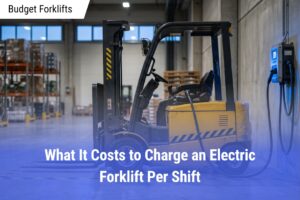
Electric forklifts are the right choice for indoor warehouses with smooth concrete floors, particularly if the space is enclosed, food-grade, or noise-sensitive. No emissions, significantly lower operating costs over time, and less ongoing maintenance than internal combustion. The honest downside: higher upfront cost and you need a charging infrastructure plan. Running two shifts? You’re either swapping batteries or investing in fast chargers.
Propane (LPG) forklifts are the most common choice for operations that move between indoor and outdoor environments, like facilities that load trucks at an outdoor dock and then work inside the building. Propane refuels in minutes versus hours for electric charging, which matters when you’re running three shifts. The trade-off is ventilation requirements indoors and ongoing fuel costs that add up over years.
Diesel forklifts are built for outdoor yards, construction sites, and applications where you’re moving very heavy loads on uneven surfaces. Emissions make them a poor fit for indoor use in enclosed spaces.
A question we get constantly: “can I use propane inside?” Yes, with proper ventilation and catalytic converters, but if you’re running the forklift for six or more hours a day in an enclosed building, electric is almost always the better long-term call. We’ve seen operations cut fuel and maintenance costs by 30–40% after switching their indoor fleet from propane to electric. The upfront equipment cost difference pays back faster than most people expect.
What About Battery and Charging Strategy?
If you go electric (and increasingly, most indoor operations should), your battery setup determines your uptime more than the forklift model itself. We cover the day-to-day side of this in detail in our forklift battery maintenance guide, but here’s the short version for choosing between the two main types.
Lead-acid batteries are the traditional choice. Lower upfront cost, but they require watering every few cycles, need ventilation during charging, and take 8 hours to fully charge. If you’re running a single shift, that’s fine. Charge overnight and you’re ready every morning.
Lithium-ion batteries charge significantly faster (often 1–2 hours for an 80% charge), require no watering, and handle opportunity charging during breaks. Higher upfront cost, but the math often works out over a 5-year horizon, especially for multi-shift operations.
The question we ask: how many shifts are you running? One shift with an overnight charge window means lead-acid is fine, keep things simple. Two or more shifts, or tight break schedules, and lithium-ion or a battery swap system is the smarter call. Buying the wrong battery setup is one of the most common and most expensive mistakes we see in electric fleet decisions.
New vs. Used Forklift: What Makes Sense for Your Operation?
The honest answer: it depends on how many hours per day the forklift runs and how much downtime your operation can absorb.
New forklifts come with full warranties, current safety features, and predictable maintenance schedules. If the truck runs 8+ hours a day or your operation can’t tolerate unexpected downtime, new is almost always worth the premium. You can see what’s currently available in our new equipment lineup.
Used forklifts from reputable dealers (inspected, serviced, with documented histories) can be a smart financial move for lighter-duty applications or operations with in-house mechanical support. What you want to avoid is buying used at auction without a proper inspection. We see it too often: a buyer saves $8,000 on the purchase price and spends $12,000 in the first year on repairs they didn’t see coming. Our own used forklift inventory is inspected and serviced before it ever reaches a customer, for exactly this reason.
If upfront cost is the constraint, forklift financing and rental-to-own options let you get the right truck without the full capital hit. Short-term forklift rental is also worth considering if your need is tied to a peak season or a one-time project, and if you want to see what that typically runs, our forklift rental cost guide breaks down current pricing.
Do You Need Attachments?
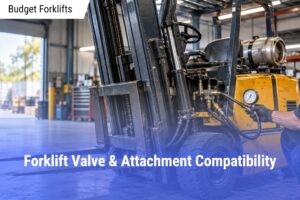
Side shifters, fork positioners, clamps, rotators: attachments can genuinely improve workflow. But every attachment reduces the truck’s rated capacity and requires updated load ratings on the nameplate.
The rule: only spec attachments you’ll actually use daily. A fork positioner makes real sense for a warehouse handling multiple pallet sizes. A paper roll clamp makes sense for a paper products distributor. A “just in case” attachment sitting unused adds weight, reduces capacity, and increases wear. If you already know what you need, our forklift parts team can help you spec the right attachment for your fleet.
If you’re adding attachments after purchase, OSHA requires written manufacturer approval before any modification that affects capacity or safe operation, and the nameplate must be updated to reflect the change. This isn’t paperwork to skip.
A Quick Pre-Purchase Checklist
Before you call us or any other dealer, have these answers ready:
- What’s your heaviest pallet load (and what do you expect it to be in 12 months)?
- What are your aisle widths at the narrowest point?
- What’s your highest rack level?
- What’s your lowest fixed ceiling obstacle?
- Indoor, outdoor, or both?
- How many shifts per day?
- Buying, renting, or financing?
Those seven answers cut the decision tree in half. Most customers who call us with all seven can get to a recommendation in one conversation.
Ready to Find the Right Forklift?
Our team at Illinois Industrial Equipment has been matching warehouses to the right equipment for years. Whether you’re buying, renting, or figuring it out for the first time, we’d rather spend 20 minutes on the phone getting it right than have you deal with a truck that doesn’t fit your operation.
Call us at 708-358-6555 or browse our current inventory to see what’s available and ready to go.
FAQs
What is the most common forklift used in warehouses?
The sit-down electric counterbalance forklift is the most widely used type in standard warehouse environments. For tighter aisles and high racking, the electric reach truck is the most common choice.
What's the difference between a 2-stage and 3-stage forklift mast?
A 2-stage (duplex) mast works well for loading trailers and lower-ceiling applications with lift heights up to around 157 inches. A 3-stage (triplex) mast reaches 159 to 238 inches and is the most common choice for general warehouse use with high racking.
Should I buy electric or propane for my warehouse?
If you’re working in an enclosed indoor environment for most of the shift, electric is typically the better long-term choice: lower operating costs, no emissions, less maintenance. Propane makes more sense for indoor/outdoor mixed operations or when fast refueling is a priority.
What type of forklift is best for narrow warehouse aisles?
Narrow aisles require highly maneuverable equipment to prevent accidents and maximize storage density. Reach trucks or electric counterbalance models are typically the best choice because they are designed with tighter turning radii specifically for confined spaces, unlike larger internal combustion models which need significantly more room to operate safely.
How do I determine the right forklift weight capacity?
You must select a forklift rated for your heaviest possible load, not just your average load, to avoid tipping and equipment stress. Experts at Illinois Industrial Equipment, Inc. recommend assessing whether you lift uneven, long, or wide loads, as these factors impact stability and require a machine with a capacity buffer to ensure safety and longevity.
Which forklift engine type is best for indoor warehouses?
Electric forklifts are the superior choice for indoor environments with smooth concrete floors because they produce zero emissions and operate quietly. While internal combustion engines are powerful, they require ventilation; however, for mixed indoor-outdoor use, Illinois Industrial Equipment, Inc. can guide you toward propane models or specific hybrids that bridge the gap without compromising air quality.
What is the difference between cushion and pneumatic forklift tires?
Cushion tires are made of solid rubber and have a smaller turning radius, making them ideal for smooth indoor surfaces, whereas pneumatic tires (air-filled or solid) provide better traction and shock absorption for uneven outdoor terrain. Choosing the wrong tire type can lead to rapid wear and instability, so matching the tire to your specific flooring is critical.
How do I choose the right forklift mast height?
You need to measure the height of your highest storage rack and ensure the forklift can reach it while maintaining stability under load. For warehouses with high racking but tight overhead clearance, a three-stage mast (FV or FSV) is often required, and consulting with specialists like Illinois Industrial Equipment, Inc. ensures you select a mast that balances vertical reach with collapsed height limitations.
What safety features should I look for when buying a forklift?
Essential safety features include backup alarms, load backrests, seat belts, and overhead guards to protect operators and bystanders. Modern options also offer speed limiters and visibility enhancements like cameras; prioritizing these features is a non-negotiable aspect of procurement that Illinois Industrial Equipment, Inc. emphasizes to reduce workplace accidents and liability.
Is an electric forklift cheaper than a gas forklift in the long run?
While electric forklifts often have a higher upfront cost, they typically offer a better long-term return on investment due to lower fuel expenses and fewer moving parts requiring maintenance. Calculating total cost of ownership – including downtime and energy is vital, a process that Illinois Industrial Equipment, Inc. suggests to ensure you aren’t saving money now only to spend more on repairs later.
Why is forklift turning radius important for my warehouse layout?
The turning radius dictates how much space a forklift needs to safely reverse and change direction, directly impacting your aisle width requirements. Three-wheel forklifts generally offer the tightest turning abilities for congested areas, whereas sit-down riders might need more room but offer greater stability for longer shifts and heavier loads.
What are the maintenance differences between electric and diesel forklifts?
Electric forklifts generally require less daily maintenance because they lack engine oil, filters, and exhaust systems, though they do need disciplined battery management and charging schedules. Conversely, diesel and gas forklifts need regular engine servicing; choosing a model with easy-to-source parts and a reliable service network is crucial to minimize costly downtime.
Do I need different training for different types of forklifts?
Yes, operator requirements vary significantly; for instance, electric pallet jacks are beginner-friendly, while sit-down riders and heavy-duty IC forklifts require specific certification and more skill. Aligning your equipment choice with your team’s current capabilities and OSHA requirements ensures a smoother transition and reduces the risk of accidents caused by operator error.