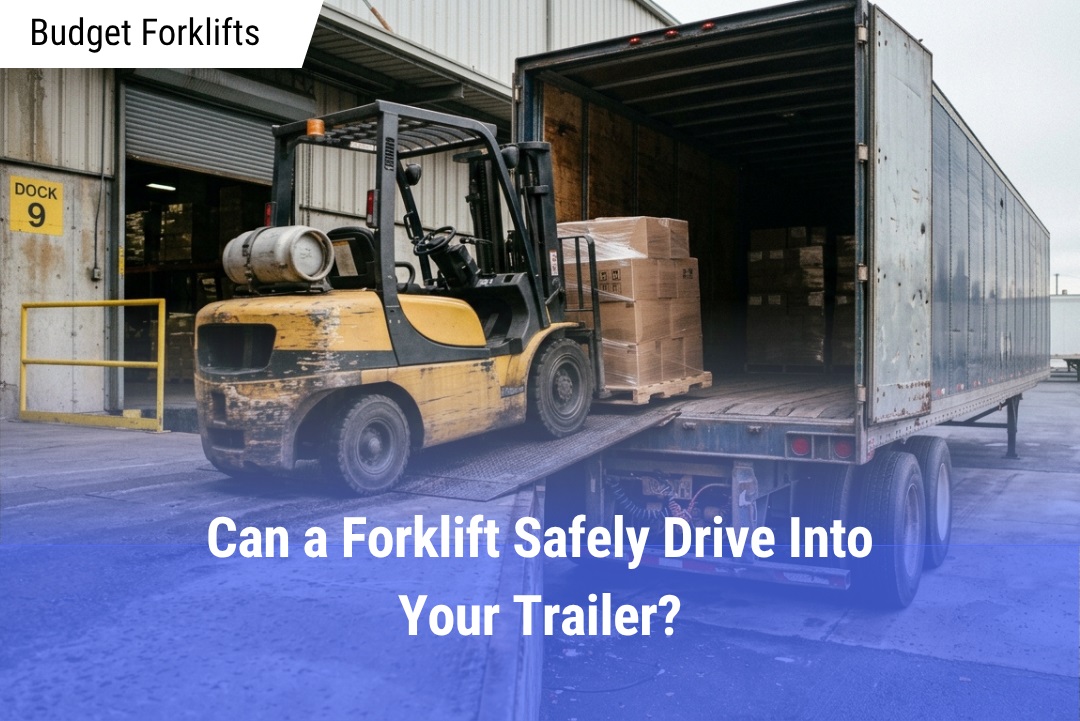
Can a forklift drive into a trailer safely?
Yes, but only after the floor has been inspected, the trailer wheels are chocked, and the gap between the dock and the trailer has been checked. Skip any one of those three steps and “safe” turns into a guess.
Warehouses run this move dozens of times a day, so it starts to feel routine. It isn’t. The OSHA Powered Industrial Trucks standard requires that a trailer’s floor be inspected before a forklift enters it, and that the trailer’s wheels be chocked so it cannot roll while it’s being loaded or unloaded. Those two requirements exist because a forklift adds several thousand pounds of concentrated weight to a structure that was built to carry cargo spread evenly across its length, not a machine parked in one spot. Before you size up the machine itself, it helps to know how much weight a forklift can actually carry, since that figure is the starting point for whether a given trailer floor can take it.
What determines a trailer’s floor rating?
A trailer’s floor rating comes down to floor thickness, how far apart the cross-members are spaced, and how much of the floor is left unsupported at any given moment. A trailer’s advertised payload capacity tells you almost nothing about this.
Per federal workplace safety guidance on entering trucks and trailers, the larger the unsupported floor area under the forklift’s wheels, the lower that trailer’s real capacity is for the same floor thickness. This is a different question from the forklift’s own rated capacity, which is stamped on its forklift data plate and reflects what the machine can lift, not what the surface beneath it can support. It’s the same reason a warehouse floor slab has to be checked against the forklift you’re ordering before delivery day. A trailer floor deserves the same scrutiny, just on a much smaller and less forgiving structure.
The forklift itself is part of the equation too. A diesel counterbalance unit and a battery-electric model of the same rated capacity don’t weigh the same amount empty, so the difference between electric and diesel forklifts can shift how much total weight actually reaches the trailer floor.
How much weight can a trailer floor actually hold?
There’s no single number, because a forklift’s wheels put concentrated point-loads on a small area rather than spreading weight the way stacked pallets do. Industrial dock equipment sizing standards illustrate the gap well: a dock board built to carry a forklift safely is typically rated at roughly three times that forklift’s own lifting capacity, precisely because point-loading demands that much more margin.
| Forklift Lifting Capacity | 3-Wheel Forklift Range | 4-Wheel Forklift Range | Required Board Capacity |
| Light duty | 2,000 to 2,500 lbs | 2,000 to 3,000 lbs | 10,000 lbs |
| Mid duty | 2,500 to 3,500 lbs | 3,000 to 5,000 lbs | 15,000 lbs |
| Heavy duty | 3,500 to 5,000 lbs | 5,000 to 6,000 lbs | 20,000 lbs |
That 3-to-1 margin exists because standard equipment (dock boards, bridge plates) is engineered for the exact kind of point-loading a forklift creates. A trailer floor was never built to that same safety factor. That’s part of why a reach truck and a counterbalance forklift, despite similar rated capacities, don’t put identical stress on the surface beneath them; their weight distribution and wheelbase differ.
What usually causes a trailer floor or dock connection to fail during unloading?
Most failures trace back to two things: a floor that has quietly degraded past what it looks like from the outside, and “trailer creep,” where the trailer inches away from the dock as a forklift repeatedly drives in and out. Either one turns a routine unload into a serious incident.
OSHA’s own accident records include a case where a forklift operator drove into a trailer to unload cylinders, and as he backed out, the forklift’s weight pushed the truck forward just enough to open a gap between the trailer floor and the dock. The forklift flipped backward into that gap and the operator was crushed. Nothing about the floor itself failed; the trailer simply wasn’t chocked, and the small forward movement was enough.
Dealers who deliver rental forklifts to job sites see the lead-up to this kind of incident more often than most warehouses do, because they’re the ones showing up cold to trailers and dock setups they’ve never inspected before. A recurring pattern: a site assumes any forklift within its stated capacity is automatically fine to drive onto any trailer at the dock, when in practice the trailer’s condition, age, and floor construction matter just as much as the machine’s weight. It’s one of the more common forklift rental mistakes we see, and it’s also why short-term forklift rentals for one-off loading jobs are often paired with a quick floor and dock check before the machine ever leaves the truck.
How do you inspect a trailer before driving a forklift onto it?
A proper trailer check takes under a minute: look at the floor for soft spots or visible damage, confirm the wheels are chocked, and check that there’s no gap or slope between the dock and the trailer bed. Skipping any of these three is how a manageable risk turns into an incident.
Standard trailer loading and unloading procedure also calls for operators to confirm the entry door has adequate clearance for the forklift, drive straight across bridge plates rather than at an angle, and sound the horn when entering or exiting. Delivery crews who hand off rental equipment day after day tend to build this into muscle memory faster than anyone, since a floor that looks fine from a distance can still flex or sound hollow under a loaded machine. That instinct, walking the floor before trusting it, holds up whether the forklift is a rented unit going in for an afternoon or a fleet machine that runs the same dock every day.
- Walk the trailer floor and check for soft spots, cracks, or water staining before driving on it.
- Confirm wheel chocks are in place on the trailer, not just assumed.
- Check for a gap or height mismatch between the dock and the trailer bed.
- Match the forklift’s weight and the location of its fulcrum point to where the load will sit, since a forward-heavy approach concentrates more stress on a smaller section of floor.
FAQ
Is a trailer’s floor rating the same as its rated payload capacity?
No. Payload capacity describes evenly distributed cargo weight, while floor rating describes how much concentrated point-load the floor structure can take in one spot. A trailer can be rated to haul tens of thousands of pounds of cargo and still have a floor that can’t safely take a heavy forklift.
Are box trucks different from dry van trailers when it comes to floor strength?
Yes, and the difference is significant. Standard box trucks often lack the reinforced floors built into dry van trailers, so a forklift that’s fine entering one may not be fine entering the other.
How often should a trailer floor be re-inspected?
Every single time before loading or unloading, not just periodically. Floors degrade from moisture, repeated point-loading, and age, so a trailer that was fine last week isn’t guaranteed to be fine today.
What should you do if a trailer floor looks questionable?
Don’t drive the forklift onto it. Unload from the dock edge with a pallet jack or shift the load closer to the opening by hand until the trailer can be properly assessed or repaired.
Conclusion
A forklift driving into a trailer is one of the most routine moves in a warehouse, which is exactly why it gets treated casually. The floor rating, the chocks, and the dock gap take a minute to check and have nothing to do with luck. Whether you’re running a fleet forklift on the same dock every day or bringing in a rental unit for a seasonal push, the same short checklist applies before the forks ever cross into the trailer.