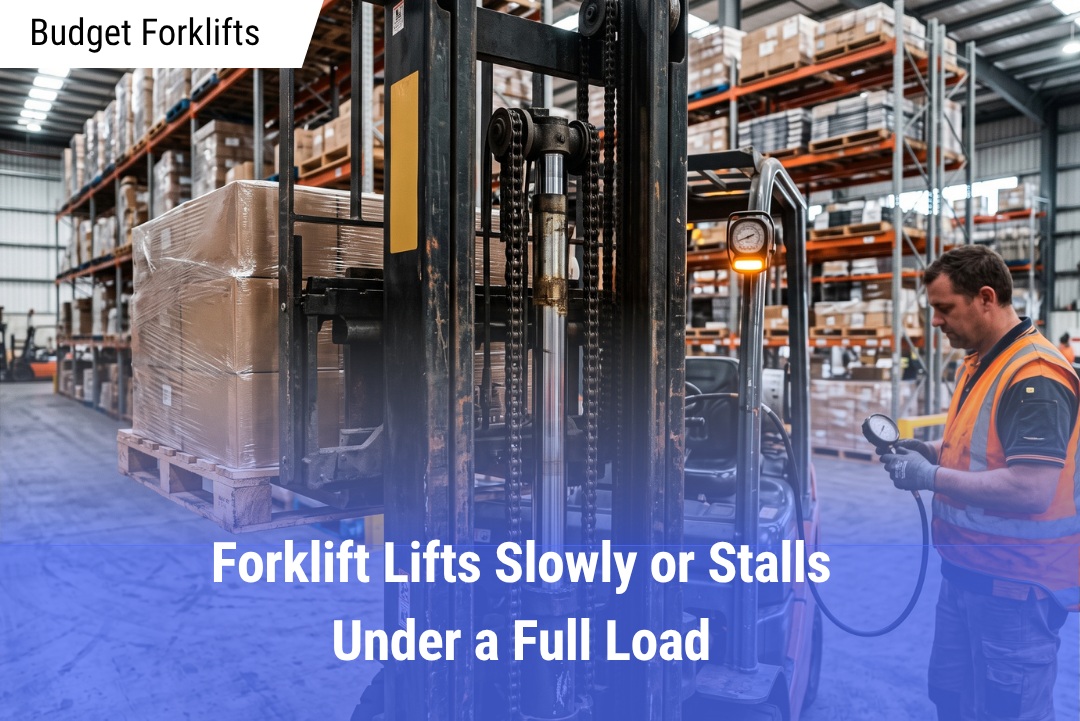
A forklift that raises an empty mast normally but crawls or stops dead with a pallet on the forks is telling you something specific. Most troubleshooting guides list the same eight causes in the same order and stop there. What they never tell you is what each one costs, which is the only thing you actually need to decide whether to fix it today, schedule it for next week, or start pricing a replacement.
This guide ranks every realistic cause from free to five figures, gives you a two-minute test that cuts the range in half before a technician ever quotes you, and explains why the labor line on a hydraulic invoice is usually bigger than the parts line.
Table of Contents
Why does a forklift lift slowly or stall under a full load?
A forklift that lifts slowly or stalls under a full load has a pressure problem, not a power problem. The hydraulic system can still move oil, but it can no longer build or hold the pressure needed to raise that weight to that height.
That is why the symptom is so confusing on the floor. The engine or drive motor sounds healthy, the truck drives and steers normally, and the forks come back down without complaint. Operators often discover that revving the engine hard gets the load moving, and then assume the machine is simply getting old. Revving is not a fix. It is a clue that the pump is being asked to make up in speed what it can no longer make in pressure.
On our service calls, this one symptom resolves at every price tier. Some trucks need nothing but a fluid change. Some need a pump, a valve, and a full system flush. The difference between those two invoices is roughly $3,000, and the diagnostic path below is what separates them.
Is it a flow problem or a pressure problem?
Raise the empty mast, then raise it again with the load. Slow both times points to a flow restriction. Normal speed empty but dying under load points to a pressure fault. That single comparison cuts the cost range in half and costs you nothing.
Slow with the mast empty as well. Oil is not reaching the cylinder fast enough. Look at fluid level and condition, the suction strainer, the return filter, a restricted hose, or a mast that is physically binding. These are the cheap end of the table.
Normal empty, weak or stalling loaded. Oil is flowing but pressure is escaping or was never built. Look at the relief valve setting, a worn control valve spool, a leaking cylinder stage, or a tired pump. These are the expensive end.
Run the test with the forks clear of people and racking, and never add weight to force a lift that the truck is refusing. Our techs ask this question on the phone before dispatching a truck, because the answer determines what parts get loaded on the service van. A caller who already knows the answer often saves a return visit.
What does each cause cost to fix?
Slow-lift repairs range from $0 to well past $6,000 depending on which component failed. The figures below are typical ranges for a standard 5,000 lb class counterbalance truck in the United States, assuming a shop labor rate between $95 and $165 per hour. Larger capacity machines, high-reach masts, and older or imported models push every row upward.
| Cause | What it looks like | Parts | Labor | Typical total | Downtime |
| Overload or height derating | Lifts fine low, refuses high. Nothing is broken. | $0 | None | $0 | None |
| Low, aerated or wrong-grade oil | Slow empty and loaded, jerky motion, foamy fluid. | $60 to $250 | 0.5 to 1.5 hr | $80 to $400 | Same day |
| Clogged suction strainer or filter | Slow empty, pump whines, fluid runs hot. | $40 to $180 | 1 to 3 hr | $180 to $600 | Same day |
| Sticking control linkage | Lever feels stiff or will not reach full travel. | $0 to $120 | 1 to 2 hr | $120 to $400 | Same day |
| Mast binding, dry rails, chain adjustment | One side climbs ahead of the other, grinding. | $0 to $150 | 1 to 3 hr | $120 to $550 | Same day |
| Relief valve set low or sticking | Audible pressure dump, load stops at a fixed height. | $0 to $300 | 1 to 2.5 hr | $150 to $650 | Same day |
| Control valve rebuild or seal kit | Lifts empty, dies loaded, oil heats quickly. | $150 to $500 | 3 to 6 hr | $600 to $1,600 | 1 to 2 days |
| Lift cylinder reseal | Load rises then drifts down on its own. | $120 to $400 | 4 to 8 hr | $700 to $2,000 | 2 to 3 days |
| Hydraulic pump replacement | Loud whine, pressure test fails, no lift under load. | $600 to $1,800 | 3 to 6 hr | $1,100 to $3,000 | 2 to 4 days |
| Complete control valve replacement | Rebuild not viable, spool bore worn past spec. | $1,200 to $3,000 | 3 to 6 hr | $1,700 to $4,000 | 3 to 7 days |
| System flush after pump failure | Metal debris found in the tank or filter. | $150 to $450 | 2 to 5 hr | $400 to $1,200 added | Adds 1 day |
| Mast rebuild | Rollers, rails and cylinders all worn together. | $1,500 to $4,000 | 10 to 20 hr | $2,500 to $6,000+ | 1 to 2 weeks |
Ranges reflect what we see across our own service work and are intended for budgeting, not quoting. Get a written estimate against your specific make, model and hour meter before approving any repair above the fluid tier.
Is the forklift broken, or is the load too heavy for that height?
Very often nothing is broken. Rated capacity falls as the mast rises and as the load center moves away from the fork face, so a truck that refuses a pallet at 18 feet after handling it at 4 feet is usually obeying physics rather than failing.
The federal powered industrial truck standard spells out the arithmetic in its stability appendix. A truck rated for 3,000 lb at a 24 inch rated load center has a maximum allowable load moment of 72,000 inch-pounds. Put a 60 inch long load on it and the load center moves to 30 inches, which drops the safe weight to 2,400 lb. Nothing about the machine changed. The geometry did.
Three things quietly eat capacity on a working truck. Lift height is the first. Load center is the second. Attachments are the third, because a side shifter or fork positioner adds weight ahead of the front axle and shifts the balance point forward. Learning to read a forklift data plate takes about five minutes and settles the question immediately, since the capacity chart on the plate lists the real limit at each height and load center rather than the single headline number.
If your loads have grown since the truck was bought, the problem may be the specification rather than the hydraulics. Our guides on how much weight a forklift can carry and the fulcrum on a forklift explain why the numbers move, and choosing the right forklift for your warehouse covers what to buy when the answer is that the truck was never rated for the work.
Could low or contaminated hydraulic oil be the only problem?
Yes, and it is the cheapest real fault on the list. Low fluid, aerated fluid, or the wrong viscosity grade starves the lift circuit, so the pump moves less oil per revolution and the mast crawls whether it is loaded or not.
Air in the lines is the usual reason a lift feels jerky rather than merely slow. Fluid that looks milky or foamy on the dipstick is aerated. Fluid that looks dark and smells scorched has been overheated and has lost the viscosity it needs to seal the clearances inside the pump. Both conditions get worse the longer the truck runs, which is why a same-day fluid service is genuinely cheaper than a same-week one.
A clogged suction strainer produces the same symptom by a different route. The pump is healthy but cannot draw enough oil, so it cavitates, whines, and heats the tank. Debris on the strainer is also a warning sign in its own right, because metal particles in the screen mean something upstream is already wearing out.
A meaningful share of the slow-lift calls our service team takes end at this tier, with a fluid and filter service and nothing more. Checking level and condition before you call anyone is the single highest-value two minutes in this whole article.
What if the mast is binding instead of the hydraulics failing?
A dry, dirty or misaligned mast slows a lift even when the hydraulic system is perfectly healthy. The giveaway is uneven motion: one side of the carriage climbs ahead of the other, or the mast moves in steps rather than smoothly.
Warehouses that run close to racking collect more debris in the mast channels than anyone expects. Shrink wrap fragments, banding, dust and pallet splinters pack into the rails, and the rollers stop rolling. Lift chains that have stretched unevenly cant the carriage in the rails and add friction that the cylinders then have to overcome. Exposed cylinder chrome that looks bone dry rather than lightly oiled is another common contributor, especially on a truck that sat idle for months.
There is a version of this fault that costs nothing but a can of penetrating oil. The mechanical linkage between the control lever and the valve spool corrodes, the lever no longer pushes the spool to the end of its travel, and the truck behaves exactly like it has a hydraulic problem. We have cleared this one on a machine the customer had already priced a valve for.
Do not try to force a binding mast by revving the engine or shock-loading the lift. Binding releases suddenly, and a load that drops several inches without warning at height is how pallets and people get hurt.
When is the relief valve or the control valve the cause?
Suspect the valves when the truck raises an empty mast at normal speed and then stalls with weight on the forks. A relief valve opening too early dumps pressure back to the tank before the load moves, and a worn control valve lets oil leak across the spool instead of reaching the cylinder.
Both faults have an audible signature. A relief valve venting makes a distinct hiss or squeal at the moment the lift stops. Both also generate heat fast, because every drop of pressure that gets dumped instead of used turns into warm oil. If the tank is noticeably hotter after ten minutes of lift attempts than it is after an hour of driving, pressure is escaping somewhere it should not.
Cost splits sharply here, and it is worth pushing back before approving the expensive option. A relief valve that has simply drifted out of adjustment is a gauge and a wrench. A control valve with worn seals often takes a seal kit rather than a new valve body. Complete valve assemblies for common warehouse trucks run past $3,000, and we have seen operators quoted for a full replacement on a valve that a rebuild would have carried for several more years. Ask your technician to pressure test and quote the rebuild path before ordering a new assembly.
When is it the lift cylinder or the hydraulic pump?
A pump that cannot hold rated pressure on a gauge, or a cylinder that raises a load and then lets it settle back down, is where this repair gets expensive. These are the two faults that turn a slow-lift complaint into a four-figure invoice.
A tired pump has a specific personality. It idles quietly with no load, it whines under demand, and its output falls off as the oil warms. Worn internal clearances mean it recirculates oil inside itself rather than pushing it out, so volumetric efficiency drops exactly when you need it most. A cylinder with failed seals behaves differently: the lift works but will not hold, because oil bleeds past the packing from the pressure side to the return side.
The hidden cost in this tier is contamination. When a pump fails internally, it sheds metal into the oil, and that debris travels through the valve and into the cylinders. Replacing the pump without flushing the system is how a $1,800 job becomes a $3,500 job six weeks later when the new pump eats itself on the old debris. If the failed pump left metal in the filter, budget for the flush.
This is the point where a truck stops being a maintenance question and becomes a financial one. If the pump, a cylinder and the mast are all due at the same time on a high-hour machine, the repair total can exceed what the truck is worth.
What causes slow lift on an electric forklift?
Electric trucks suffer every hydraulic fault above, plus two that internal combustion trucks do not have. A battery that sags under the pump motor’s current draw and a failing pump motor or controller both produce a lift that weakens under load.
Battery sag has a pattern worth recognising. The truck lifts well at the start of a shift and gets progressively weaker, or it lifts normally until the operator lifts and travels at the same time, at which point the mast slows noticeably. Cells that are aged, undercharged, or low on water cannot deliver the current spike that a loaded lift demands. Learning what causes forklift battery failures and how to water a forklift battery correctly removes a surprising number of these complaints without touching the hydraulics at all.
If the pack is genuinely at end of life, you have three routes and they price very differently. Battery regeneration can recover a sulfated lead-acid pack for a fraction of replacement cost. A straight replacement makes sense on a truck with years left in it, and our guide to how long a forklift battery lasts helps you judge where yours sits. Fleets running multiple shifts should also weigh lithium-ion against lead-acid, because opportunity charging changes the economics of the whole comparison.
When the pack tests healthy and the lift is still weak, attention moves to the hydraulic pump motor, its brushes on older units, and the controller that drives it. A motor drawing high current while turning slowly points there rather than at the pump itself.
Why does the labor line cost more than the part?
Diagnostic time drives most slow-lift invoices, not parts. Several different failures produce an identical symptom, so a technician has to pressure test the circuit and eliminate causes in sequence before a single component gets ordered.
The trade itself is also expensive to staff. Federal wage data puts the median pay for heavy vehicle and mobile equipment service technicians at $63,850 a year as of May 2025, with the top ten percent above $93,450. Add a stocked service vehicle, manufacturer training, diagnostic equipment and insurance, and a billed rate several times the raw wage is what keeps a mobile technician on the road. Field service usually carries a call-out charge on top of the hourly rate, which is why batching a hydraulic complaint with other deferred work on the same visit saves real money.
You can shorten the billed hours yourself. Have the hour meter reading, the make and model, the fluid level and condition, and the result of the empty-versus-loaded test ready before you call. A technician who arrives already knowing it is a pressure fault skips an hour of elimination.
Downtime usually costs more than the repair. If the truck is central to your operation, price a short term rental to cover the gap and compare it against the shift you would otherwise lose. Our forklift rental cost guide gives current daily, weekly and monthly rates for that calculation.
Can I keep running it until the busy season is over?
No. Under the same federal standard covering powered industrial trucks, a truck found to be in need of repair, defective, or in any way unsafe must be taken out of service until it has been restored to safe operating condition. A lift that stalls under a rated load meets that description.
Two further provisions in that standard tighten the point. Trucks must be examined before being placed in service, at least daily and after each shift where they run around the clock, with defects reported and corrected immediately. Separately, when any part of a truck runs hotter than its normal operating temperature in a way that creates a hazard, the vehicle must come out of service until the cause is eliminated. Overheated hydraulic oil from a valve dumping pressure falls squarely inside that second rule.
There is a practical argument alongside the legal one. Running a truck that is struggling to lift is the fastest way to escalate the bill. A worn pump starved of pressure sheds metal into the oil. A binding mast wears rollers and rails. The cheap tier of the cost table turns into the expensive tier precisely because the truck kept working.
If the timing is genuinely impossible, rent rather than risk it. Bringing in a unit for a peak period is routine, and renting for seasonal demand is often cheaper than the combination of a larger repair and a compliance problem. The comparison between long term and short term rental depends mostly on how long your repair window actually is.
Should you repair this forklift or replace it?
Repair while the quoted fix sits under roughly one third of the truck’s current market value and the rest of the machine is sound. Replace when the pump, a cylinder and the mast are all due together on a high-hour unit, because that combination usually exceeds what the truck would sell for.
Hours matter more than model year. A ten year old truck with 6,000 hours and a full service history is a better repair candidate than a six year old truck with 14,000 hours and no records. Our breakdown of the average lifespan of a forklift sets realistic expectations for where your machine sits on that curve.
When replacement is the answer, the choice is rarely between repair and a brand new machine. A well-reconditioned used truck covers most single-shift operations at a fraction of the cost, and our new versus used forklift comparison lays out where each one wins. If you go that route, the questions in our guide on what to ask when purchasing a used forklift are designed to surface exactly the hydraulic history you are trying to escape. Financing options can also spread a replacement across the same period you would have spent paying for repairs.
Frequently asked questions
Can low hydraulic fluid alone make a forklift lift slowly?
Yes. The lift circuit is entirely hydraulic, so low or aerated oil starves the pump and weakens the lift before anything mechanical has failed, and it is the first thing any technician checks.
Why does my forklift lift fine empty but stall with a pallet?
That pattern points to pressure rather than flow, which usually means a relief valve opening early, a worn control valve spool, a leaking cylinder, or a pump that can no longer build full pressure. Oil is still moving, it just is not holding the force the load needs.
Can an operator top up the hydraulic oil themselves?
Checking the level and condition is a normal part of a daily inspection, and topping up with the exact grade the manufacturer specifies is usually within an operator’s scope. Anything beyond that, including flushing, bleeding air, or opening a pressurised component, belongs to a qualified technician.
How long does it take to diagnose a slow lift?
Expect one to three hours for a proper diagnosis, including a pressure test, because the same symptom has at least eight possible causes. Arriving with the empty-versus-loaded result and the fluid condition already known can cut that time substantially.
The bottom line
A forklift that lifts slowly or stalls under a full load is not a single problem with a single price. It is a symptom shared by a dozen faults that range from a free capacity misunderstanding to a mast rebuild past $6,000, and the gap between those outcomes is decided in the first ten minutes.
Do three things before you spend anything. Check the capacity chart on the data plate against the load and the height you are actually lifting. Check the hydraulic fluid level and condition. Run the empty-versus-loaded test and write down the result. Those three steps resolve or correctly categorise the majority of the calls we take on this symptom, and they cost nothing but a few minutes.
Then take the truck out of service and get it quoted properly. The cheapest version of this repair is always the one you do before the truck spends another week grinding its way through the fault. If the numbers point toward replacement rather than repair, we can help you compare what a sound reconditioned machine would cost against the invoice in front of you.