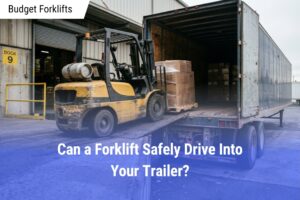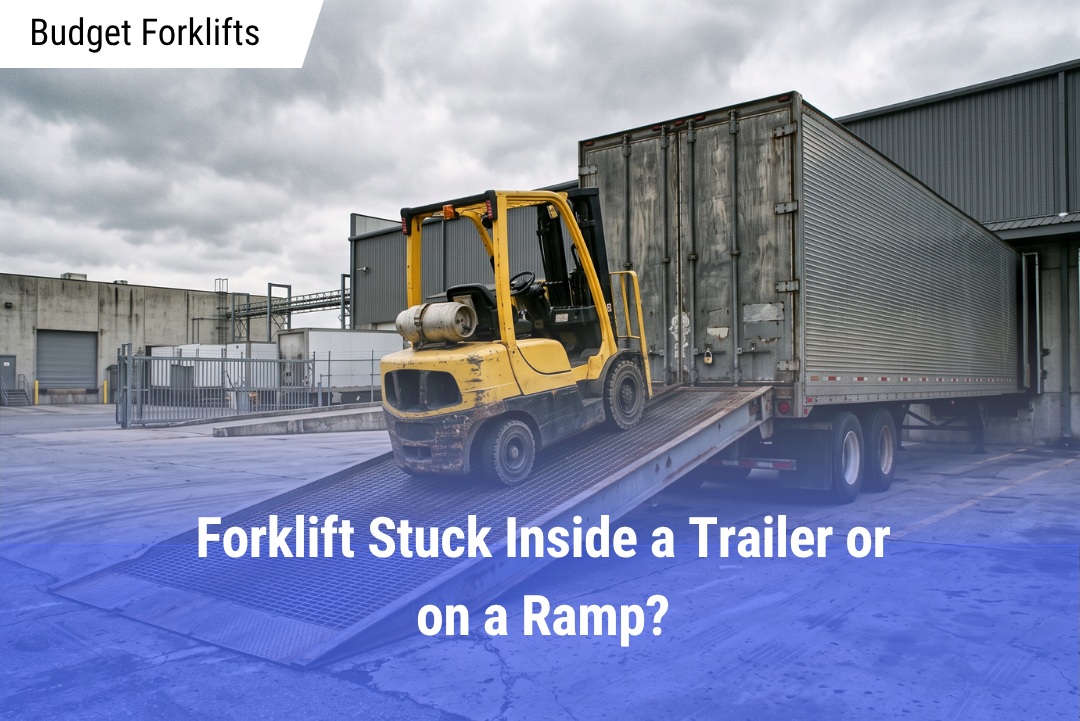
A forklift that won’t move inside a trailer, or one that’s hung up halfway down a ramp, is one of the most common emergency calls a dealer gets. It’s rarely a mechanical breakdown. Most of the time the forklift is fine. What’s actually happened is a floor, a ramp, or a trailer position problem that turned a routine load or unload into a standoff. Here’s what actually causes it, what to check first, and why the instinct to hook a chain to it and pull is the exact move that has killed people.
Table of Contents
What causes a forklift to get stuck inside a trailer?
Three things account for almost every case: soft or damaged trailer flooring that flexes or gives way under the wheels, the trailer creeping away from the dock so the forklift is suddenly straddling a gap it didn’t drive into, and a landing gear or dock leveler that shifts or fails while the forklift is still inside. All three feel identical from the seat. The forklift stops responding the way it should, and the operator’s first instinct is to add throttle, which usually makes it worse.
In our own service calls, the flooring issue shows up more than people expect, especially on older or rented trailers that see heavy rotation. A crossmember that’s been quietly corroding underneath a plywood deck won’t show any warning signs from on top. It just gives way the moment a loaded lift truck settles its full weight onto that one spot. If you’re evaluating a used forklift for this kind of work, it’s worth pairing that inspection with the same questions you’d ask about buying a used forklift, since a mismatched or oversized unit puts more strain on a marginal trailer floor than it was ever rated for.
Why does a trailer move away from the dock while a forklift is still inside it?
Trailer creep happens because the forklift’s own momentum, combined with the trailer’s suspension bounce, walks the trailer forward a few inches at a time until it separates from the dock. It’s not a rare fluke. It’s a known, named hazard in the industry, and it’s exactly why federal rules require the trailer to be immobilized before a forklift ever enters it.
Under OSHA’s powered industrial truck standard, 29 CFR 1910.178, brakes must be set and wheel chocks placed before loading or unloading begins, and if the trailer isn’t coupled to a tractor, fixed jacks are required to keep the front end from lifting or “popping up” under the forklift’s weight. Skipping either step is what turns ordinary trailer creep into a forklift that’s suddenly stuck straddling open air.
What should you check before driving into a trailer?
Check the trailer’s brakes and chocks, confirm the floor has no visible breaks or soft spots, and verify the forklift’s rated capacity actually matches the load before the forks ever cross the threshold. That last point gets skipped more often than the first two.
OSHA’s standard is direct on this: the flooring of the truck, trailer, or railcar has to be checked for breaks and weakness before it’s driven onto, every time, not just on the first load of the day. Pair that with knowing your own machine’s limits. If you’re not sure what your forklift is rated to carry on a given load center, that’s worth confirming on the data plate before you find out the hard way, and the general question of how much weight a forklift can actually carry is worth revisiting any time the load or the trailer looks unfamiliar. Worn or low-traction tires make all of this worse on a damp or dusty ramp, which is one reason we point customers toward replacing tires before they’re bald rather than after a slip.
Is it safe to tow or chain-pull a stuck forklift out?
No, not with an improvised chain hookup, and not from an angle other than straight in line with the direction of travel. Forklifts have a high center of gravity and a short wheelbase, and a sideways or off-angle pull can flip one before the operator has any chance to react.
A 1997 NIOSH fatality investigation documents exactly how this goes wrong. A forklift got stuck in soft ground near a trailer, and a coworker attempted to tow it free using a chain hooked to the roll cage instead of a proper tow point, pulling from roughly a 90-degree angle. The forklift flipped, and the operator, who wasn’t wearing a seat belt, was crushed. NIOSH’s own recommendations afterward were specific: use the forklift’s designated tow point, keep the towing vehicle in line with the forklift, and never rely on the cage, a radiator guard, or any other unrated point as an attachment spot.
How do you safely get a forklift unstuck on a ramp or in a trailer?
Stop, don’t add throttle, and figure out whether the forklift is mechanically stuck or just resting against a hazard before you touch a chain. The right response depends entirely on which one it is.
We’ve had calls where a customer’s operator felt the forklift “stop climbing” on a ramp and immediately gunned it, which is what turns a minor traction issue on a wet or dirty ramp surface into a genuinely stuck unit. The safer move is almost always to back off the throttle, check what the wheels are actually resting on, and reassess before making a second attempt. If the equipment itself was the wrong fit for the job (a counterbalance unit trying to do work a narrower-aisle machine handles better, for instance) that’s worth a broader look at whether you’re running the right forklift for your warehouse in the first place, or whether a reach truck versus a counterbalance forklift makes more sense for trailer work specifically.
| Do this | Not this |
| Stop and assess before adding throttle | Gun the engine to power through |
| Use the forklift’s rated tow point, in line with the pull | Chain to the roll cage, radiator guard, or any unrated point |
| Confirm the trailer is chocked and braked before re-entry attempts | Assume the trailer hasn’t moved since it was parked |
| Call a technician if the cause isn’t obvious | Keep trying variations of the same pull |
Frequently Asked Questions
Is a “stuck” forklift the same as a broken-down one?
Usually not. A stuck forklift is almost always a floor, ramp, or positioning problem rather than a mechanical fault, though a bad tow attempt can turn a stuck forklift into a genuinely damaged one.
Who’s responsible if a rented trailer’s floor fails under a forklift?
That depends on the rental agreement and who inspected the trailer beforehand, which is exactly why avoiding common forklift rental mistakes up front, including confirming trailer condition, matters as much as the forklift rental itself.
Can I fix this myself, or should I call a technician?
If the cause is visible and simple, a chock that wasn’t set, a ramp angle that’s too steep, self-recovery may be reasonable. If the forklift won’t budge and the cause isn’t obvious, stop and call it in rather than guessing with a chain.
How often does this actually happen?
There’s no single national count specific to “stuck” incidents, but trailer separation and dock-related forklift accidents are common enough that OSHA built specific chocking and jacking requirements directly into the powered industrial truck standard.
Conclusion
A forklift stuck inside a trailer or wedged on a ramp is almost never about the forklift itself. It’s a floor that wasn’t checked, a trailer that wasn’t chocked, or an operator who added throttle instead of stopping to assess. The fix isn’t a chain and a truck pulling from whatever angle is convenient. It’s confirming the trailer is immobilized, using a rated tow point in line with the pull if towing is genuinely needed, and knowing when to stop and call a technician instead of making a second attempt. That’s the difference between a five-minute delay and the kind of incident NIOSH writes reports about.