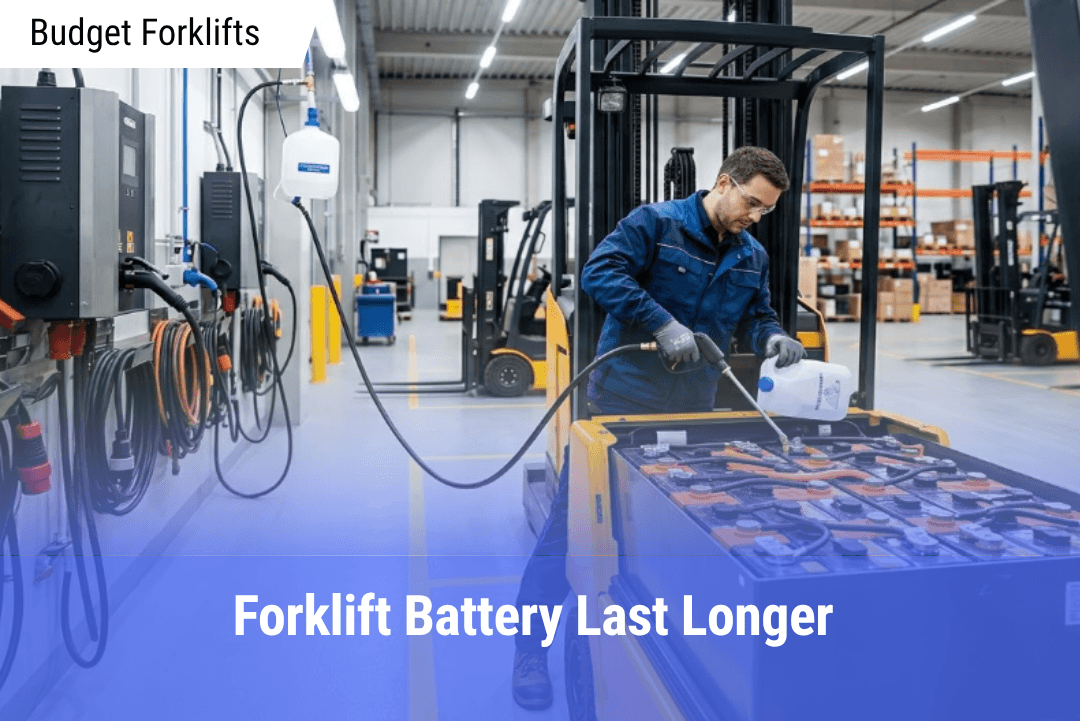
If you run a warehouse or a busy shop, your forklift is the heartbeat of your operation. But that heartbeat depends entirely on the big, heavy battery sitting inside it. A poorly maintained battery doesn’t just die, it leaks money, slows down your team, and eventually stops your business in its tracks.
Most people think forklift batteries are set it and forget it. In reality, they are living, breathing chemical powerhouses. Treat them right and they can run for up to 2,000 work shifts, which is roughly five years of single-shift use. Ignore them and you’ll be cutting a check for a replacement ($3,000 to $5,000+) much sooner than you’d like.
Here is how to master forklift battery maintenance to keep your warehouse moving and your costs low. If you want the bigger picture on lifespan first, here is how long a forklift battery lasts.
Table of Contents
1. The Golden Rule of Charging
Charge a forklift battery only after it drops to about 20% power, then run it all the way to 100% in one go. Short, partial top-ups during breaks burn through its limited cycles and are the fastest way to kill it. Think of a forklift battery like a marathon runner. It needs a full night’s sleep to perform the next day. Every time you plug it in for just 20 minutes during a lunch break, you use up one of its cycles, and a lead-acid battery only has a couple thousand of those in its entire lifetime before it wears out.- Wait for the 20% Mark: Don’t charge the battery until it drops to about 20% power. Running it lower than that does permanent damage, so 20% is the floor, not a suggestion.
- Finish the Job: Once you start charging, let it go all the way to 100%. Stopping early leaves the acid uneven and shortens the battery’s life.
- Cool Down: Batteries get hot when they charge. Give them time to cool and keep the battery cover open during the charge to dissipate heat and let off gas before putting them back to work.
2. Watering Your Battery (The Right Way)
Always water a flooded battery after a full charge, never before, and only with distilled or deionized water. Fill it before charging and the liquid expands and overflows; use tap water and the minerals slowly poison the cells.
Lead-acid batteries use a mix of sulfuric acid and water. As the battery works and charges, the water evaporates. If the water level gets too low, the lead plates inside are exposed to air, which causes permanent damage.
- Timing is Everything: Always water after charging, never before. If you fill it up before charging, the liquid will expand and overflow, spilling dangerous acid onto your floor.
- Use Pure Water: Only use distilled or deionized water. Tap water contains minerals like calcium and iron that clog the plates and ruin the battery’s chemistry, which is exactly why battery makers tell you to skip high-mineral water entirely.
- Check Levels Weekly: Make it a habit every Friday to check the levels in every cell. Fill to about a quarter inch above the plates, never up to the cap.
3. Keep It Clean to Stop Phantom Drains
That white, crusty powder on top of your battery is acid corrosion, and it quietly conducts electricity, bleeding power even when the forklift is parked. Wipe it down monthly with a baking soda and water mix to neutralize the acid and kill the leak.
This buildup does more than just look ugly. It creates a slow leak where the battery loses power even when the forklift is turned off, so a battery you thought was full shows up half dead on Monday morning.
- The Cleaning Solution: Use a mix of baking soda and water to neutralize the acid, the same neutralizer used to clean up an acid spill.
- Rinse and Dry: Wipe down the top of the battery monthly, then coat the terminals with a thin anti-corrosive film. A clean battery stays cool and holds its charge much longer.
- Inspect the Cables: Look for frayed wires or loose connectors. A bad connection makes the motor work harder and drains the battery faster.
4. Watch the Temperature
Heat is what kills forklift batteries fastest. According to Trojan, every 18°F rise above room temperature (77°F) cuts a lead-acid battery’s life in half. Cold is gentler but sneakier, because a low battery left in the cold can freeze and crack.
Forklift batteries are like humans, they hate being too hot or too cold.
- Heat is the Enemy: A hot warehouse is brutal on battery life. Every 18°F you climb above 77°F roughly halves how long the battery will last, so airflow during charging is not optional in the summer.
- Cold Weather Care: In cold storage or winter months, keep the battery charged. A discharged battery can freeze (at around 40% charge, the electrolyte freezes near 16°F), and freezing cracks the plates for good. Never charge a frozen battery, and let a cold one warm up slightly before plugging it in.
5. The Equalize Charge
An equalize charge is a long, low-power overcharge you run after the battery is already full. It reverses stratification (acid pooling heavier at the bottom of the cell) and clears the sulfate crystals that slowly choke a lead-acid battery’s capacity.
Most modern chargers have an Equalize button. Think of it as a reset for your battery. Over time the acid inside becomes uneven, thicker at the bottom and thinner at the top, and that is exactly what an equalize charge is built to fix. Many forklift operations run it once a week over the weekend, though Trojan’s own guidance is to equalize based on specific-gravity readings rather than a fixed calendar. Either way, do not skip it, or the cells drift out of balance and lose capacity.
Summary: Your Daily Maintenance Checklist
| Task | When to Do It | Why It Matters |
|---|---|---|
| Check Water Level | Weekly (After Charging) | Prevents plate damage |
| Clean Corrosion | Monthly | Prevents power leaks |
| Equalize Charge | Weekly | Balances the chemistry |
| Visual Inspection | Daily | Catches safety issues early |
For a full walk-through that covers the rest of the truck too, use our electric forklift maintenance checklist.
Conclusion: Better Care Equals Better Profits
At Illinois Industrial Equipment, Inc., we’ve seen firsthand how a simple routine can be the difference between a thriving warehouse and a stalled one. Managing a forklift battery doesn’t require a degree in science, it just requires a consistent system. By watering at the right time, avoiding short charges, and keeping the equipment clean, you ensure your fleet stays on the floor and out of the repair shop.
When your batteries last longer, your cost per hour goes down, and your entire operation stays productive. A little bit of attention to your power sources today saves thousands of dollars in replacement costs tomorrow.
FAQs
How often should I add water to my forklift battery?
Check and add water once a week after a full charging cycle is complete. Filling a battery before charging causes lead-acid expansion and dangerous boil-overs. Illinois Industrial Equipment, Inc. recommends using only distilled or deionized water to prevent mineral buildup on the lead plates.
Why is my forklift battery losing power so fast?
Rapid power loss is often caused by sulfation from frequent short charging. Plugging in a battery for 15 to 30 minutes during breaks without a full cycle builds up hardened crystals that reduce capacity. Run the battery down to 20% before performing a full 100% charge to maintain depth of discharge.
What is the white powder on my forklift battery terminals?
That crusty substance is lead sulfate or corrosion caused by acid vapors. This buildup creates a tracking current that slowly drains power even when the forklift is idle. The experts at Illinois Industrial Equipment, Inc. advise neutralizing this with baking soda and water to stop these phantom power drains.
Can I use tap water in a forklift battery?
Never use tap water because it contains dissolved minerals like calcium and iron. These impurities attach to lead plates and interfere with the chemical reaction needed to store energy. Using pure distilled water prevents a premature 5,000 dollar replacement bill.
How many years does a lead-acid forklift battery last?
A standard industrial battery lasts approximately 1500 charging cycles or five years of single-shift use. Every plug-in counts as one cycle regardless of duration. Following maintenance protocols from Illinois Industrial Equipment, Inc. like weekly equalizations can extend this lifespan beyond the five year mark.
What does the Equalize button on my forklift charger do?
The equalization setting provides a low current overcharge to mix the electrolyte solution. Over time acid becomes stratified or concentrated at the bottom. An equalize charge bubbles the liquid to re-mix the acid. Illinois Industrial Equipment, Inc. suggests running this once a week to prevent permanent cell damage.
Is it bad to charge a forklift battery every night?
It is only bad if the battery is still mostly full. Charging a battery at 80% power wastes its limited 1500 cycle lifespan on junk charges. For maximum return on investment wait until the battery reaches 20% to 30% remaining power before plugging it in.
How long should a forklift battery cool down after charging?
A battery requires eight hours of cooling after a full charge before returning to service. Internal chemistry generates significant heat during charging and using a hot battery causes thermal runaway which damages separators. Follow the 8-8-8 rule: 8 hours use, 8 hours charge, 8 hours cool.
Why is my forklift battery smoking or smelling like rotten eggs?
A rotten egg smell is hydrogen sulfide gas indicating the battery is overheating or overcharging. This happens when a cell is damaged or water levels are low enough to expose lead plates to air. Stop the charger immediately and move the battery to a ventilated area.
What is the correct water level for a forklift battery?
Water should cover the plastic splash guard inside the cell about 1/4 to 1/2 inch above the lead plates. Never fill to the top of the vent hole because the liquid needs space to expand during the gassing stage of the charging cycle. Keeping plates submerged prevents permanent capacity loss.