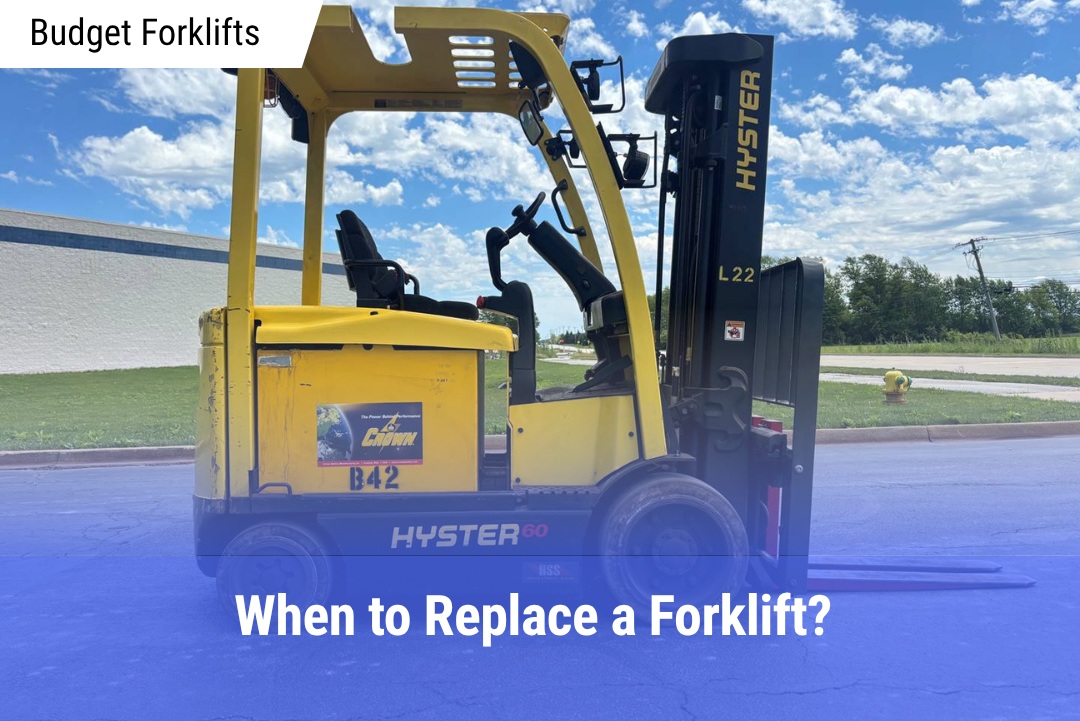
Replace a forklift when it passes roughly 10,000 operating hours, when maintenance costs climb past $3 to $5 per hour, or when a single repair exceeds 50% of the machine’s current market value. Safety defects that cannot be economically corrected end the decision immediately.
Those three triggers cover most fleets, but the right answer for your operation depends on how the truck is used, what it would cost to keep alive, and what a replacement actually costs once depreciation and used equipment options enter the picture. Here is the full framework.
How many hours does a forklift last?
Most forklifts last 10,000 to 12,000 operating hours, which works out to roughly 7 to 10 years in a single-shift operation. Electric forklifts typically outlast internal combustion models because they have far fewer moving parts.
Forklift age is measured in hours, not years, the same way a car is judged by mileage. A single-shift operation running 8 hours a day puts about 2,000 hours a year on a truck, so the average lifespan of a forklift translates to 5 to 7 years of daily use before major components start failing more often. Well-built trucks from top brands can run 20,000 hours with disciplined maintenance, while machines in corrosive plants, cold storage, or multi-shift operations can be worn out below 8,000.
Fuel type shifts the benchmark. Diesel and propane trucks average 10,000 to 12,000 hours, while electric units often reach 15,000 or more because there is no engine, transmission, or exhaust system to rebuild. The trade-off moves to the battery, which is why the electric vs diesel forklift decision should always account for battery replacement cost in the total picture.
One trap worth knowing: older trucks carry 4-digit hour meters that roll back to 0000 once they pass 9,999 hours. A 20-year-old forklift showing 3,000 hours has almost certainly been around the clock at least once. Trucks that come through our trade-in yard confirm it constantly, which is why we verify wear against the pedals, seat, mast rollers, and maintenance records instead of trusting the meter alone.
What are the warning signs a forklift needs to be replaced?
Four signals tell you a forklift is at the end of its run: repairs are becoming frequent, downtime is stretching longer, safety-critical defects keep appearing, and the truck can no longer handle your loads or lift heights. Any one of them justifies a replacement review; two or more usually decide it.
Safety is the non-negotiable one. Under OSHA regulation 29 CFR 1910.178, a powered industrial truck found to be in need of repair, defective, or in any way unsafe must be taken out of service until it is restored to safe operating condition, and trucks must be examined before each shift. OSHA has also made clear in its interpretation letters that keeping an unsafe truck around “as a backup” is not a defense. When brakes, steering, hydraulics, or the mast develop problems that keep returning after repair, the truck is not just expensive. It is a liability.
Forks deserve their own inspection. OSHA’s guidance requires forks to be withdrawn from service for surface cracks, a bent blade or shank, an incorrect fork angle, uneven tip height, or a broken positioning lock. Worn forks alone do not condemn the whole machine, but on the trucks we evaluate, heavy fork and heel wear almost always travels together with mast, chain, and carriage wear, because all of it comes from the same years of hard loading.
Capability mismatch is the sign most owners miss. If your loads have grown heavier or your racking taller, check the rated capacity on the data plate before blaming the machine. Our guide on how to read a forklift data plate shows exactly where to find those numbers. A healthy truck that is simply undersized for the job is still the wrong truck.
Should I repair or replace my forklift?
Repair the forklift when the fix costs less than 50% of the machine’s current market value and the truck is under roughly 10,000 hours. Replace it when repairs cross that 50% line, when maintenance runs past $3 to $5 per operating hour, or when downtime is disrupting your operation.
The 50% rule uses current market value, not what you paid. A truck worth $9,000 today facing a $6,000 engine or transmission job has failed the test, no matter what it cost new. Customers regularly call us with exactly that kind of repair quote in hand, and the math almost always lands the same way: the repair buys a few thousand more hours on a tired machine, while the same money puts a meaningful dent in a reconditioned replacement with its wear life ahead of it.
Normal wear items do not count against the machine. Tires, brake pads, hoses, belts, and batteries are designed to be replaced, and swapping them on a mid-life truck is money well spent. Knowing when to replace forklift tires or what causes forklift battery failures keeps those decisions cheap and routine. The expensive question only arrives when core components fail: engine, transmission, hydraulic pump, mast.
| Situation | Hours on truck | Repair cost vs current value | Verdict |
| Wear items only (tires, battery, hoses) | Under 10,000 | Under 15% | Repair |
| Single major component, otherwise solid | Under 10,000 | 15% to 50% | Repair, then monitor |
| Major component failure | Over 10,000 | Over 50% | Replace |
| Repeat safety defects after repair | Any | Any | Replace |
| 4+ work orders in 12 months | Over 10,000 | Cumulative climbing | Replace |
How do you calculate forklift maintenance cost per hour?
Divide your annual repair and maintenance spend by the truck’s annual operating hours. A newer forklift typically runs near $1 per hour, and once the figure climbs past $3 to $5 per hour, replacing the machine is usually cheaper than keeping it.
The math takes two minutes with your service invoices. A truck that ran 2,000 hours last year and needed $2,000 in repairs costs $1 per hour, which is healthy. The same truck five years later needing $8,000 across multiple work orders is at $4 per hour and climbing, and every unplanned breakdown adds hidden costs the invoice never shows: idle operators, missed shipments, and rush freight. If a down truck forces you to bring in temporary equipment, current forklift rental cost figures belong in your true cost per hour as well.
Replacement also costs less than the sticker suggests. Forklifts are business equipment, and IRS Publication 946 explains how businesses recover the purchase cost through depreciation deductions, with Section 179 rules allowing much of the cost to be expensed early. Pouring $8,000 a year into a dying machine generates repair bills. Putting similar money toward a replacement generates an asset your accountant can work with, and forklift financing options can spread the outlay to match the machine’s working life.
Is it better to replace an old forklift with a new or used one?
For most single-shift operations, a reconditioned used forklift with verified hours and documented maintenance delivers the same reliability reset at roughly half the price of new. New equipment makes sense mainly for heavy multi-shift duty where warranty coverage and maximum uptime justify the premium.
The economics favor used because forklifts depreciate fastest in their early years while their working life runs long. A well-maintained truck with 4,000 hours has most of its useful life still ahead of it at a fraction of the original price. The full breakdown in our new vs used forklift comparison walks through where each option wins, and buyers weighing brands can start with how Toyota vs Hyster forklifts hold their value over time.
Buying used is only as good as the inspection behind it. Before any trade-in reaches our lot, the evaluation covers verified hour readings against physical wear, fork and mast condition, hydraulic function under load, brakes, steering, and the service history that came with the machine. Do the same when you shop: our list of top questions to ask when purchasing a used forklift covers the checks that separate a reconditioned truck from someone else’s problem.
Match the replacement to the operation you have now, not the one you had when you bought the old truck. Aisle widths, lift heights, load weights, and duty cycles all change over the years, and our guide on how to choose the right forklift for your warehouse helps you spec the truck to today’s workload. If replacement timing is awkward, a bridge rental keeps freight moving while you decide, and the long term vs short term forklift rental breakdown shows which arrangement fits a transition period.
FAQ
What is considered high hours on a forklift?
Anything over 10,000 hours is generally considered high for a forklift, since that marks the point where major components begin failing more frequently. Premium brands with strong maintenance histories can remain productive well past that number.
Can a forklift last 20,000 hours?
Yes, well-built forklifts from top-tier manufacturers can reach 20,000 hours with disciplined preventive maintenance and single-shift use in clean environments. Electric models reach high hour counts more often than internal combustion trucks because they have fewer wearing parts.
Does OSHA require forklifts to be replaced at a certain age?
No, OSHA sets no age or hour limit for forklifts. The requirement is condition-based: any truck found defective or unsafe must be removed from service until repaired, regardless of whether it is 2 years old or 20.
How much does it cost to replace a forklift?
New forklifts commonly run $25,000 to $50,000 or more depending on capacity and fuel type, while quality reconditioned used trucks often cost 40% to 60% less. Financing and the tax treatment of equipment purchases both reduce the effective cost further.
The Bottom Line on Forklift Replacement
Replace a forklift when any of the three triggers fires: the truck passes roughly 10,000 hours, maintenance climbs past $3 to $5 per operating hour, or a single repair quote exceeds half its current market value. Safety defects that keep returning after repair end the debate on their own.
The mistake that costs operations the most is not replacing too early. It is holding on too long, paying for the old truck twice through repair bills and downtime while the replacement money drains away one work order at a time. Run the cost per hour math once a year on every truck in your fleet, keep the 50% rule next to every major repair quote, and treat the hour meter as one data point rather than the whole story. When the numbers say replace, a properly inspected reconditioned truck with verified hours gets you back to dependable uptime without the new equipment price, and the sooner the decision is made, the less the dying machine takes with it.