Warehousing, construction, manufacturing, retail, agriculture, and food and beverage are the industries that benefit most from forklift rentals, each for different reasons, but all sharing the same core advantage: they need heavy lifting capability on a schedule that doesn’t justify buying.
Renting a forklift instead of buying isn’t just a budget move. It’s a strategic one. The US forklift rental market is valued at $1.51 billion in 2025 and growing at over 6% annually, driven almost entirely by industries that need flexibility more than ownership. Our favorite reason companies rent, and what we hear most often, is the ability to scale up fast during peak demand, then hand the keys back when it’s over. No depreciation. No storage. No repair bills waiting to ambush your Q4.
If you’ve been wondering whether forklift rentals make sense for your operation, the answer is usually somewhere in the list below.
Table of Contents
Warehousing and Distribution
Warehouses and distribution centers are the single largest users of rental forklifts, holding the highest share of rental demand of any industry in the US.
It’s not hard to see why. These facilities move enormous volumes of goods every day, and their labor requirements don’t stay flat across the year. During the holiday shipping season, a warehouse that runs lean on equipment all spring suddenly needs three times the lift capacity. Renting covers that surge without committing to machines that will sit idle in January.
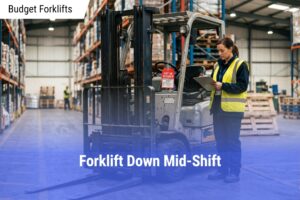
Rental also solves the breakdown problem. When a purchased unit goes down mid-shift during peak season, the whole line stalls waiting for a technician. With a rental fleet, the forklift rental company swaps the unit and your dock doesn’t stop.
What warehouses typically rent: electric counterbalance forklifts, reach trucks, pallet jacks for high-volume indoor use on smooth warehouse floors.
When demand spikes: Q4 holiday fulfillment, back-to-school season, post-holiday returns processing, large inventory audits, and facility expansions or relocations.
Construction Industry
Construction sites are the second-largest driver of forklift rental demand in the US. Every project is time-limited by definition, which makes ownership a hard case to justify.
Think about it: a commercial contractor building a warehouse complex might need telehandlers for 14 weeks to set steel and place roofing materials. Buying that equipment for a 14-week job, then paying to store, insure, and maintain it between projects, is a cash drain that rentals eliminate entirely.
Construction also deals with constantly shifting terrain. The right forklift for one phase of a build isn’t always the right one for the next. Rough terrain forklifts with oversized pneumatic tires are built for uneven ground and outdoor lifts, while standard cushion-tire units handle flatwork closer to grade. Renting lets contractors match the machine to the phase rather than compromising on one owned unit.
What construction companies typically rent: rough terrain forklifts, telehandlers with extendable booms for elevated placements, diesel-powered units for outdoor use.
When demand spikes: foundation and framing phases that require material staging, roofing and facade work needing elevated reach, large commercial or infrastructure projects with defined start-and-end schedules.
Manufacturing Plants
Manufacturing plants deal with two forklift scenarios that ownership handles poorly: production surges and unexpected equipment failures.
When a factory ramps up a new product line, or takes on a large contract that doubles its throughput, it needs more material-handling capacity immediately. Buying new equipment on a production timeline isn’t realistic: the lead times alone can kill the opportunity. Rental bridges that gap. When the contract ends or production normalizes, the extra units go back.
The breakdown scenario is just as costly. OSHA’s powered industrial truck standards apply strictly to manufacturing facilities, and a downed unit in a regulated environment doesn’t just slow production. It creates compliance exposure. Rental companies replace broken units quickly, keeping the floor moving and the safety record intact.
Manufacturing also benefits from access to newer forklift models. Rental fleets get refreshed regularly, which means renting often puts a more fuel-efficient, safety-compliant machine on the floor than a purchased unit that’s been depreciating for six years.
What manufacturers typically rent: heavy-duty electric or LPG counterbalance forklifts, specialized units with side-shift attachments for precise pallet placement, high-capacity units for heavy raw material movement.
When demand spikes: new product launches, large seasonal contracts, equipment failures during active production runs, line expansions.
Retail
Retail might not be the first industry that comes to mind for forklift rentals, but it’s one of the most consistent users, especially for mid-size and large-format stores managing their own receiving and stocking.
The dynamic is similar to warehousing but compressed. A regional home improvement chain or grocery distributor doesn’t need forklifts on the floor every day, but it absolutely needs them during peak receiving windows. Holiday inventory shipments, seasonal changeovers, and large promotional resets can bring in pallet volumes that manual labor simply can’t handle at speed.
Rather than owning units that sit 200+ days a year, retail operations rent for the windows where throughput demands it. This also keeps forklift rental costs off the capital budget and onto the operating side, a meaningful difference for retail finance teams managing thin margins.
What retailers typically rent: warehouse-style electric forklifts and pallet jacks for indoor dock-to-floor movement, smaller counterbalance units that fit store receiving areas.
When demand spikes: holiday season stock builds (October through December), post-holiday clearance resets, store remodels or relocations, large promotional event preparation.
Agriculture
Farming and agricultural businesses have a forklift problem that’s almost perfectly suited to rentals: their need is intense, specific, and seasonal.
During planting and harvest, farms are moving seed, feed, fertilizer, equipment, and bulk produce at volumes that require powered lift equipment. Once the season ends, that equipment has no purpose for months. Owning a forklift that earns its keep for 10 weeks a year is an expensive proposition, especially when that same unit needs maintenance, storage, and insurance during the idle stretch.
Telehandlers with extendable boom arms are particularly useful in agricultural settings, where loads need to be placed at angles or heights that a standard counterbalance unit can’t reach. Rough terrain models handle unpaved farm roads and uneven field access without issues. Both types are available as rentals sized to the season.
Nurseries, landscaping operations, and co-ops see the same pattern: concentrated need, seasonal boundary, and a strong case against ownership.
What agricultural operations typically rent: telehandlers for bulk grain, feed, and produce handling; rough terrain forklifts for outdoor and unpaved access; units with agricultural attachments for produce and nursery stock.
When demand spikes: planting season (spring), harvest season (fall), large co-op receiving days.
Food and Beverage
Food and beverage operations sit at the intersection of manufacturing and distribution, moving heavy raw materials in and finished product out continuously. What makes this industry distinct is that the volume swings tied to retail cycles create predictable but intense rental windows.
A regional beverage distributor stocking up before the summer grilling season, or a food manufacturer fulfilling a large holiday contract, can see throughput double in a matter of weeks. Renting scales the fleet to meet that window without the overhead of permanent equipment expansion.
Cold storage adds another layer. Forklifts operating in freezer environments require specialized configurations, and a business that only needs cold-storage-rated units for part of the year is better served by renting the right spec than buying and modifying a unit for occasional use.
What food and beverage operations typically rent: electric counterbalance units rated for temperature-controlled environments, high-capacity models for bulk ingredient and finished goods movement.
When demand spikes: Q4 holiday contract fulfillment, summer beverage season, large retail promotional windows.
Events and Entertainment
This one surprises people, but it’s been a consistent rental category for decades. Staging companies, convention centers, and large event promoters need forklifts to move the physical world of a major event: rigging, stage decks, lighting truss, sound equipment, vendor booths, and display structures.
The entire need is time-bound. A trade show setup might require four forklifts for three days, then nothing until the next show. No company in this space should be owning that equipment. Rental is the only model that makes sense.
Outdoor festivals often need rough terrain models for soft ground access. Indoor arenas need compact units that can navigate loading dock configurations without scratching floors. Both are available through rental, matched to the venue and timeline.
What events operations typically rent: compact electric forklifts for indoor arena use, rough terrain units for outdoor festival grounds, telehandlers for elevated rigging and stage construction.
When demand spikes: trade show season, festival season (spring through fall), large conference and convention setup windows.
Is Renting the Right Call for Your Business?
Renting makes more sense than buying if your forklift need is tied to seasons, projects, or demand windows and not year-round daily production.
| Situation | Rent | Buy |
|---|---|---|
| Seasonal peak demand (3 months or less) | Yes | No |
| Short-term project with defined end date | Yes | No |
| Equipment breakdown coverage | Yes | No |
| Daily year-round use, single location | Evaluate | Likely |
| Budget for upfront capital investment | Depends on ROI | Maybe |
| Need latest safety-compliant models | Yes | Less flexible |
The rental side of this industry isn’t a niche anymore. It’s the majority of operators deciding that ownership math doesn’t add up for most use cases. If your need is year-round and daily, run the numbers on both paths: compare forklift financing options against rental rates, and price a used forklift before committing to new. For everything shorter, a short-term forklift rental almost always wins on total cost.
If your operation is in warehousing, construction, manufacturing, retail, agriculture, food and beverage, or events, the question isn’t really whether rental makes sense. It’s which forklift, and for how long.
Why rent a forklift instead of buying one?
Renting is a smarter choice if your projects are short, your demand is seasonal, or if you simply want to avoid the high cost of maintenance. You save a lot of upfront cash and you don’t have to worry about the machine losing value (depreciation). The best part? The rental company handles all the big repairs. Illinois Industrial Equipment Inc. provides clear cost-benefit analyses, helping you decide if renting or buying is the best financial move for your operation’s long-term health.
How much does it cost to rent a forklift per day?
The daily cost can vary widely! It depends on the forklift’s size (how much it can lift), the type (like electric, propane, or diesel), and the rental company’s location. Typically, prices range from about $150 to over $500 per day. For an exact price based on the specific type of machine you need, you should always check with a reputable provider like Illinois Industrial Equipment Inc. to get a competitive, all-inclusive quote.
Do I need a license to rent and operate a forklift?
Yes, absolutely. Anyone operating a forklift must be properly trained and certified according to OSHA (Occupational Safety and Health Administration) standards in the U.S., regardless of whether the machine is owned or rented. While the rental is provided by companies like Illinois Industrial Equipment Inc., it is the renter’s responsibility to ensure all operators have valid, required certification for safety and legal reasons.
What size forklift do I need for my job?
To determine the right size, you must know the heaviest load you need to lift and the maximum height you need to reach. Renting is beneficial because you can get an exact size for the job. If you’re unsure, tell the experts at Illinois Industrial Equipment Inc. details about your materials and workspace (like aisle width), and they can recommend the exact capacity and mast height you need, ensuring safe and efficient operation.
Can I rent forklifts for seasonal demand?
Yes, this is a core benefit of renting! Businesses that see huge spikes in workload during specific times – like warehouses during the holidays or farms during harvest – can rent extra equipment for a few weeks or months. This helps you manage all the extra work without buying expensive equipment that would sit unused for the rest of the year. The flexible short-term leases offered by a provider like Illinois Industrial Equipment Inc. allow you to scale up instantly.
What happens if a rental forklift breaks down?
This is where renting shines! In most cases, if a machine stops working, the rental agreement requires the provider to send a repair technician quickly or deliver a replacement unit to your site right away. This commitment from quality providers like Illinois Industrial Equipment Inc. means your crew experiences minimal disruption and your operations keep moving with almost no delay.
Are forklift rentals available with an operator included?
Generally, a rental agreement covers the machine only. However, some full-service equipment companies can sometimes help connect you with staffing agencies that specialize in certified forklift operators. It’s important to ask your rental provider upfront if they have any resources or referrals for operators, as it is a separate service.
Can I rent different types of forklifts for one project?
Absolutely! This is another powerful reason to rent. For one large project, you might need a heavy, rough-terrain forklift for outdoor work and a small, quiet electric forklift for indoor tasks. Renting allows you to easily pick a mix and match of models (like narrow-aisle, sit-down, or stand-up units) to perfectly fit the specific needs of different parts of your operation.
Is forklift rental better for short-term projects?
Definitely! For any job that is expected to last less than 6 to 12 months, renting almost always makes the most financial sense. You are only paying for the equipment for the time it is actively generating value, and you avoid all the long-term headaches, like depreciation, insurance costs, and finding a place to store it when the project is finished.
How far in advance should I book my rental?
You should book your rental as soon as you know your project or busy season start dates. This is especially true if you need a specialized machine or a large number of units. During peak industrial seasons, demand is high, so calling your provider 2-4 weeks ahead of time will ensure the equipment you need is available and delivered exactly when you require it.