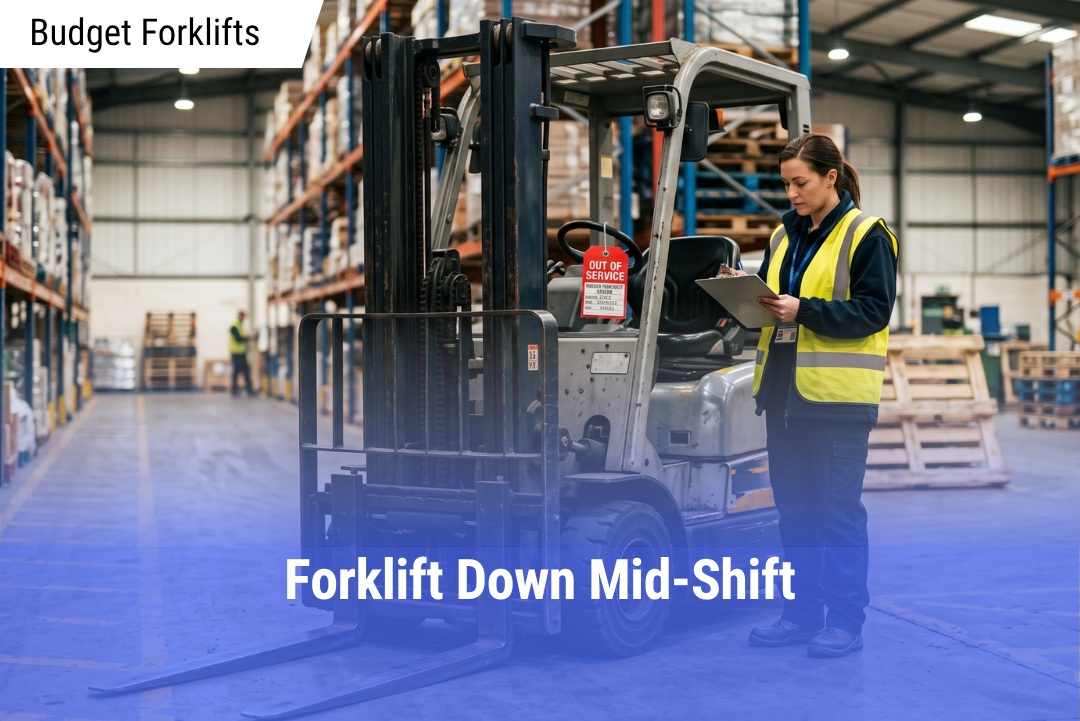
Federal rules leave no room for limping a bad truck to the end of the shift. Under OSHA’s powered industrial truck standard, a forklift found to be defective, in need of repair or in any way unsafe at any time must be taken out of service until it is restored to safe operating condition.
The first hour decides two things: whether anyone gets hurt, and how much the breakdown ends up costing you. Here is how to run it, minute by minute.
Table of Contents
The first hour at a glance
| Time | Action | Who | Why it matters |
| 0 to 5 min | Stop out of the travel lane, lower the forks, controls in neutral, power off, brake set | Operator | Keeps a dead truck from rolling or dropping its load |
| 5 to 15 min | Clear the area, pull the key, hang an out-of-service tag | Operator and supervisor | Stops the next person from climbing on and running it |
| 15 to 30 min | Report the defect, record the hour meter, data plate details and symptoms, call service | Supervisor | Gives the technician what they need to diagnose fast |
| 30 to 60 min | Decide repair, swap or rent, and reassign the work | Operations manager | Limits idle labor and missed shipments |
What should the operator do in the first 5 minutes after a forklift breaks down?
Bring the truck to a controlled stop out of the travel lane, lower the forks fully, put the controls in neutral, shut off the power and set the parking brake. If the truck is on an incline, block the wheels before you walk away.
Those are the same steps OSHA requires whenever a forklift is left unattended, and a broken truck is about to sit unattended for a while. The standard treats a truck as unattended once the operator is 25 feet or more away, or out of sight of it.
Location matters as much as procedure. If the truck quit in a cross aisle, at a dock edge or halfway into a trailer, keep pedestrians and other trucks away and wait for help instead of trying to force it clear. Recovering a truck from those spots carries its own hazards, which we cover in our guide to a forklift stuck inside a trailer or on a ramp.
Before you step off, note what happened right before the failure. A warning light, a smell of hot oil, a grinding noise or a sudden loss of lift speed tells the technician more than “it just died.”
What if the forklift dies with the forks raised or a load in the air?
Clear everyone out from under the load and keep them out. Lowering a stuck load is a job for an authorized technician following the manufacturer’s procedure, or a trained operator using a second truck rated for that weight.
OSHA’s rule here is absolute: no person may stand or pass under the elevated portion of any truck, whether it is loaded or empty. A dead truck with a pallet at rack height is exactly that situation, and it can stay that way for hours.
Many operators assume raised forks will drift down on their own once power is lost. On a lot of electric trucks they will not, because the hydraulic system holds pressure by design. Our technicians treat a stuck elevated load as one of the most serious calls they take, and in our experience the people who get hurt are usually the ones who try to help before the technician arrives.
If you bring in a second forklift to take the load off, check its capacity at the actual lift height and load center, not just the headline number. Our guide on how much weight a forklift can carry explains why capacity drops as the load goes higher, and understanding the fulcrum on a forklift shows why an overreaching rescue truck tips forward.
Never do this with a stuck raised load
- Stand, walk or reach under the forks or the load
- Climb the mast or the rack to hand-unload
- Loosen hydraulic fittings or touch the chains
- Slide a pallet jack under the raised load
- Tilt the mast forward to “help it down”
Can you keep using a forklift that is acting up until the end of the shift?
No. A forklift that is defective, in need of repair or in any way unsafe must come out of service immediately, and OSHA has stated that needing the truck as a backup does not excuse running it.
In a 2004 interpretation letter, OSHA confirmed that the duty is not limited to steering, brakes, horn and hoist. Any condition that affects safety counts. An employer who keeps the truck running because it cannot spare it could be cited.
The common mid-shift warning signs are easy to rationalize: a horn that sounds weak, a mast that creeps down under load, a brake pedal that sinks further than it did this morning, a lift that slows near the top. In our shop, the biggest repair bills often belong to trucks that were nursed through a few more shifts after the first warning sign. Small faults rarely stay small under load.
Operators also need to know they will not be blamed for speaking up. A crew that fears a write-up for reporting a problem will keep driving a bad truck, and that costs far more than a lost hour.
Who is allowed to fix a broken forklift on the floor?
Only authorized personnel, meaning trained technicians your company has designated for forklift repair. On electric trucks, the battery must be disconnected before anyone works on the electrical system.
Both points come straight from the maintenance section of OSHA’s forklift standard, which also requires replacement parts to be equivalent in safety to the originals and bars operating a truck with a fuel system leak until the leak is corrected. If you smell propane, nobody restarts that truck.
The temptation in a busy shift is the quick fix: a jump-start from a pickup, a jumper wire across the starter, a reset of a fault code that keeps coming back. A dead truck that suddenly starts can lurch in whatever direction its controls were left in. Start interlocks exist to stop exactly that, and bypassing one turns a breakdown into an injury.
How do you tag out and report a broken forklift?
Remove the key, hang an out-of-service tag on the steering wheel or controls, and park the truck where nobody will mistake it for a working unit. Then report the defect to your supervisor and service provider right away, with the hour meter reading and a plain description of the failure.
OSHA requires that defects be reported immediately and corrected once they are found. A tag alone is weak protection on a busy floor, so pull the key and tell the next shift in person.
When a customer calls our service line with a down truck, we ask for four things first:
- Make, model and serial number from the data plate
- The hour meter reading
- Any fault code showing on the display
- What the truck did in the minute before it stopped
Having those ready shortens the diagnosis and often means the technician arrives with the right part. If you are unsure where to find the details, see how to read a forklift data plate. Log every breakdown against that truck as well, because a complete forklift service history drives smarter repair decisions now and a better resale price later.
Should you repair the forklift, swap trucks or rent a replacement?
Repair on site when a technician can restore the truck the same day, swap in a spare when you have one, and rent when the repair needs parts or shop time and the work cannot wait.
Repair on site
Best when the diagnosis points to a hose, contactor, fuse, sensor or similar component. In our field service work, those are often same-visit fixes. Major components such as a transmission, drive motor or mast cylinder usually are not.
Swap in a spare
Best when you have another truck of the same capacity and type available. Re-plan the shift around it before the first truck’s operator is standing idle.
Rent a replacement
Best when the repair will run past today and the work cannot wait. Match the capacity, fuel type, mast height and tires to the job, including non-marking forklift tires if your floors require them.
Make the call with numbers, not hope. Add up the operators standing idle, the trailers waiting at the dock and any late-delivery penalties, then compare that against current forklift rental cost for the days the repair will take. The benefits of short-term forklift rental are strongest in exactly this situation, and avoiding the most common forklift rental mistakes, such as renting the wrong capacity, keeps an emergency rental from creating a second problem.
One more point from experience: an honest turnaround estimate comes after the first diagnosis, not before. Plan for the rental decision at the 30 to 60 minute mark, once the technician has looked at the truck or talked you through it.
What usually causes a forklift to break down mid-shift?
Most mid-shift breakdowns trace back to the battery and charging system on electric trucks, fuel and cooling problems on internal combustion trucks, hydraulic leaks and tire damage. Overheating is a stop-now condition that requires removing the truck from service until the cause is fixed.
Battery and charging. On electric trucks, a large share of the “dead truck” calls we answer are really low-voltage, cable or charging problems rather than motor failures. Our guide to what causes forklift battery failures covers the usual culprits.
Overheating. When any part of a truck runs hotter than its normal operating temperature and creates a hazard, OSHA requires removing it from service until the cause is eliminated. A temperature warning is not a suggestion to finish the load first.
Hydraulics. A mast that drifts, lifts slowly or leaves a puddle under the carriage usually means a leaking hose, fitting or cylinder seal. Hydraulic oil on the floor is also a slip hazard for everyone around the truck.
Tires. Chunking, flat spots and separation make a truck unstable and can stop it outright. Knowing when to replace forklift tires keeps a worn set from failing in the middle of a shift.
How do you safely put the forklift back into service?
A forklift goes back into service only after the repair is complete and the truck passes a full examination. OSHA prohibits placing a truck in service if that examination shows any condition that adversely affects safety.
The same rule that drives the daily pre-use examination applies after a repair. Build a short return-to-service routine around it:
- The technician confirms the repair and notes what was replaced
- A trained operator runs a full pre-use check, including brakes, steering, horn, lift, lower and tilt
- The truck lifts a test load before it returns to production work
- Only the authorized person removes the out-of-service tag and logs the return
How do you prevent the next mid-shift breakdown?
Catch problems at the pre-shift inspection, keep batteries and tires on schedule, and track breakdowns per truck. When the same truck keeps failing, retiring it is often the cheapest fix.
Most mid-shift failures send signals first. A pre-shift check that operators actually perform, rather than tick off, catches leaks, worn tires and weak brakes before the truck carries a load. On electric fleets, routine care such as knowing how to water a forklift battery correctly prevents a surprising number of dead-truck calls.
Repeat breakdowns on the same unit are the clearest signal we see that a machine is near the end of its working life. Compare its hours against the average lifespan of a forklift, and if replacement makes sense, a reconditioned truck can reset your reliability for less. Our new vs used forklift comparison walks through that decision.
Frequently asked questions
Can you push or tow a broken forklift out of the way?
Only by the method the manufacturer’s manual describes, and only by trained people. Many trucks have brakes that apply automatically without power, so dragging one can damage the drive system and create a runaway hazard.
Can an operator clear a fault code and keep working?
Only if the manual lists that reset as a normal operator action and the fault points to no safety issue. If the code returns or involves brakes, steering, hydraulics or the electrical system, the truck stays out of service until a technician clears it.
Who is allowed to remove an out-of-service tag?
Only the person your company authorizes, after the repair and a return-to-service check. An operator who needs a truck should never remove a tag to get one.
Does OSHA require a written report when a forklift breaks down?
The forklift standard requires defects to be reported immediately and corrected, but it does not prescribe a specific form. A written log is still the best practice because it proves the truck was pulled and shows patterns across your fleet.
The bottom line on a forklift breakdown mid-shift
A forklift that fails mid-shift is a safety event first and a scheduling problem second. Secure the truck, keep everyone clear of any raised load, tag it out and report it, then let a qualified technician decide what it needs. Use the rest of the hour to make the repair, swap or rent decision with real numbers, so one broken truck costs you an hour instead of a day.
The operations that recover fastest are the ones that rehearsed this before it happened. Put the first-hour timeline above in front of every operator and supervisor, and the next breakdown becomes a routine call rather than a scramble.