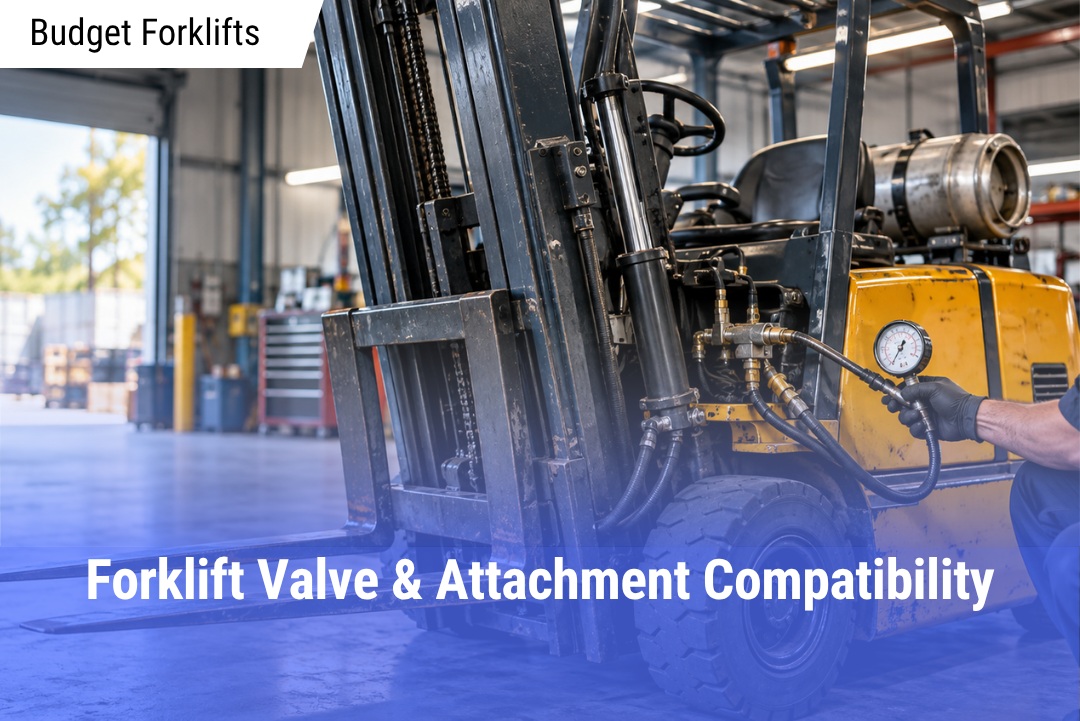
A new fork positioner arrives, the installer walks up to the truck, and the cab has three levers. It happens more often than you would think, and it almost always starts the same way: the attachment got ordered first and the forklift got checked second. Before you buy a sideshifter, fork positioner, clamp, or rotator, you need three answers. How many auxiliary valve functions does your truck have, does its hydraulic flow and pressure fit the attachment, and what can you do if it comes up one function short?
Quick answer: Count the hose pairs running up the mast to the carriage. Each working pair is one auxiliary function. A single-motion attachment needs one, a combination attachment needs two, and the truck’s flow and relief pressure must sit inside the attachment’s published range.
Table of Contents
What is a valve function on a forklift?
A valve function is one independent hydraulic circuit, run by its own valve section and control, that powers one attachment motion. Every forklift ships with two functions, lift and tilt, and anything beyond that needs an auxiliary function.
Attachment makers wire their hoses to an industry lever order so every truck behaves the same way. Cascade’s installation manual for its G-Series handler lays out the standard ITA (ISO) auxiliary valve layout as hoist, tilt, sideshift, and then fork open and close. In plain terms, the third lever is usually sideshift and the fourth lever is usually fork positioning or clamp.
That is why sellers describe trucks as “three-function” or “four-function.” A three-function truck can run one auxiliary motion. A four-function truck can run two at the same time, each with full control.
On the used trucks we take in, the spec sheet rarely tells the whole story. A listing that says “sideshift” can mean an integral sideshift carriage using the third function, a hook-on sideshifter using the third function, or a truck with a spare fourth valve section that nobody ever plumbed. You only find out by looking.
How do you count the valve functions on your forklift?
Count the working hose pairs that run up the mast to the carriage, not the levers in the cab. Levers can be spare, joysticks can hide extra directions, and a valve section can sit unplumbed under the floorplate.
Work through the truck in this order:
- Cab controls. Count the levers, then move each one. A lever that travels on two axes, or a joystick with a thumb switch, may control more than one function.
- Valve bank. Lift the floorplate and count the sections on the main control valve. Two sections means lift and tilt only.
- Mast routing. Follow the hoses up the mast. A 2-port hose reel carries one function and a 4-port reel carries two. Some masts route hoses internally instead of using a reel.
- Carriage end. Look at the fittings on the carriage. Capped ports mean the circuit exists but nothing is connected to it.
The mismatch we run into most on trade-ins is a fourth valve section sitting at the valve bank with no hoses taken over the mast. The truck technically has four functions, but you cannot use the fourth one until someone adds a hose reel or internal reeving. The reverse also shows up: hoses reaching the carriage with a cab lever that was disconnected years ago.
How many functions does each attachment need?
Single-motion attachments such as a sideshifter, fork positioner, rotator, or carton clamp need one auxiliary function. Combination attachments that do two things, such as a sideshifting fork positioner or a rotating clamp, need two.
| Attachment | Auxiliary functions | Typical lever position | What to watch |
| Sideshifter | 1 | 3rd | Uses the function most other attachments want |
| Fork positioner (no sideshift) | 1 | 3rd, or 4th if sideshift is kept | Adding one to a sideshift truck needs a 4th |
| Sideshifting fork positioner | 2 | 3rd and 4th | Needs two hose pairs over the mast |
| Rotator | 1 | 3rd | Speed depends heavily on flow |
| Carton or bale clamp | 1 (2 with sideshift) | 4th for clamp | Clamp force follows relief pressure |
| Rotating paper roll clamp | 2 | Clamp and rotate | Both circuits must hold under load |
| Push-pull (slip sheet) | 1 to 2 | 3rd, plus 4th on some models | Check whether gripper runs on its own circuit |
| Multiple pallet handler | 2 | Sideshift and fork spread | 4 to 10 gpm range on Cascade G-Series |
The hose routing tells you the same thing as the table. Cascade’s G-Series installation instructions call for one 2-port hose reel or single internal reeving on the non-sideshifting model, but right and left 2-port reels or double internal reeving once sideshift is added. Two functions means two hose pairs, every time.
Before you settle on an attachment, it also helps to confirm the truck type suits it. Carriage size and mast design differ between reach trucks and counterbalance forklifts, and most heavy clamp and rotator work lands on counterbalance units.
What happens if your forklift’s flow or pressure does not match the attachment?
Flow sets speed and pressure sets force, so a mismatch shows up as a slow, uneven, or overheating attachment. Having the right number of functions is only half the check.
Every hydraulic attachment publishes a flow range and a maximum relief setting. For its G-Series handlers, Cascade lists truck flow and relief pressure requirements of 4 gpm minimum, 7 to 10 gpm recommended depending on model, and a relief setting of 2,600 psi recommended with 2,900 psi as the ceiling. The same manual explains that flow under the recommended figure gives reduced or unequal arm speed, while flow over the maximum causes excess heat, weaker performance, and shorter hydraulic system life.
In practice, the complaint we hear is “the attachment is slow” or “the forks do not move together.” More often than not, the attachment is fine and the circuit feeding it is the problem: undersized hoses, too many fittings, a worn pump, or an auxiliary flow setting that was never adjusted. On many electric trucks the auxiliary flow is set in the controller, so a technician can often tune it without swapping hardware.
Pressure matters most on clamps. Too little and the load slips. Too much and cartons crush, which is why many clamp setups use a pressure-regulating valve rather than full truck relief.
Your forklift is one function short. What are your options?
You have four realistic options: add a valve section, fit a selector kit, use a sequence valve, or pick the one function you need most. The right choice depends on how often you need both motions and how much downtime the change costs you.
1. Add a true auxiliary function
A technician stacks a new section on the main valve, adds a cab control, and runs a new hose pair over the mast with a reel or internal reeving. You get full, independent control of both motions. It is the most parts and labor of the four, and some valve banks cannot take another section at all.
2. Fit an electric selector (diverter) kit
A solenoid valve on the carriage switches one existing hose pair between two attachment circuits. A button on the lever picks which one moves, and a coiled cable follows the carriage up the mast instead of a second hose reel. The trade-off is that both motions cannot run together. For sideshift plus fork positioning, that rarely matters, because operators seldom need both at once.
3. Use a sequence valve
A sequence valve runs one motion and then the next from the same lever, based on pressure. Some sideshifter and fork positioner combinations are built this way. It needs no wiring, but the operator gives up direct control over which motion happens first.
4. Choose the function you use most
Some owners simply plumb the third lever to whichever motion earns its keep. If you change fork spacing all day and rarely sideshift, that can be the cheapest answer. It is also the one that costs you the most time per pallet later.
Our rule of thumb: a selector kit is fine for intermittent use, while all-day clamp or rotator work deserves a true function. If the retrofit quote starts approaching the value of a truck that is already plumbed correctly, compare the numbers in a new vs used forklift comparison before spending money on the old one. Forklift financing options can also spread the cost of a replacement truck.
Is it legal to add a hydraulic function to a forklift?
Yes, but only with the forklift manufacturer’s written approval before the work is done. The capacity plates then have to be updated to match the new setup.
The federal rules sit in OSHA’s powered industrial truck standard, 29 CFR 1910.178. Paragraph (a)(4) bars users from making modifications that affect capacity or safe operation without the manufacturer’s prior written approval, and requires the capacity, operation, and maintenance plates to be changed accordingly. Paragraph (a)(5) says a truck carrying non-factory front-end attachments should be marked to identify them and show the approximate combined weight of truck and attachment at maximum elevation. Paragraph (q)(6) separately bars adding parts the manufacturer did not provide.
The same standard has two more points that catch people out. Under (o)(4), a truck fitted with an attachment must be operated as a partially loaded truck even when it carries nothing. Under (l)(3)(i)(G), operator training must cover fork and attachment use and its limits, so a new attachment usually means updated training too.
Capacity is the part owners underestimate. The attachment adds weight and pushes the load center forward, which works against the truck’s fulcrum point on the front axle. That is why the real answer to how much weight a forklift can carry changes once an attachment goes on. Cascade’s manuals also warn that the truck and attachment combination rating is set by the truck manufacturer and may be lower than the attachment’s own nameplate. Always go by the updated forklift data plate, not the attachment tag.
What should you check before buying or renting a forklift for attachment work?
Check five things before you commit: hose pairs, data plate, carriage class, tested flow, and hose condition. Ten minutes at the truck saves a retrofit bill later.
- Hose pairs at the carriage. Match the working pairs to the functions your attachment needs, using the table above.
- Data plate. Confirm it lists the attachment, or plan for an updated plate before the truck goes to work.
- Carriage class. The attachment must hang on the same class carriage (Class II, III, or IV) as the truck.
- Flow and relief pressure. Ask for a reading at the carriage hose terminal and compare it to the attachment spec.
- Hoses and reel. Look for weeping fittings, cracked covers, and a hose reel that retracts smoothly under tension.
When a customer tells us up front which attachment they plan to run, we check the functions and plumbing on the truck before it leaves the yard rather than after it arrives. Add these checks to your list of questions to ask before buying a used forklift, and weigh them alongside capacity, lift height, and aisle width when choosing the right forklift for your warehouse.
If you only need the attachment for a project or a busy season, a short-term forklift rental with the right functions already plumbed is often cheaper than retrofitting your own truck. Naming the attachment when you book avoids one of the most common forklift rental mistakes: a truck that shows up with one function too few.
Frequently asked questions
Can I run a fourth function off my third lever?
Yes, an electric selector kit lets one lever and one hose pair operate two attachment functions, chosen with a button. You can only run one of the two motions at a time.
Does a sideshifter count as a function?
Yes, a sideshifter uses one auxiliary function, usually the third lever, whether it is integral or hook-on. Adding a separate fork positioner to a sideshift truck therefore needs a fourth function or a selector kit.
Will adding a valve function reduce my forklift’s capacity?
The valve section itself adds little weight, but the attachment it powers adds weight and moves the load center forward. The truck manufacturer sets the new rated capacity, and the data plate must be updated to show it.
How do I check hydraulic flow at the carriage?
A technician connects an inline flow meter and pressure gauge at the carriage hose terminal and runs the auxiliary lever through its full stroke. The readings are then compared with the flow and relief figures on the attachment’s spec sheet.
Conclusion
An attachment is only as good as the circuit feeding it. Count the hose pairs at the carriage, match the attachment’s function count, and confirm the truck’s flow and relief pressure sit inside its published range. If the truck comes up short, choose between a true added function, a selector kit, a sequence valve, or a trade-off based on how hard the attachment will work. Get the manufacturer’s approval and an updated data plate before it goes back into service. Do those checks before you buy or rent, and the attachment works from day one instead of waiting on a retrofit.