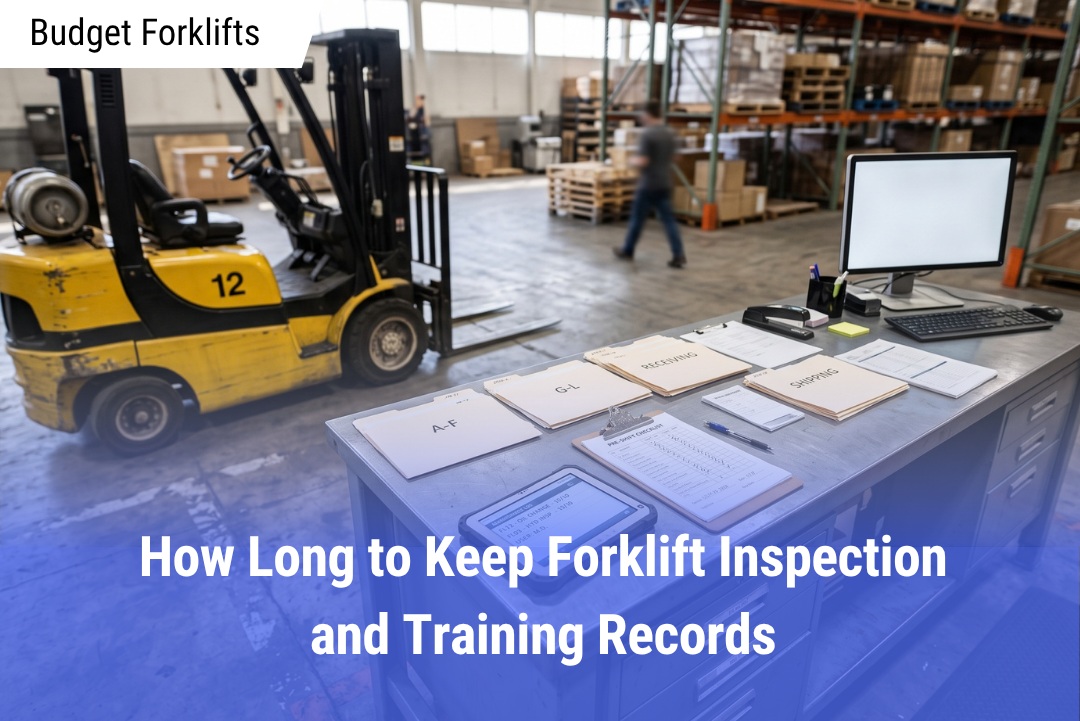
Federal OSHA does not set a retention period for forklift inspection records or for operator training records. The policy most safety managers can defend is simple: keep daily inspection sheets for at least 12 months, keep every defect and repair record for the life of the truck, and keep each operator’s certification for as long as they work for you plus three years after they leave.
It is one of the questions we hear most often at the service counter, usually right after a customer finds a box of old checklists and wonders whether they can finally shred it. The honest answer is that the regulation is silent on how long to keep them, so the real decision is what you need to prove, to whom, and for how long.
Quick answer
Daily inspection sheets: 12 months minimum. Defect, repair and maintenance records: life of the truck. Operator certifications: duration of employment plus 3 years. None of these periods is written into federal law; they are a retention policy built around how OSHA inspections, operator evaluations and injury claims actually work.
Table of Contents
How long do you have to keep forklift inspection records?
Federal OSHA does not require forklift inspection records to be kept for any set period, because it does not require daily inspections to be written down at all. A defensible policy is to keep daily checklists for at least 12 months and keep every defect and repair record for the life of the truck.
The clearest statement comes from OSHA’s February 2000 interpretation letter on forklift examinations, which confirms that the standard does not require the daily examination to be documented and that any record retention is left to the employer. The one year, three year and five year “OSHA requirements” you see repeated online are company best practices that have been passed along as law.
Because the decision is yours, put it in writing. A single line in your forklift safety program, such as “completed daily inspection checklists are retained for 12 months,” shows an inspector that you run a system rather than keeping paper by accident. It also protects you from the opposite problem: a warehouse that saves everything forever and cannot find the one sheet that matters.
Twelve months of routine sheets is enough to show a consistent habit, but sheets that record a problem deserve different treatment. When a truck comes into our shop with a recurring hydraulic leak or a brake complaint, the operator checklists are often the only record of when the issue first appeared and how long the truck kept running with it. Pull any sheet that flags a defect out of the rolling file and keep it with that truck’s permanent service record. The same goes for battery notes: checklists that log low electrolyte, heat or corroded cables are early warnings of the causes of forklift battery failures, and they help prove the truck was being looked after.
Does OSHA require a written daily forklift checklist?
No. OSHA requires the forklift to be examined before it is placed in service, at least daily or after every shift for round-the-clock operations, but it does not require that examination to be recorded on a checklist.
Paragraph 1910.178(q)(7) of the powered industrial truck standard is about the examination itself: a truck with any condition that affects its safety cannot be placed in service, and defects must be reported and corrected immediately. OSHA does not prescribe a form, the items on it, or a signature.
The catch is proof. If an inspector asks whether your trucks are examined every shift and you have nothing written, it becomes your word against what they observe on the floor. A signed checklist, paper or digital, is the cheapest evidence you will ever produce. It also creates a defect history that tells you, for example, when to replace forklift tires before chunking or wear turns into a stability problem.
How long should forklift training and certification records be kept?
Keep each operator’s current certification for as long as they operate a forklift for you, plus at least three years after they leave. OSHA sets no retention period for training records, but it requires a performance evaluation at least every three years, and the certification is your only proof that cycle is being kept.
Under OSHA’s powered industrial truck standard, 29 CFR 1910.178, the employer must certify that every operator has been trained and evaluated, must evaluate each operator’s performance at least once every three years, and must provide refresher training when specific events occur. The standard never says how long to keep the certificate, which is why so many websites disagree.
Do not replace old certificates when a new one is issued; file them together. The refresher triggers in paragraph (l)(4)(ii) are the reason:
- The operator was seen operating the truck unsafely.
- The operator was involved in an accident or near miss, such as a forklift stuck inside a trailer or on a ramp.
- An evaluation showed the operator is not driving safely.
- The operator is assigned a different type of truck, for example moving from a sit-down counterbalance to a stand-up reach truck (see reach truck vs counterbalance forklift for how different they handle).
- A workplace condition changes in a way that could affect safe operation.
A complete file of certificates shows that each of those events was followed by training, not just that the three-year date was met.
What must a forklift certification record include?
Paragraph 1910.178(l)(6) requires four items: the operator’s name, the date of training, the date of evaluation, and the identity of the person or people who performed the training or evaluation.
A certificate missing any one of those four items is not a complete certification, no matter how good the training was. Most well-run programs add a few fields that OSHA does not require but that make the record far more useful:
- The truck classes and models the operator was evaluated on.
- The signed practical evaluation checklist, not just a wallet card.
- The date the next three-year evaluation is due.
- The reason for any refresher training, such as “near miss at dock 4.”
What happens to training records when an operator leaves or an outside trainer did the training?
The records stay your responsibility in both cases. OSHA has said the standard does not specify who physically holds the records, but the employer is ultimately responsible for making them available.
If a third-party trainer keeps the files, your agreement should require them to hand over copies immediately on request; an inspector will not wait for a trainer to dig through an archive. When an operator quits, keep their file for at least three years. That covers questions about incidents that happened while they worked for you, and it saves time if you rehire them, since OSHA allows an employer to consider documented prior training when deciding how much retraining is needed.
Renting equipment does not move this duty to someone else. The rental company is responsible for the truck, but you are responsible for the people driving it, which is one of the most common forklift rental mistakes we see when a seasonal crew is added in a hurry.
Why keep forklift records longer than the minimum?
Because the clocks that matter run longer than a year. OSHA can issue a citation up to six months after a violation, operator evaluations run on a three-year cycle, and injury claims can surface years after the incident.
After an incident, investigators typically ask for the training records of the injured operator and of other operators doing the same work, along with the inspection history of the truck involved. Insurance carriers and attorneys ask for the same documents, often long after OSHA has closed its file. In Illinois, personal injury claims generally have a two-year filing window, and the litigation that follows can run for years; the records have to survive all of it.
Some states add their own rules. California, for example, treats daily forklift inspection logs as records of scheduled inspections, which Cal/OSHA requires employers to keep for one year. If you run sites in a state with its own OSHA plan, check that plan before settling on a company-wide policy.
Forklift record retention at a glance
| Record | What federal OSHA requires | Recommended retention | Why |
| Routine daily inspection checklists | Examination required; no written record or retention period | 12 months, rolling | Proves a consistent inspection habit; covers the six-month citation window twice over |
| Checklists that record a defect | Defects must be reported and corrected | Life of the truck | Shows the defect was found and fixed; key evidence after an incident |
| Maintenance and repair records | Repairs by authorized personnel; no retention period | Life of the truck, then transfer to the buyer | Supports safety history, warranty questions and resale value |
| Operator certifications | Certification with four required items; evaluation every 3 years | All certificates for the length of employment | Proves the three-year cycle and every refresher were completed |
| Refresher training after an incident | Refresher training required after listed triggers | Length of employment, plus a copy in the incident file | Links the corrective action to the event |
| Records of operators who have left | No retention period | 3 years after separation | Covers late claims and speeds up rehiring |
How long should you keep forklift maintenance and repair records?
Keep forklift maintenance and repair records for as long as you own the truck, then pass them to the next owner. That history follows the machine, not the operator, and it is the first thing a buyer or appraiser asks for.
When a used truck comes to us for appraisal or trade-in, the service file changes the conversation. A folder with hour-meter readings at each visit, planned maintenance intervals and dated major repairs lets us verify the hours and see how the truck was treated. A truck with no paperwork gets valued only on what we can inspect in the yard, and buyers apply the same caution. Service history is near the top of the questions to ask when purchasing a used forklift for exactly that reason.
Good records also show you where a truck sits against the average lifespan of a forklift, so you can budget for replacement instead of reacting to a breakdown. Tie every record to the serial number and model on the truck’s forklift data plate; in a mixed fleet, records filed by nickname or unit color become useless the moment a truck is repainted or moved to another site.
For electric trucks, keep battery watering, equalizing and load test records in the same file. Those logs are what separate a battery that failed early from one that simply reached the end of a normal forklift battery life, and that distinction matters when you are deciding between a replacement battery and a replacement truck.
Can forklift inspection and training records be kept digitally?
Yes. Nothing in OSHA’s forklift standard dictates a paper format, so digital checklists and electronic certificates are acceptable as long as each record is complete, dated, tied to a specific truck and operator, and can be produced quickly.
Digital systems solve the two most common failures we see with paper: checklists that get filled in at the end of the week from memory, and binders that disappear when a supervisor leaves. Look for time stamps, operator log-ins, the option to attach a photo of a defect, and a locked record once a defect is logged so it cannot be quietly edited later. Set the retention rules in the system itself so routine sheets roll off after 12 months while defect entries and certifications stay.
If you keep paper, scan it. Signed practical evaluations and the service reports left after each maintenance visit should be scanned into the truck or operator file the same week, with the originals stored off the shop floor where heat, grease and water are not a factor.
Frequently asked questions
Do forklift certifications expire?
OSHA does not print an expiration date on a certification, but it requires each operator’s performance to be evaluated at least once every three years. A certificate with an evaluation date older than three years no longer shows compliance, and an accident, near miss or new truck type can require retraining sooner.
Is a forklift certification from a previous employer still valid?
Not on its own, because the new employer must certify that the operator was trained and evaluated on its own trucks and in its own workplace. Documented prior training can reduce how much training is repeated, but the evaluation and a new certificate are still required.
Who keeps the records when we rent a forklift?
The rental company normally maintains the truck’s service history, while the renter is responsible for operator training, certification and the daily examination while the truck is on site. The split matters more on longer contracts, one of the differences covered in long-term vs short-term forklift rental.
Can we throw away old daily inspection checklists?
Yes, once they pass the retention period in your written policy and no defect, incident or open claim involves that truck. Before disposal, move any sheet that records a defect into the truck’s permanent file.
Conclusion
OSHA tells you what has to happen: examine every truck before each shift, train and certify every operator, and evaluate them at least every three years. It leaves the length of your recordkeeping to you. A written policy of 12 months for routine inspection sheets, the life of the truck for defect and maintenance records, and employment plus three years for operator certifications covers the six-month citation window, the three-year evaluation cycle and most late claims.
The records also pay you back outside compliance. A clean service file makes a truck easier to sell, trade or finance, and a complete training file lets you add operators or rental units during busy seasons without guessing who is qualified to drive what. Decide the policy once, write it into your forklift program, and let the system do the remembering.