Get Budget Forklifts Now. Call Us Today! 708-358-6555

Crown vs Raymond Reach Trucks: Which One Fits Your Warehouse?

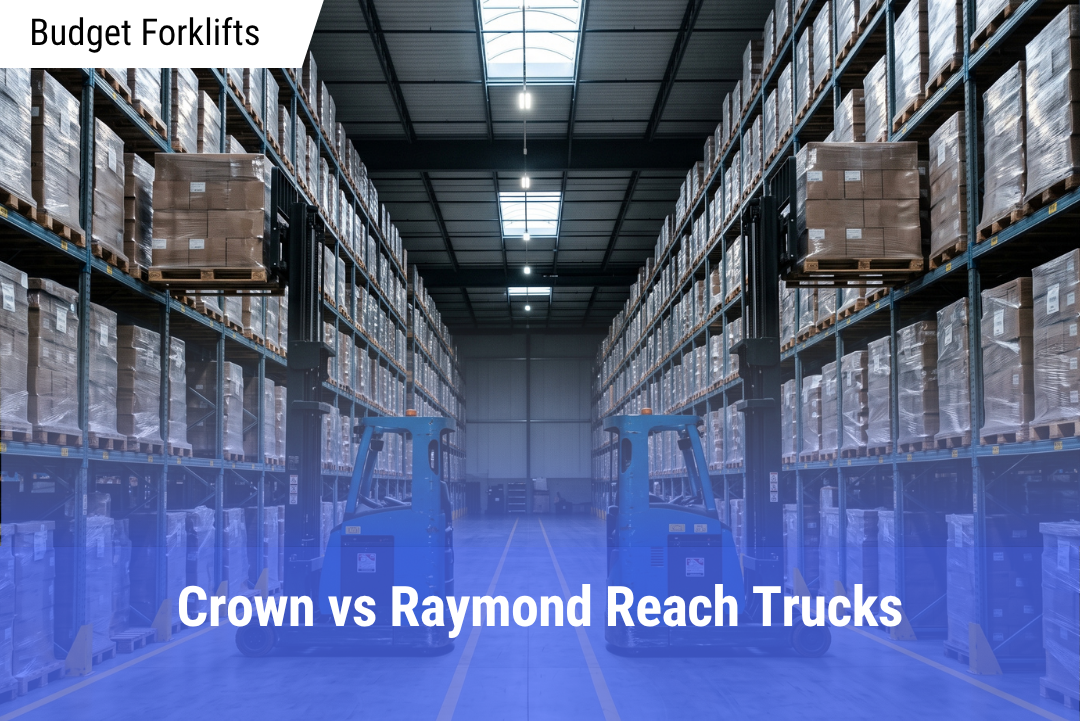
Crown vs Raymond Reach Trucks

If you run narrow aisle racking in North America, your reach truck decision usually comes down to two names. Crown and Raymond have split this category for decades, and both build a genuinely good machine. That is exactly why the choice is hard. Nobody is going to talk you out of either one on quality grounds.

I sell and service used lift trucks for a living, so I see both brands after the shine wears off. This comparison is written from that side of the fence: what actually separates them, what the spec sheets do and do not tell you, and what changes when you are buying secondhand instead of new.

Table of Contents

What is the difference between a Crown and a Raymond reach truck?

The core difference is mast architecture. Crown builds a single MonoLift mast offset to the operator’s left, while Raymond builds a dual upright open view mast the operator looks through. Almost every other difference between these two trucks traces back to that one engineering decision. Crown’s MonoLift mast on the RM and RMD Series uses a boxed cross section instead of two channels. Crown’s argument is that a single rigid mast twists and flexes less than a pair of uprights when a heavy load is extended at height, and that offsetting it to one side gives the operator a clear window instead of two posts in the middle of their sightline. In practice, operators who have never run one need about half a shift to stop looking for the mast where they expect it to be. Raymond takes the opposite approach. The open view mast keeps the dual upright layout but opens the sightline through it, so the operator has a direct line to the baselegs, the forks, and the rack face. Raymond pairs that with what it calls Universal Stance, which gives the operator three standing positions instead of locking them into one. Crown offers both stand up and sit down operator compartments across the RM and RMD line. Neither approach is wrong. Crown is betting on rigidity and a clean window to one side. Raymond is betting on a familiar layout with the obstruction reduced. Which one your operators prefer is worth finding out before you commit a fleet, and it is one of the better reasons to run a short term forklift rental on each brand before you sign anything. If you are still deciding whether a reach truck is even the right machine, that question comes first. Our breakdown of a reach truck vs a counterbalance forklift covers where each one earns its keep.

How high and how heavy can each brand lift?

Both brands lift to 505 inches and both rate 4,500 pounds on single reach and 3,200 pounds on deep reach. The practical spread is narrow, and it sits in mast configuration rather than headline capacity. Crown’s RM 6000S and RMD 6000S sit down models reach 505 inches, while the stand up RM 6000 and RMD 6000 top out at 400 inches. Raymond’s 7530 High Capacity Reach-Fork truck lifts 4,500 pounds and carries 2,000 pounds to 505 inches, with a maximum elevated mast height of 542 inches. Watch that distinction. Elevated height is how tall the mast stands when fully extended, not how high the forks go. It matters for clearing sprinklers, ceiling steel, and dock door openings, and it is the number that trips people up most often when they are speccing against an existing building. The rest of the Raymond reach lineup steps down from there. The 7500 rates 3,500 to 4,500 pounds at 444 inches elevated, the 7300 covers 372 inches, and the 7200 handles lighter duty at 270 inches on 24 volts instead of 36.
Crown RM 6000 Crown RM 6000S Raymond 7500 Raymond 7530
Configuration Stand up, single reach Sit down, single reach Stand up, single reach High capacity, single or deep
Rated capacity 4,500 lb 4,500 lb 3,500 to 4,500 lb 4,500 lb
Max lift height 400 in 505 in Not published as lift height 505 in at 2,000 lb
Max elevated height Not published separately Not published separately 444 in 542 in
Head length 56 to 60.4 in 62.4 to 64.9 in Varies by battery compartment Varies by battery compartment
Power 36V, 930 to 1,240 Ah 36V, 930 to 1,395 Ah 36V 36V
Deep reach versions of both brands drop to 3,200 pounds. That is not a Crown or Raymond limitation, it is physics. Extending a pantograph two pallets deep moves the load center out and the rated capacity comes down to match. If capacity derating at height is new to you, it is all written on the machine itself, and reading a forklift data plate is the fastest way to check what a specific unit is actually rated for. The same principle governs how much weight a forklift can carry at any load center.

Which reach truck needs a narrower aisle?

Head length drives aisle width, and the tightest configurations of both brands land within about two inches of each other. That gap is small on paper and expensive across a full building. Head length is the distance from the back of the truck to the front of the load backrest, and it is the single dimension that decides how tight you can build your rack. Aisle dimension work published by Lean Inc in May 2025, measured against a consistent 384 inch top beam and 40 by 48 inch pallets, put Crown’s RR5725 at 58.04 inches of head length needing a 118.04 inch minimum rack to rack aisle, Crown’s RM 6025 at 60.4 inches needing 120.4 inches, and Raymond’s 7520 with an 18.12 inch battery compartment at 62.2 inches needing 118 inches. The detail worth stealing from that analysis has nothing to do with brand. Stepping the Raymond 7520 from an 18.12 inch battery compartment up to a 21.12 inch compartment added three inches to the head length and pushed the minimum aisle from 118 inches to 121 inches. A bigger battery bought more runtime and cost aisle width. If your building was laid out on a ten foot aisle grid, that single option code breaks the layout. This is where I have seen the most expensive mistakes get made, and it is almost never a brand problem. Someone specs a truck around a capacity number, the battery option gets upsized late in the order for runtime reasons, and nobody rechecks the aisle math against rack that is already anchored to the floor. Measure your existing rack to rack dimension before you shop, not after. If the building is not built yet, decide the truck first and lay the rack to it. Battery compartment sizing is also where power chemistry enters the conversation, because a lithium pack changes both the runtime math and the physical envelope. Our comparison of lithium ion vs lead acid forklift batteries walks through that tradeoff in detail.

Which brand gets more pallets per battery charge?

Both manufacturers publish third party test results that favor themselves, so treat every efficiency claim from either side as directional rather than settled. Read the claims, then verify on your own floor. Raymond states that in third party testing its 7500 Reach-Fork truck delivered 9% faster cycle times than competing narrow aisle forklifts and used as much as 21% less energy, and that regenerative lowering returns up to 10% of used amps to the battery. Crown counters with regenerative lowering of its own plus Xpress Lower, which raises top lowering speed from 110 feet per minute to 240 feet per minute using no additional energy, on the logic that half your cycle is spent coming down empty. Here is the part no spec sheet will tell you. Both of those studies were commissioned by the company quoting them, both were run on a closed course, and neither was run in your building with your operators, your floor condition, your rack heights, and your pick profile. I am not calling either manufacturer dishonest. I am saying a 9% cycle time advantage measured on a 100 foot test loop does not survive contact with a warehouse where the real constraint is how long operators wait at the dock. What actually moves battery performance in a used fleet is rarely the truck. It is charging discipline, watering, and whether the pack has been deep cycled for years. If you are inheriting batteries with a used purchase, read up on what causes forklift battery failures and how long a forklift battery lasts before you assume the pack has life left in it. A tired battery will erase any cycle time difference between these two brands several times over.

Which reach truck is cheaper to maintain?

Raymond leans on longer service intervals and simpler components, Crown leans on faster wear part replacement. Your real cost tracks your local dealer more closely than either spec sheet. Raymond publishes 500 hour scheduled maintenance intervals, a control handle built with 35 parts that it states is 61% fewer than competing models, and ductile iron baselegs it rates 30% stronger than steel. Crown attacks the same problem from the wear side with a quick change load wheel assembly it says lets a technician swap wheels in 2.5 minutes against 30 to 40 minutes for a traditional replacement, plus OnTrac anti slip traction control to cut tire spin during acceleration and braking. Both sets of numbers are real. Both are also selectively chosen. Raymond is measuring how often you touch the truck, Crown is measuring how long each touch takes. From the service side, the items that actually generate work orders on either brand are the same short list: load wheels and drive tires, mast chains and rollers, hydraulic hoses at the reach carriage, contactors, and control handle wiring on high hour units. Reach trucks eat load wheels because they carry the load out over them all day, so when to replace forklift tires is worth knowing cold regardless of which badge is on the counterweight. The variable that beats every published maintenance stat is how far away your nearest tech is and whether parts sit on their shelf. A truck with a four hour response time and same day parts will cost you less over five years than a technically superior truck with a two day wait, every time. Before you choose a brand, find out which one is genuinely supported in your area. If you have not built a cost model yet, our guide on how to choose the right forklift for your warehouse covers what belongs in it.

Do operators need retraining if you switch from Raymond to Crown?

Yes, and it is a legal requirement rather than a nice to have. OSHA requires refresher training and evaluation whenever an operator is assigned to a different type of truck, which means a brand switch carries a training cost you should price into the purchase. Under the powered industrial truck standard at 29 CFR 1910.178(l), training has to be specific to the truck type and to the workplace where it will be operated, refresher training is triggered when an operator is assigned to a different type of truck, and every operator’s performance has to be evaluated at least once every three years regardless. Certification records need the operator name, the training date, the evaluation date, and who did the evaluating. This matters more than most buyers expect, because the differences between these two trucks are exactly the kind that change operator behavior. A Crown MonoLift mast sits where a Raymond operator’s eyes are not trained to look. Control handle layouts differ. Lowering speeds differ, and Xpress Lower in particular changes the timing of a task an operator has muscle memory for. None of that is dangerous on its own. All of it is a reason a good evaluator will want to watch that operator run the new truck before signing them off. The practical read: if you already run a fleet of one brand, adding a second brand costs you a retraining cycle, a second parts inventory, and a second diagnostic system your techs have to learn. That is not a reason to never switch. It is a reason a small price advantage on a single unit usually is not worth it, while a fleet replacement might be.

Should you buy a used Crown or a used Raymond?

On the used market, the brand matters less than the parts pipeline, the service coverage, and the condition of three specific systems. Both brands run well past a decade with maintenance, and both turn into money pits without it. Here is the order I inspect them in, and it is the same order for either badge. Mast and reach carriage first. Run the mast to full height empty and watch it. Hesitation, jerking, or drift on the way down points at cylinders, valves, or a load holding problem, and mast work is the repair most likely to exceed what the truck is worth. Extend the pantograph fully and look for slop in the linkage. On a deep reach unit, do this twice, once at floor level and once at height. Battery and compartment second. Check the pack’s age, the electrolyte levels if it is lead acid, and whether the compartment size matches what the customer’s aisle can take. I have watched more than one good deal die because the truck was fine and the battery behind it was a $6,000 replacement nobody budgeted. Confirm what charger the buyer already owns before assuming compatibility. Load wheels, drive tire, and baselegs third. Load wheels tell you how the truck was run. Flat spotted or chunked wheels on a low hour truck means it was driven hard or across bad floor. Bent or gouged baselegs mean rack strikes, and rack strikes mean the mast has taken shock loads you cannot see. The thing that kills a deal for me fastest is a hour meter that does not match the wear. A truck showing 4,000 hours with worn floorboard, a polished control handle, and fresh paint on the counterweight is telling you something the display is not. Ask for service records, and if nobody has them, price the unit as if it has none. Parts availability is the quiet advantage on both sides. Crown builds most of its own components, which tends to mean consistent parts but sourcing through Crown’s channel. Raymond operates as part of Toyota Material Handling, which gives it a deep dealer network. Neither is a problem in a metro area. In a rural location, whichever brand has the closer branch usually wins on total cost regardless of what the trucks do. Before you commit, work through the questions to ask when purchasing a used forklift, and if you are still weighing the decision at all, our new vs used forklift comparison and the numbers on the average lifespan of a forklift will tell you whether a used unit fits your run hours.

Which one should you buy?

There is no universally better truck here, so match the truck to the constraint that actually binds you. High bay racking above 400 inches. Both reach 505 inches, but Crown gets there in a sit down configuration and Raymond’s 7530 offers the taller 542 inch elevated mast. Check your building clearance before either. Tight aisle retrofit into existing rack. Measure your rack to rack dimension first, then shop head length. Both brands have configurations that fit under 120 inches, and the battery compartment option matters more than the badge. You already run one brand. Stay. The retraining requirement, the second parts inventory, and the second diagnostic platform usually cost more than the unit price difference on a single truck. Freezer and cold storage. Both build for it. Raymond runs its own cold storage test facility and offers a heated control handle and floor cushion package. Crown markets the RM 6000 heavily into freezer applications on the strength of building up rather than out. Tight budget, first reach truck. Buy on dealer proximity and truck condition, not brand loyalty. Then confirm the financing works. Our overview of forklift financing options and forklift rental cost covers both paths, and if the need is seasonal rather than permanent, renting for seasonal demand is usually the cheaper answer.

Frequently asked questions

Are Crown and Raymond reach truck parts interchangeable?

No. Masts, control handles, load wheels, and electronics are brand specific and are not cross compatible. Running both brands means carrying two parts inventories and two diagnostic systems.

Is Raymond owned by Toyota?

Yes. The Raymond Corporation operates as a subsidiary of Toyota Material Handling and is based in Greene, New York. Crown Equipment remains privately held and is based in New Bremen, Ohio.

What is a deep reach truck and do I need one?

A deep reach truck extends its forks far enough to place or retrieve a pallet stored two deep in the rack, which raises storage density without adding building. You need one only if you are running double deep racking, and it costs you capacity, since both brands drop to 3,200 pounds in that configuration.

How many hours does a used reach truck have left in it?

That depends far more on maintenance history than on hour meter reading, and a well serviced truck at 8,000 hours often outlives a neglected one at 4,000. Inspect the mast, battery, and load wheels before you trust the meter.

The bottom line

Crown and Raymond build to the same standard, so stop shopping badges and start shopping constraints. Measure your rack to rack aisle first, since head length and battery compartment size disqualify more trucks than capacity ever will. Then find out which brand has a technician close enough to reach you in half a day, because that beats every published maintenance interval over a five year hold. On the used side, condition wins outright: inspect the mast, battery, and load wheels in that order. Tell us your aisle width, top beam height, and heaviest pallet and we can narrow it to two or three trucks worth looking at. If the need is seasonal rather than permanent, it is worth knowing how to save money on forklift rentals and which forklift rental mistakes cost buyers the most first.

Share:

More Posts

Send Us A Message