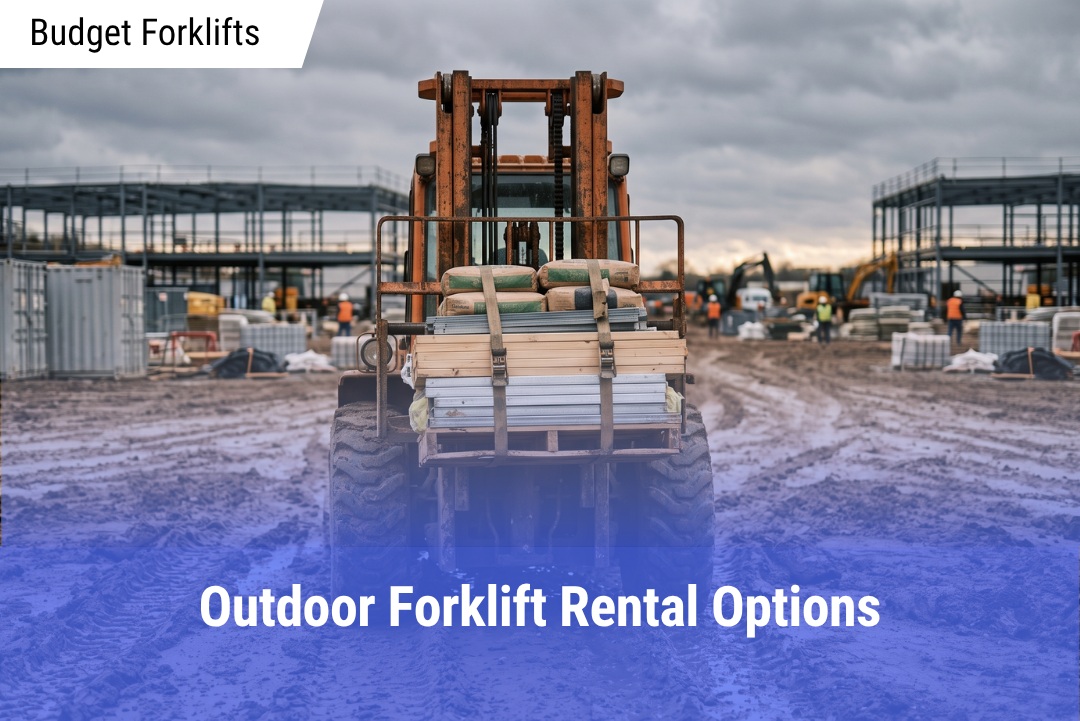
Most outdoor forklift rentals go wrong before the machine ever leaves our yard. The caller describes the load correctly, gets the capacity right, and never mentions that the pallets are going onto graded dirt that saw rain two days earlier. We deliver, the unit sinks, and the job stalls while we arrange a swap.
This guide covers what you can actually rent for outdoor work, how to match the machine to your ground conditions, and the compliance items that catch renters off guard on the first morning.
What are the outdoor forklift rental options?
Four machine types cover nearly all outdoor rentals: a vertical mast rough terrain forklift, a variable reach telehandler, a truck or trailer mounted unit, and a pneumatic tire industrial forklift for improved surfaces only. The first three are built for unimproved ground. The fourth is not, though it gets rented for outdoor jobs constantly.
OSHA groups the purpose-built machines under Class VII and identifies three basic types of rough terrain forklift: the vertical mast type, the variable reach type with a telescoping boom, and the truck or trailer mounted type that rides to the site on a carrier and unloads the delivery vehicle.
The truck mounted option is the one people forget exists. If your only outdoor need is getting freight off a flatbed at a site with no dock, you may not need a full rough terrain machine at all.
A standard pneumatic tire industrial forklift sits outside that class. It handles outdoor work on packed, improved surfaces and nothing more demanding. Deciding between machine categories follows the same logic as choosing the right forklift for a warehouse, except the surface, not the aisle width, drives the decision.
Can I rent a regular pneumatic tire forklift for outdoor work instead?
Yes, on packed gravel, compacted base, asphalt, and concrete. No, on soft dirt, mud, sand, fresh fill, grass, or any meaningful slope. The failure point is traction and ground pressure, not engine power, so a bigger standard forklift does not solve it.
This is the question we field more than any other, and the honest answer costs us the larger rental about a third of the time. If your yard drains well and stays compacted, a pneumatic tire industrial unit is cheaper, easier to transport, and perfectly adequate. If any part of the route is unimproved, it will bury itself, and the recovery costs more than the upgrade would have.
Worth noting: OSHA is explicit that the rough terrain label does not imply the forklift can be operated safely on every conceivable type of terrain. Even the purpose-built machines have limits. Ask the rental yard what surface the specific unit is rated for rather than assuming the category covers you.
Tire condition matters more outdoors than in. A rough terrain unit with worn tread loses most of its advantage on wet ground, which is one reason knowing when to replace forklift tires is worth understanding even on a rental you do not own.
Rough terrain forklift or telehandler: which one should I rent?
Rent a vertical mast rough terrain forklift for repeated pallet handling at ground level and moderate height. Rent a telehandler when you need to place a load forward of the machine, over an obstruction, or onto an elevated deck the machine cannot drive up to.
The distinction is reach, not toughness. A mast unit lifts straight up over its own front axle, which keeps it stable and fast for high-volume cycles. A telehandler extends a boom out in front, which is the only way to set material on a second-floor deck or across a trench, but every foot of extension reduces what it can safely carry.
| Machine type | Best surface | Typical rental capacity | Reach behavior | Main trade-off |
| Vertical mast rough terrain | Dirt, gravel, mud, mild slope | 5,000 to 12,000 lb | Straight up, over the front axle | No forward reach at all |
| Telehandler (variable reach) | Dirt, gravel, mud, uneven grade | 5,000 to 23,000 lb | Extends forward and up | Capacity drops sharply as the boom extends |
| Truck or trailer mounted | Improved to lightly unimproved | 2,000 to 6,000 lb | Short, ground level | Small capacity, unloading duty only |
| Pneumatic tire industrial | Packed gravel, asphalt, concrete | 3,000 to 15,000 lb | Straight up | Gets stuck on anything soft |
If you go with a telehandler, read the load chart before you commit, not after delivery. A machine advertised at 8,000 lb may be rated at a fraction of that with the boom fully extended, which is the same load-versus-distance relationship explained by the fulcrum principle on a forklift.
What capacity and lift height should I rent for an outdoor job?
Size the rental to your heaviest single load at the height you will actually lift it, not to your average load. Undersizing is the most common ordering error we see, and it usually happens because the caller averages instead of taking the worst case.
Two adjustments matter outdoors. First, add margin for load shift on uneven ground, because a load that sits fine on a flat slab moves on a rutted site. Second, account for attachments. Anything hung off the carriage changes the load center and reduces net capacity, whether that is a fork positioner or a boom extension.
When callers are unsure, we ask three questions: what is the single heaviest thing you will pick, how high does it need to go, and how far from the mast will its center of gravity sit. Those three answers determine the machine. If you want to run the math yourself before calling, start with how much weight a forklift can carry and work back from your worst case.
Diesel, propane, or electric for an outdoor rental?
Diesel is the default for outdoor rough terrain rentals because it delivers the torque and hydraulic power the work demands and runs as long as you keep fuel in it. Fuel type becomes a compliance issue only when the machine enters a trailer, a container, or any partially enclosed space.
That caveat catches people. A diesel or propane unit loading a dry van from the outside is fine. The same unit driven inside the van and left idling is a different situation, because OSHA notes that internal combustion forklifts can produce high levels of carbon monoxide in enclosed work areas and assigns specific designations, including D, DS, LP, and LPS, that govern where each type may operate. If your outdoor job includes any trailer loading, tell the rental yard up front.
Electric rough terrain options exist but remain limited in most rental fleets, and runtime on a full outdoor shift is the practical constraint rather than capability. If you are weighing power sources for a longer term need, the trade-offs in electric versus diesel forklifts and electric versus propane apply to outdoor units too, with runtime weighted more heavily.
Do my operators need new certification to run a rented rough terrain forklift?
In most cases yes. OSHA treats a rough terrain forklift as a distinct truck type, so a crew certified only on the sit down counterbalanced riders they run indoors is not automatically covered when a rough terrain unit arrives.
The agency addressed this directly in a letter of interpretation confirming that a sit down counterbalanced rider truck and a rough terrain forklift are different types of trucks for training purposes. Operators trained on one type do not need retraining for the same type from a different manufacturer, but they do need additional training when the truck-related and workplace-related topics differ. Moving a warehouse operator onto a diesel rough terrain machine on graded dirt changes both.
We cover machine-specific familiarization at delivery: controls, load chart, stability behavior, and the particular quirks of the unit being dropped. That is not the same as operator certification, and we say so plainly. Certification remains the employer’s obligation, and delivery day is a poor time to discover the gap. Skipping this step is high on our list of forklift rental mistakes that turn a straightforward rental into a stopped job.
What should I check when the rental machine arrives on site?
Confirm the rated capacity plate is present, legible, and matches the machine you ordered, and verify that any attachment came from the manufacturer with written approval. Both are regulatory requirements, not preferences, and both are easiest to catch before the driver leaves.
Federal construction rules require that lift trucks havethe rated capacity clearly posted and visible to the operator, and they prohibit modifications or additions affecting capacity or safe operation without the manufacturer’s written approval. If an attachment changes the rating, the capacity plate has to reflect it. A faded or missing plate on arrival is grounds to refuse the unit.
Our drivers walk three items with the customer before leaving: the data plate and its capacity at the intended load center, the tire condition against the site’s actual ground, and the fuel or charge state with the refueling arrangement confirmed in writing. If you are unsure what you are reading on that plate, how to read a forklift data plate walks through each field.
How do I run an outdoor rental safely on slopes and soft ground?
Keep the load pointed up the grade regardless of which direction you are driving, and never turn while on the incline. Turn before you reach it, position the forks, then travel.
OSHA’s guidance on traveling on ramps and grades sets out the pattern: loaded, you drive forward going up and in reverse coming down, with the forks pointed upgrade both times. Empty, the forks point downgrade, so you reverse up and drive forward down. The standard also directs operators to stay clear of the ramp edge and to avoid slopes exceeding the manufacturer’s recommendation, which is a number worth pulling off the machine rather than estimating.
On soft ground, the practical additions are to keep the load low while traveling, avoid spinning the drive wheels, and plan a route that does not require a loaded turn on a side slope. Most of the outdoor tipovers we hear about involve a turn that should have happened thirty feet earlier.
How long should I rent, and when does buying make more sense?
Daily and weekly terms suit defined-scope jobs with a firm end date. Monthly terms change the math considerably, and once you are renewing month after month with no end in sight, you are financing a machine you will never own.
The threshold we quote is roughly six to eight consecutive months of full-time outdoor use. Below that, renting almost always wins because you avoid maintenance, storage, transport between sites, and the cost of owning specialized equipment you use seasonally. Past it, the monthly total starts to resemble a payment, and the conversation should shift.
Seasonal work is the clearest case for renting rather than buying, and renting a forklift for seasonal demand lays out why a machine that sits idle nine months a year rarely justifies purchase. For shorter jobs, the advantages compound quickly, as covered in short term forklift rental benefits and the direct comparison of long term versus short term rental.
Budget the transport separately. Delivery and pickup on a rough terrain unit or telehandler costs real money because the machine needs a heavy trailer, and it is the line item renters most often forget. Current drivers of the total are broken down in forklift rental cost, and there are practical levers in how to save money on forklift rentals.
If the math does push you toward ownership, weigh it deliberately rather than by default. New versus used forklift and forklift financing options are the right starting points, and anyone shopping used should work through the questions to ask before buying a used forklift first.
Frequently asked questions
Is transport included in an outdoor forklift rental?
Usually not. Delivery and pickup are quoted separately for rough terrain machines and telehandlers because they require a heavy trailer, so confirm both legs in writing before you book.
Does a telehandler require different certification than a mast rough terrain forklift?
Often yes. The variable reach boom introduces load chart behavior and stability characteristics the mast unit does not have, which is exactly the kind of truck-related difference that triggers additional operator training.
Can I bring an outdoor rough terrain forklift inside a building?
Only with adequate ventilation and the correct truck designation for that location. Diesel units are built for open air, and running one inside a warehouse, container, or trailer creates a carbon monoxide hazard within minutes.
What capacity do most outdoor rentals need?
Between 5,000 and 10,000 lb covers the majority of construction, lumberyard, and outdoor storage work. Anything involving pipe, steel, or containers usually pushes into telehandler territory with higher ratings.
Getting the right outdoor rental the first time
The machines are the easy part. Match the unit to your worst ground condition rather than your average one, confirm your operators are covered for the truck type before it arrives, and check the capacity plate while the driver is still on site. Those three habits prevent most of the failed outdoor rentals we see.
If you can describe your surface, your heaviest single load, and your site’s tightest access point, any competent rental yard can put the right machine on your job. Bring those three answers to the call.