Blog Post
Is a Forklift Rental Damage Waiver a Rip-Off or Real Protection?
| | 11 min read
Is a forklift rental damage waiver worth it? Compare fees, deductibles and exclusions, and learn when to buy it or skip it before you sign.
The quote looks fine until you reach a line near the bottom: damage waiver, 15 percent. It is optional, it adds real money to the rental, and the person on the phone says most customers take it. So is it worth paying, or is it padding?
Short answer: a damage waiver is real protection when your operators are new to the machine, the rental is short, and nothing else you own covers rented equipment. It becomes an expensive add-on when your business insurance already covers rented equipment, or when the damage you are most likely to cause is excluded anyway. After years of writing rental contracts and checking in returned forklifts, we can tell you the exclusions decide which side you land on far more than the price does.
What is a forklift rental damage waiver?
A forklift rental damage waiver is an optional charge, usually a percentage of the rental rate, under which the dealer agrees not to bill you for some or all accidental damage to the machine. It limits what you owe the dealer, and it does not pay anyone else for anything.
Texas, one of the few states with a law written specifically for these agreements, defines a heavy equipment loss damage waiver in almost exactly those terms: the merchant agrees not to hold the customer liable for all or part of the damage. Nothing in that definition promises a payout. The waiver simply erases part of a bill you would otherwise owe.
Across the published waiver terms we reviewed from US and Canadian rental fleets, fees ran from roughly 10 to 16 percent of the rental rate. Deductibles ranged from $250 to $2,500 per incident, climbing higher on very expensive machines. Some plans also cap what they absorb, commonly at $2,500 or $5,000, after which the renter pays the balance up to full replacement value.
A clear quote shows the waiver as its own line, with the percentage, the deductible, and any cap written beside it. If yours shows only a dollar figure, ask for the waiver terms in writing before you sign. The waiver sits on top of the base rate, so include it when you compare forklift rental cost between dealers.
Is a damage waiver the same as insurance?
No. A damage waiver is a promise from the rental dealer not to collect from you, while insurance is a policy you hold with a carrier that pays claims, and Texas law states outright that a heavy equipment damage waiver is not insurance.
The difference matters in three practical ways. First, the waiver covers only the rented forklift. Damaged racking, a crushed pallet of product, a hole in your dock wall, or an injured worker all fall outside it. Second, a waiver claim does not touch your insurance loss history or your premiums, which is one reason some businesses buy it even when they carry coverage. Third, the reverse is not automatic: many general liability policies exclude property in your care, custody, or control, and a rented forklift fits that description.
The disclosure notice required under the Texas damage waiver statute makes the same point to renters: before buying, check whether your own policies already cover the rented equipment and what deductible you would pay under them. Good advice in any state. A five-minute call to your insurance agent before delivery day answers it.
What does a forklift damage waiver cover?
A damage waiver typically covers accidental damage that happens during normal, permitted use, such as a cracked light, a dented overhead guard, a bent mast channel, or a damaged load backrest, minus the deductible. Theft and fire are sometimes included and sometimes sold as a separate waiver.
The damage we see on returned rentals falls into a short, predictable list. Forks come back bent from prying, from lifting off-center loads, or from being used to push. Lights and mirrors get knocked off in tight aisles. Overhead guards and mast channels meet dock door headers, low beams, and sprinkler pipes. Tires get chunked on rough concrete, expansion joints, and loose debris.
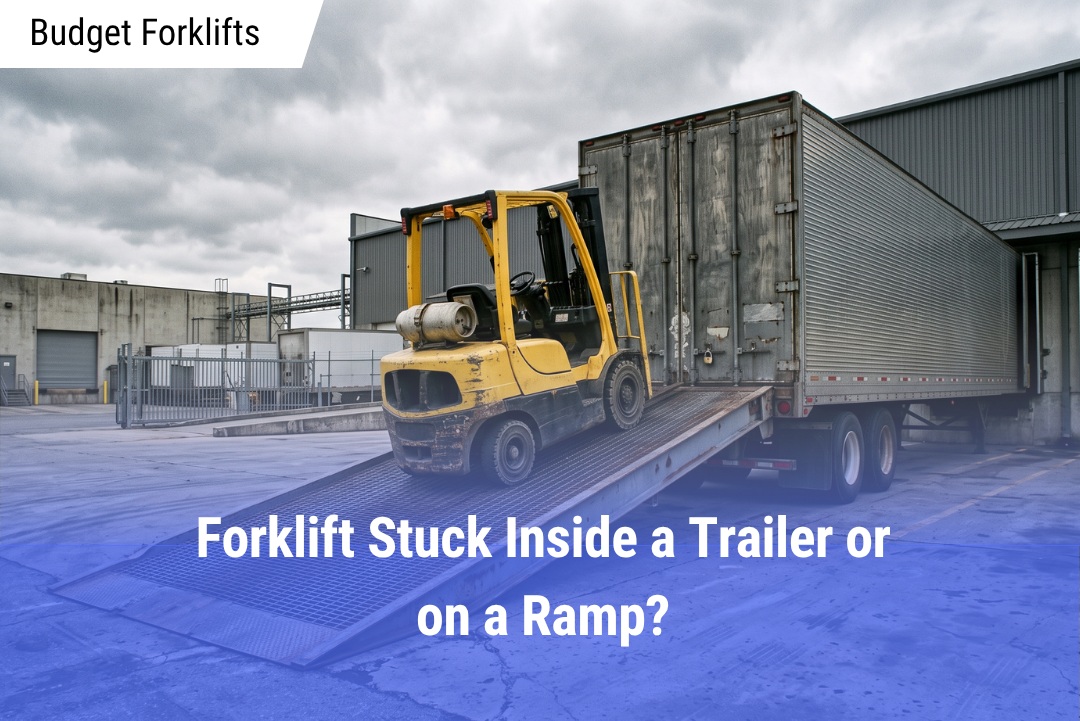
A surprising share of the serious damage happens at the dock rather than in the aisle. A trailer that creeps forward, a dock plate that is not seated, or a trailer floor that gives way can drop a front wheel and twist the mast. Before your crew starts loading, read our guide on whether a forklift can safely drive into your trailer, and know what to do if a forklift gets stuck inside a trailer or on a ramp, because forcing it out is how small incidents become large invoices.
One detail catches many renters: the deductible applies to every incident. If a bent fork costs $700 to replace and your deductible is $1,000, the waiver pays nothing and you have still paid the fee.
What does a damage waiver not cover on a forklift?
The exclusions are where a waiver earns or loses its value. Overloading, tire and wheel damage, untrained operators, skipped daily inspections, and poor maintenance are common carve-outs, and almost every one of them lines up with a federal forklift safety rule.
Dealers did not invent these exclusions at random. Each one mirrors a requirement in OSHA's powered industrial truck standard, which means the same mistake that breaks the rule usually voids the waiver:
- Overloading. OSHA allows only loads within the truck's rated capacity. Damage from lifting beyond the rating is excluded in nearly every waiver we have read. Learn to read the forklift data plate and check how much weight a forklift can carry at your actual load center and lift height.
- Untrained or unauthorized operators. OSHA requires every operator to be trained and evaluated before driving. Waivers commonly apply only to operators authorized by the renter, and a claim gets harder to defend when nobody can produce forklift inspection and training records.
- Skipped inspections and running a damaged truck. OSHA requires an examination at least daily before use and requires a defective truck to be taken out of service. A hydraulic leak reported on day one is a dealer repair. The same leak run until the lift cylinder fails often becomes a maintenance failure on your side of the contract.
- Tires and wheels. Many plans exclude them outright. Know when forklift tires need replacing so you can document their condition at delivery.
- Battery neglect. On electric rentals, a battery ruined by low electrolyte or improper charging is a maintenance issue, not an accident. If your rental terms put watering on you, follow the steps for how to water a forklift battery.
- Disappearance and deliberate damage. Missing equipment with no police report, abandonment, and intentional damage are excluded almost universally.
The conversation we have most often after a damaged return is about a load that weighed more than the operator thought. A pallet of mixed product with no weight on the label goes up, the rear wheels go light, and the forks or mast take the strain. Once the numbers show the load exceeded the data plate rating, the waiver no longer applies, and the renter is looking at the full repair bill.
Is a forklift damage waiver worth it?
Compare the waiver fee plus the deductible against what you would realistically pay without it. On short rentals with new or mixed operators, the waiver usually pays for itself; on long rentals with certified operators and equipment coverage on your own policy, it often does not.
The table below runs four common damage scenarios on a standard 5,000 lb counterbalance forklift. It assumes a one-week rental at $500, a 15 percent waiver ($75), and a $1,000 deductible. Repair ranges reflect what we typically see in parts and labor; your dealer's rates will differ.
| Damage scenario | Typical repair | You pay with waiver | You pay without waiver | Verdict |
|---|---|---|---|---|
| Bent or cracked fork | $500 to $1,500 | $575 to $1,075 | $500 to $1,500 | Small savings at best |
| Chunked or blown tire | $200 to $600 | $275 to $675 (usually excluded) | $200 to $600 | Waiver adds cost |
| Overhead guard or mast strike | $3,000 to $8,000 | $1,075 | $3,000 to $8,000 | Waiver wins |
| Tip-over from overloading | $10,000 and up | $10,075 and up (overload excluded) | $10,000 and up | Waiver does nothing |
The pattern is clear. A waiver does little for small damage below the deductible and nothing for excluded damage. Its real value sits in the middle: a large, genuinely accidental hit to the mast, guard, or frame that would otherwise cost thousands.
Rental length changes the math too. For short-term forklift rentals, the fee is small and the operators are often unfamiliar with the truck, so the waiver tends to earn its keep. On a six-month contract, a 15 percent fee compounds every month, and a rented-equipment endorsement on your own policy may cost less. Weigh it as part of long-term versus short-term rental planning, especially when renting a forklift for seasonal demand means temporary staff on the seat.
Can a rental company make you buy a damage waiver?
In Texas, no: state law bars dealers from requiring a heavy equipment damage waiver as a condition of renting, requires your written agreement, and requires the total charge to be stated. Outside Texas, including Illinois, we are not aware of an equivalent statute, so the rental contract controls.
The Texas heavy equipment waiver law, in force since 2015, goes further than most renters realize. The contract must include a notice saying the waiver is optional, and the law limits what a Texas waiver may exclude to three situations: unexplained disappearance or abandonment, damage the customer causes intentionally, and willful or wanton misconduct. A dealer that violates the chapter faces a civil penalty of $500 to $1,000 per violation.
Everywhere else, read the contract. In practice, most dealers ask for one of two things before a forklift leaves the yard: buy the waiver, or provide a certificate of insurance that covers the rented equipment and names the dealer. If you have that certificate ready before you call, declining the waiver is usually a short conversation.
When should you skip the damage waiver?
Skip it when your business policy already covers rented equipment with a deductible lower than the waiver's, and your operators are trained, certified, and inspecting the truck every shift. In every other case, declining it means you are carrying the full risk on a machine worth tens of thousands of dollars.
Run through this check before you decline:
- Your insurer has confirmed in writing that rented equipment is covered, and you know the deductible.
- Every operator has completed the training and evaluation OSHA requires for forklift operators, and you can produce the certification.
- Pre-shift inspections are written down, not assumed.
- Your loads are weighed or labeled, and they sit well inside the truck's rated capacity.
- The work area is flat, clear, and free of tight dock or trailer moves.
The customers who get burned by declining are rarely reckless. More often they bring in temporary workers for a busy month, assume their general liability policy covers the truck, and never photograph it at delivery. Those three habits sit near the top of our list of common forklift rental mistakes, and any one of them can turn a saved fee into a five-figure invoice.
Frequently Asked Questions
How much does a forklift damage waiver cost?
Most published dealer terms set the fee between roughly 10 and 16 percent of the rental rate. Check the deductible and any coverage cap as well, because a low fee paired with a high deductible protects you from very little.
Does a damage waiver cover forklift tires?
Usually not, since tire and wheel damage is one of the most common exclusions. If your floors are rough or littered with debris, ask about the right tire type before delivery instead of counting on the waiver.
What happens if I damage a rented forklift without a waiver?
You are billed for the repair, and if the truck is beyond repair, you can owe up to its replacement value. Report damage right away and stop using the truck, because running it damaged usually makes the bill larger.
Should I photograph the forklift at delivery?
Yes. Photograph every side, the forks, the tires, the mast, and the hour meter before the first lift, because those photos settle most disputes about damage that was already there.
Conclusion: Neither a Rip-Off Nor a Blank Check
A forklift damage waiver is not a scam, and it is not full protection either. It is a narrow agreement that pays off on large, accidental damage and does almost nothing for small dents, tires, overloads, or neglect. Whether it is worth the fee depends on three things you can check before delivery day: what your own insurance covers, who will be driving, and what loads they will lift.
If you can answer all three with confidence, declining may save money. If any answer is uncertain, the waiver is cheap compared with the bill it can prevent. Either way, read the exclusions before you sign, because they decide your outcome far more than the percentage on the quote does.
Related articles
Blog Post
Forklift Rental Cost: A Complete Guide to Planning Your Budget (2026)
Renting a forklift in 2026 costs roughly $150 to $250 per day, $450 to $900 per week, or $1,100 to $2,400 per month for a standard 5,000-lb machine, with heavy-duty and rough terrain units running higher. Those numbers are the starting point, not the final invoice. The rental rate is often the first thing warehouse […]
April 5, 2026
Blog Post
Can a Forklift Safely Drive Into Your Trailer? Floor Rating Explained
Can a forklift drive into a trailer safely? Yes, but only after the floor has been inspected, the trailer wheels are chocked, and the gap between the dock and the trailer has been checked. Skip any one of those three steps and “safe” turns into a guess. Warehouses run this move dozens of times a […]
September 17, 2026
Blog Post
Forklift Stuck Inside a Trailer or on a Ramp? Here’s the Safe Way Out
A forklift that won’t move inside a trailer, or one that’s hung up halfway down a ramp, is one of the most common emergency calls a dealer gets. It’s rarely a mechanical breakdown. Most of the time the forklift is fine. What’s actually happened is a floor, a ramp, or a trailer position problem that […]
September 19, 2026