Also called a capacity plate or nameplate, this small tag is the official record of what the forklift is engineered to do. Get the numbers wrong and you risk a tip-over, a damaged load, or an OSHA citation. Get them right and you protect your operator, your equipment, and your bottom line. Here is how to read every part of it.
What is a forklift data plate?
A forklift data plate is a permanent placard that lists the machine’s rated capacity, load center, lift height, mast type, fuel type, tire size, weight, and any approved attachments. It is the manufacturer’s official statement of how the truck was built and what it can safely handle.
The terms data plate, nameplate, and capacity plate all mean the same thing. The layout changes from one manufacturer to the next, but the core safety information stays the same because OSHA and ANSI both require it. If you want the full breakdown of how lifting limits are calculated, see how much weight a forklift can carry.
Why does reading the data plate matter?
Reading the data plate prevents accidents by defining the machine’s safe operating zone. Stay inside the numbers and the load stays balanced; ignore them and the center of gravity moves outside the Stability Triangle, which is how forklifts tip.
Following the plate gives you three things:
- Operator Safety: It keeps the combined center of gravity inside the Stability Triangle, where the machine stays stable.
- Legal Compliance: Under OSHA 1910.178, all nameplates and markings must be kept in place and maintained in a legible condition, so running a forklift with a missing or unreadable plate is a straightforward violation.
- Asset Protection: It keeps the motor, hydraulics, and mast from being overworked, which extends the life of the machine.
Where is the forklift data plate located?
On most lift trucks the data plate is riveted to the dashboard or instrument panel near the hydraulic controls, where the operator can see it easily. It is built to stay with the machine for its whole service life.
If it is not on the dash, check the cowl near the operator’s seat or the chassis frame by the engine compartment. If the plate is missing or you cannot read it, the forklift is out of service until the manufacturer supplies a replacement. Never operate on memory or a seller’s word.
What do the terms on the data plate mean?
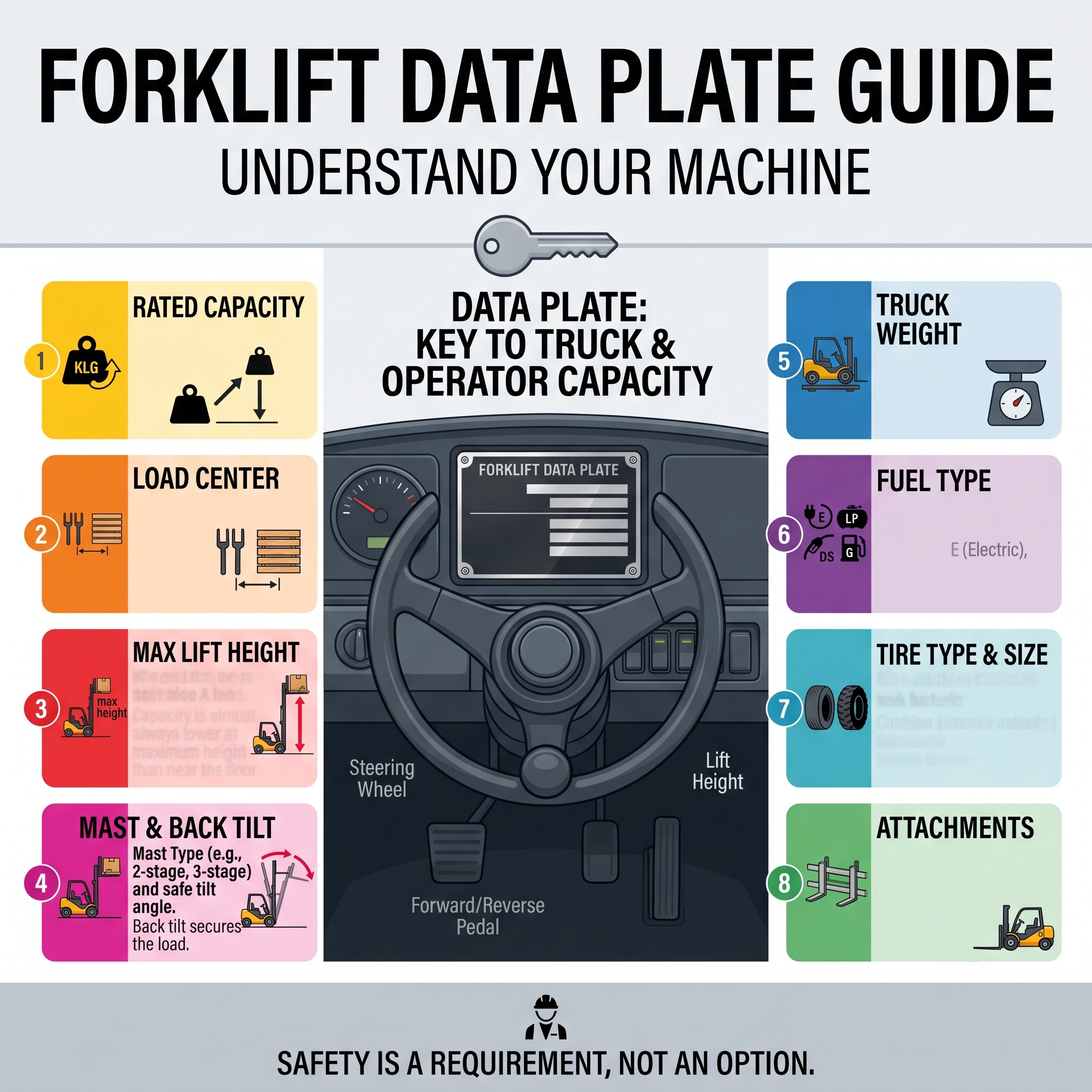
The data plate uses a handful of key terms that decide whether a lift is safe. Learn these and the rest of the plate falls into place.
- Rated Capacity: The maximum weight the forklift can lift at a specific load center and lift height. It is not a single number; it drops as you lift higher or add an attachment.
- Load Center: The distance from the face of the forks to the center of gravity of the load. Most standard forklifts are rated at a 24 inch load center, which assumes a balanced 48 inch pallet. A longer or uneven load pushes that center out and cuts your capacity instantly.
- Maximum Lift Height: The highest the mast can raise a load. Capacity at the top of the mast is almost always lower than capacity near the floor.
- Mast and Back Tilt: The mast type (2-stage, 3-stage, or 4-stage) and how far it tilts back toward the operator to keep a load secure.
- Truck Weight: The weight of the forklift with no load. On an electric machine this may be listed with and without the battery, which matters for your floor and trailer ratings.
- Fuel Type: How the machine is powered, usually abbreviated as E (electric), LP (liquid propane), DS (diesel), or G (gasoline).
- Tire Size and Type: The size and type the truck was built for. Cushion tires suit smooth indoor floors, while pneumatic tires handle rough outdoor ground.
- Attachments: Any factory-approved attachment included in the capacity rating. An attachment that is not listed changes your true limit.
How do you read the load capacity chart?
The load capacity chart shows your real lifting limit at different heights and load centers, not just the single big number on the front of the plate. Read across the row that matches your actual lift height and load center, and that figure is the most weight you can safely carry.
For example, a plate might show a chart like this:
| Lift Height | Load Center | Rated Capacity |
|---|---|---|
| 100 in | 24 in | 5,000 lbs |
| 187 in | 24 in | 4,200 lbs |
| 240 in | 24 in | 3,400 lbs |
| 187 in | 36 in | 3,300 lbs |
Read it carefully. The same truck that lifts 5,000 lbs near the floor may only handle 3,400 lbs at full mast height, and a longer load that moves the load center from 24 to 36 inches drops it further still. Always match the chart to the lift you are about to make, not the headline number.
What is derating, and what causes it?
Derating is the drop in safe lifting capacity caused by lifting higher or adding weight to the front of the machine. The plate already accounts for it, which is why the chart matters more than the maximum number.
Two factors drive it:
- Lift Height: As the mast goes up, the machine becomes less stable, so the safe weight comes down.
- Attachments: Adding a side-shifter, paper roll clamp, or fork extensions adds dead weight and pushes the load center forward, which physically reduces what you can carry.
How does an attachment change the data plate?
Adding an attachment derates the forklift by adding weight to the front and shifting the load center further out, which pulls the center of gravity away from the Stability Triangle. Because of that, the original capacity number no longer applies.
Per OSHA’s nameplate rules under the powered industrial truck standard, modifications that affect capacity or safe operation need the manufacturer’s written approval, and the truck must carry an updated plate that lists the Capacity with Attachment. That second figure, not the original rating, is your real limit once the attachment is on.
How to check the data plate before every shift
Before each shift, confirm the plate is present, legible, and matches the machine and the job in front of you. A two minute check prevents the most common cause of tip-overs.
- Identify the Model and Serial Number: Match the plate to the specific machine, and use these numbers when ordering parts or requesting service.
- Verify the Truck Weight: Confirm the total weight, including the battery, is safe for your floor and any trailer you load onto.
- Match the Capacity Chart to the Lift: Check your load weight, load center, and lift height against the chart, not the headline number.
- Confirm Attachments are Listed: Make sure any clamp, side-shifter, or extension on the truck appears on the plate with its own capacity figure.
If you are sizing up a machine to purchase, the same habit applies. Run through the plate the same way when checking the data plate before buying a used forklift, and pair it with the right questions to ask when buying a used forklift.
The bottom line
The forklift data plate is the most important safety tool in your warehouse. By reading it before every shift, you keep loads inside the Stability Triangle, stay OSHA-compliant, and make your equipment last longer.
If your machine is missing a plate, or has new attachments that are not listed, the team at Illinois Industrial Equipment, Inc. can provide the technical support and updated plates you need to keep your fleet safe and compliant. We also carry a full range of inspected used forklifts for sale ready to work.