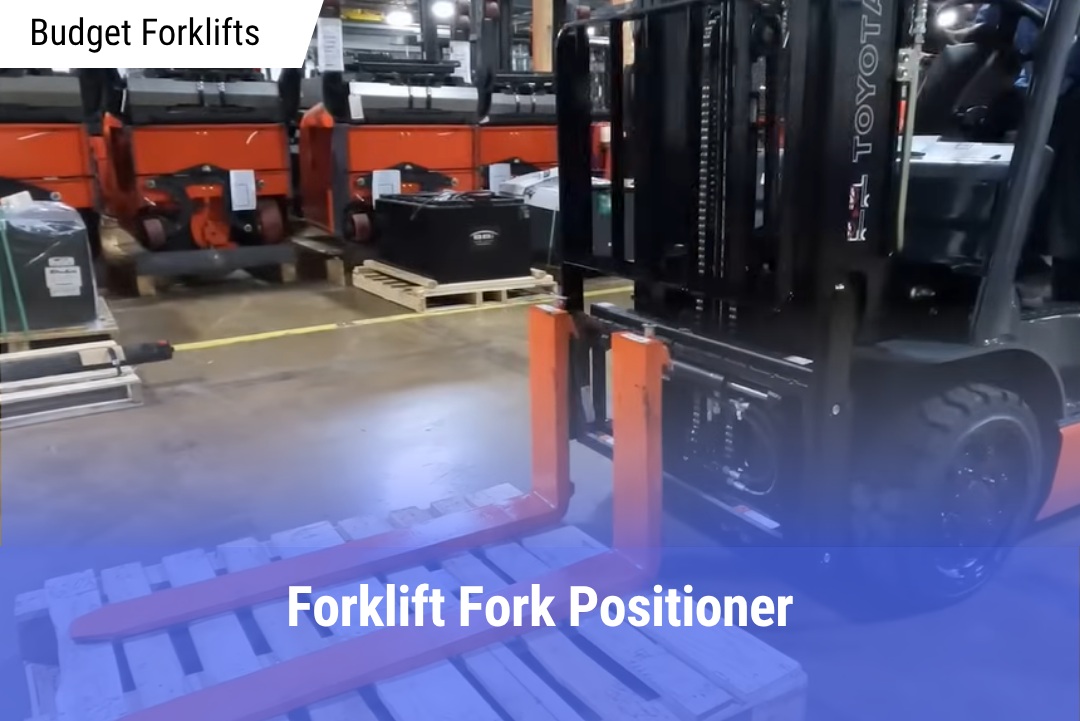
A fork positioner is a hydraulic attachment that lets an operator widen or narrow the forks from the driver’s seat instead of getting out to move them by hand. The main benefits are faster load handling, less product damage, reduced manual strain on operators, and the ability to run one truck across a wider mix of pallet sizes.
We spend a lot of time on the phone with warehouse managers who are trying to decide if a positioner is worth adding to a truck, so this guide covers what the attachment actually does, what it changes about your forklift’s capacity, and how to tell if it fits your operation.
Table of Contents
What Does a Forklift Fork Positioner Do?
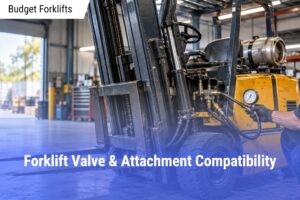
A fork positioner uses hydraulic cylinders built into the carriage to slide both forks inward or outward at the same time, controlled by a lever or auxiliary hydraulic function in the cab. The operator sets the fork spread to match the pallet or load in front of them without stepping off the truck.
Most positioners mount on the standard carriage of a reach truck or counterbalance forklift and replace the fixed fork-hanger bar with a sliding one. Hydraulic models are the most common type on the market and typically adjust fork spread in a matter of seconds. Mechanical, chain-driven positioners exist for lighter-duty applications but require more manual input than hydraulic units.
Warehouses that handle a narrow range of pallet sizes, like a single-SKU beverage operation, often don’t need one. Facilities juggling mixed pallet widths, non-standard crates, or seasonal SKU changes get the most use out of the attachment.
How Does a Fork Positioner Improve Warehouse Safety?
A fork positioner keeps operators seated and belted in instead of climbing down to manually shift heavy steel forks into place. Manual material handling is a documented driver of workplace injury, and the CDC’s National Institute for Occupational Safety and Health notes that manual material handling contributes to a large share of the musculoskeletal disorders reported in the U.S. workforce each year, most of which involve strains to the back, shoulders, and upper limbs.
On the shop floor we hear the same complaint from fleet managers every time a truck comes in for service without a positioner: operators dismount to wrestle forks into position on loads that don’t match standard spacing, and that habit is exactly the kind of repetitive, awkward lifting that leads to strain injuries and workers’ comp claims over time. Adding a positioner doesn’t just save time, it removes a task that operators were never supposed to be doing by hand in the first place.
There’s also a secondary safety benefit: an operator who never leaves the seat never has to re-mount a moving truck, which cuts down on slip-and-fall risk around the cab and steps.
Does a Fork Positioner Reduce Product Damage?
Yes. Precise, repeatable fork spacing means the forks land where they’re supposed to on the first try instead of skewering, crushing, or catching the edge of a pallet. A vice president at attachment manufacturer Bolzoni told Modern Materials Handling that manually adjusting heavy steel forks, or leaving them unadjusted and trying to wiggle them into position, is exactly the kind of handling that leads to damage, while a hydraulic positioner lets the operator hit a lever instead.
That tracks with what we see when trucks come back for inspection. Damage tends to cluster around two failure points: forks set too wide for a narrow pallet, which lets the load rock and shift in transit, and forks set too narrow for a wide pallet, which puts uneven pressure on one side and can crack a pallet deck or dent a carton corner. A positioner that’s dialed in correctly for the load in front of it removes both failure points, because the adjustment happens before the forks ever touch the pallet, not after.
Industries handling fragile or high-value freight, like electronics, appliances, and glass, tend to see the clearest payoff here since a single damaged pallet can cost more than a season of attachment maintenance.
How Much Time Does a Fork Positioner Save Operators?
A hydraulic positioner adjusts fork spread in seconds from the cab, compared to the minute or more it takes to dismount, manually slide forks along the carriage bar, and re-mount. On a shift with dozens of mixed-size pallets, that difference adds up to a meaningful chunk of recovered handling time.
The time savings compound with load variety. An operator running the same pallet size all day barely notices the difference, but an operator switching between 40-inch and 48-inch pallets, or handling odd-sized crates on top of standard pallets, saves real minutes every time they don’t have to get out of the seat. Facilities that run short-term forklift rentals for seasonal demand often ask us to spec a positioner on the rental truck specifically because seasonal SKUs rarely match their standard pallet footprint.
If you’re comparing the cost of adding the attachment against the labor hours it saves, our advice is to track how many times an operator currently dismounts per shift to adjust forks manually. That number, multiplied by even 60-90 seconds per adjustment, usually makes the case on its own.
Fork Positioner vs. Side Shifter: What’s the Difference?
The two attachments solve different problems and are often mounted together on the same carriage.
| Feature | Fork Positioner | Side Shifter |
| What it moves | The forks themselves, spreading them wider or narrower | The entire carriage and both forks together, left or right |
| Solves for | Different pallet or load widths | Aligning forks with a pallet without repositioning the truck |
| Typical control | Hydraulic lever or auxiliary function in the cab | Hydraulic lever in the cab |
| Common pairing | Often combined with a side shifter on the same carriage | Often combined with a positioner on the same carriage |
| Best fit | Mixed pallet sizes, non-standard crates | Tight aisles, precise lateral placement |
Trucks that run in narrow-aisle racking with a mix of pallet sizes usually benefit from having both attachments on the same carriage, since one solves for width and the other solves for lateral alignment.
Does Adding a Fork Positioner Affect Forklift Capacity?
Yes. A fork positioner is a front-end attachment, and OSHA treats attachments as a factor that changes a truck’s rated capacity, not a cosmetic add-on. Under 29 CFR 1910.178(a)(4), modifications and additions that affect a forklift’s capacity and safe operation cannot be performed by the customer or user without the manufacturer’s prior written approval, and the truck’s capacity plate has to be updated to reflect the change.
We see one step skipped most often when a shop installs a positioner without looping in the manufacturer first: updating the capacity plate. A positioner typically adds a few hundred pounds of dead weight out at the front of the truck, which shifts the load center forward and reduces how much the truck can safely lift at full height. If nobody updates the plate, the operator is working off capacity numbers that no longer match reality. Our techs walk every customer through how to read a forklift data plate after an attachment goes on, specifically so the crew understands the new numbers before the truck goes back into service.
If you’re unsure how much weight your truck can handle with an attachment mounted, it’s worth reviewing how much weight a forklift can carry and how load center and the forklift’s fulcrum point interact before you commit to an attachment purchase.
Is a Fork Positioner Worth It for Your Operation?
It depends on how much your pallet and load sizes vary. If your operation runs the same pallet footprint day in and day out, a positioner adds cost and maintenance without much return. If you’re handling mixed SKUs, seasonal freight, or non-standard crates on a regular basis, the labor time and damage reduction usually pay the attachment off within a season or two.
Our rule of thumb when a customer asks us this question directly: count how often an operator currently has to stop and manually adjust forks in a normal shift. If it’s a handful of times a day, a positioner is a fast payback. If it’s a rare occurrence, that budget is often better spent elsewhere on the fleet.
For operations still deciding between buying new, buying used, or renting to test the fit first, it’s worth working through how to choose the right forklift for your warehouse and comparing new versus used forklift options before adding an attachment to the spec. If you’re leaning toward a used truck that already has a positioner installed, run through the key questions to ask before purchasing a used forklift so you know the attachment’s maintenance history along with the truck’s. Renting a truck with a positioner already mounted is also a low-risk way to trial the attachment. Our short-term forklift rental customers use this approach often, and comparing forklift rental cost against a purchase, or weighing long-term versus short-term rental, is a reasonable way to test whether the attachment earns its keep before you buy. If you decide to buy outright, forklift financing options can usually roll the attachment cost into the truck’s payment.
Frequently Asked Questions
What’s the difference between a hydraulic and a mechanical fork positioner?
A hydraulic positioner uses the truck’s hydraulic system to move both forks automatically from a cab-mounted control. A mechanical positioner uses a chain or screw mechanism that typically requires more manual operator input and is usually limited to lighter-duty applications.
How much capacity does a fork positioner take off a forklift?
The added weight and forward load center from a positioner commonly reduce a truck’s rated capacity by a noticeable margin, though the exact figure depends on the truck and attachment model. Always check the updated capacity plate rather than assuming the original rating still applies.
Can a fork positioner be added to any forklift?
Most counterbalance and reach trucks can be retrofitted with a positioner, but the installation still requires manufacturer approval under OSHA’s attachment rule and a properly updated capacity plate before the truck returns to service.
Do fork positioners need regular maintenance?
Yes. Hydraulic hoses, cylinders, and mounting hardware should be inspected on the same schedule as the rest of the truck’s hydraulic system, since a leak or worn bushing in the positioner can affect fork alignment and load stability.
The Bottom Line
A fork positioner earns its place on a forklift when load variety is the daily reality, not the exception. It cuts the time operators spend dismounting to adjust forks by hand, lowers the odds of a misaligned load damaging product, and takes a repetitive strain risk off the operator’s plate entirely. The trade-off is a real one too: added weight up front, a reduced capacity rating, and a manufacturer approval step that isn’t optional under OSHA’s attachment rule.
If your fleet handles mixed pallet sizes often enough that operators are already climbing down to wrestle forks into place, a positioner usually pays for itself within a season. If your pallet footprint barely changes, the money is probably better spent elsewhere on the truck. Either way, loop in your equipment provider before installation so the capacity plate and paperwork match the truck you’re actually running.