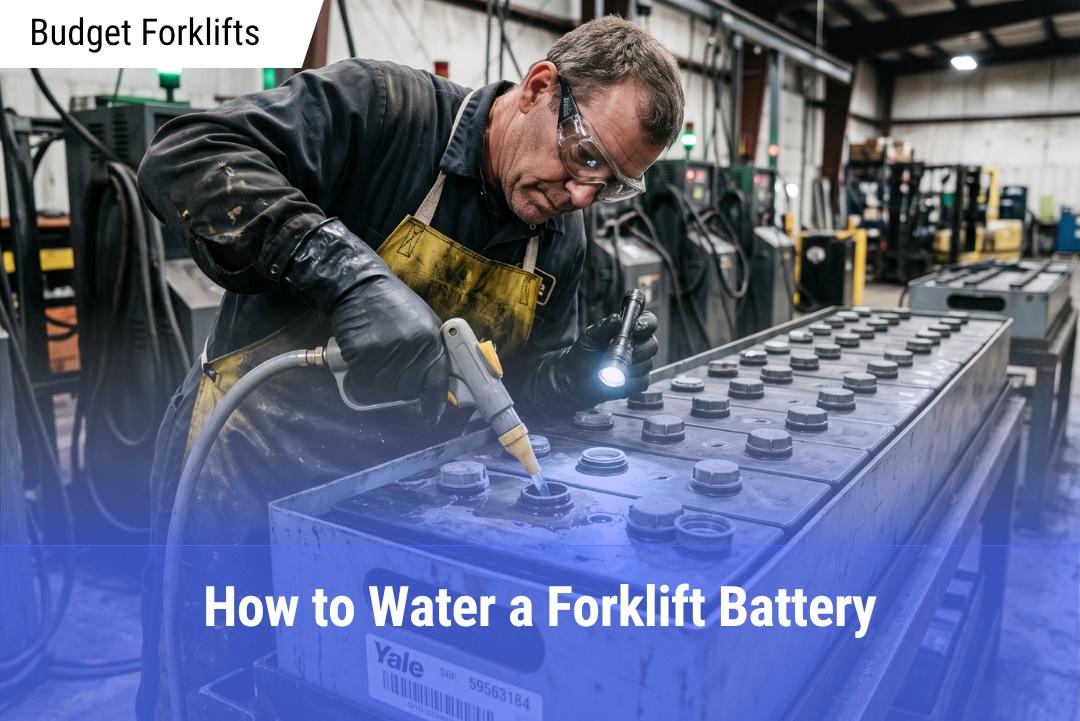
Watering is the cheapest maintenance task in the battery room and the one most likely to be done wrong. Almost every guide online gives a different fill level, and at least one of those numbers will overfill your cells. This guide uses the fill references the battery manufacturers actually print, plus the safety conditions federal regulators require around the task, so your operators fill to the right level for the right reason.
Table of Contents
How do you water a forklift battery?
Water a forklift battery at the end of a full charge, once it has cooled, by adding distilled or deionized water to each cell until the level reaches the bottom of the vent well. Never water a battery before or during a charge unless the plates are exposed.
The full sequence is short. Park the truck, set the brake, and switch the key off. Put on acid PPE. Open the battery compartment or tray cover and leave it open. Remove the vent caps and look into every cell. Fill the low cells to the vent well with a watering gun or a single point system, then reseat the caps and record the check.
East Penn’s operating instructions for Deka industrial batteries state that water should be added only near the end of the charge, raising the electrolyte to the bottom of the vent well, and that only distilled, deionized, or approved water should be used. That is the whole instruction, written by the people who built the cell. Everything else in this guide is detail around those two facts.
One habit worth building now: water the battery at the same point in the cycle every time. Batteries that get topped off at random points in the shift end up with inconsistent electrolyte levels across the string, and inconsistent cells are the ones that drift first.
Do you add water before or after charging a forklift battery?
Add water after charging, never before. Electrolyte expands and rises as the battery charges, so a cell filled beforehand pushes acid out through the vent when it heats up, which costs the battery both capacity and the acid it just lost.
OSHA’s guidance for electric powered industrial trucks is explicit on the sequence. Its powered industrial trucks eTool instructs operators to check the water level and not add water prior to recharging, then to check the level again after charging and add distilled or deionized water if the level sits below the level indicator, recording both checks in the service log.
This is also why the lunch break top off is a bad habit. An operator who plugs in for forty minutes, tops the cells, and goes back out has filled a battery that has not finished gassing and has not cooled. The acid comes back out on the next full charge.
We see the result of this constantly on trade-ins and reconditioning intakes. A battery whose tray is corroded through in stripes below the vent caps was almost never a manufacturing fault. It was watered on the wrong side of the charge cycle for two or three years, and the acid tracked down the same path every time.
How high should the water level be in a forklift battery?
Fill each cell to the bottom of the vent well, not to a measured height above the plates. The vent well is the short plastic tube extending down into the cell from the fill hole, and it is a fixed physical landmark on every flooded cell, which is exactly why manufacturers use it as the target.
This is where most online advice goes wrong. You will see half an inch above the plates, three quarters of an inch above the plates, a quarter inch above the element protector, and simply cover the plates. Those are four different levels, and the taller ones will overfill a cell whose plates sit high in the case. Manufacturers do not measure up from the plates because plate height varies by cell size and battery type.
They measure down from the vent well instead. East Penn specifies filling to the bottom of the vent well. Trojan Battery specifies stopping about one eighth of an inch below that same landmark and warns never to let the level fall below the top of the plates. Two manufacturers, one reference point, and a narrow band between them. That band is your target.
Practically, this means you need to see into the cell. A flashlight held at the fill hole is enough on most batteries. If your operators are filling by sound or by counting seconds on the trigger, you do not have a watering program, you have a guess. That is the single most common thing we correct when a customer calls about batteries that will not hold a shift, and it costs nothing to fix.
How often should you water a forklift battery?
Check every cell weekly, but only add water when the level actually calls for it. Depending on battery type and duty cycle, a battery may need water anywhere from once a week to once a month, which is why checking and watering are two separate tasks.
East Penn’s instructions separate them cleanly: the electrolyte level should be checked in every cell once each week, while adding water may be necessary on a weekly to monthly basis depending on the type of battery and the type of service. Most guides collapse those two sentences into “water it weekly,” and that is precisely how cells get overfilled by operators who feel obligated to add something.
Duty cycle drives the interval more than the calendar does. A one shift operation running a truck five days a week loses far less water than a two shift operation cycling the same battery twice as hard. Older and reconditioned batteries drink more than new ones, because plate and separator condition affects how much water is lost to gassing. Newer extended watering designs stretch the interval considerably further.
Heat is the other variable. A battery working a hot aisle in August will need water sooner than the same battery in February, so a fixed calendar interval that worked all winter can quietly run cells low in summer. This is one of the practical differences worth understanding when you compare lithium ion and lead acid forklift batteries, since lithium packs remove the watering task entirely.
What kind of water should you use in a forklift battery?
Use distilled or deionized water only, stored in a clean non-metallic container. Tap water carries calcium, chlorine, iron, and other dissolved minerals that deposit on the plates, accelerate self discharge, and permanently reduce capacity.
Distilled and deionized are both acceptable. Distilled is produced by evaporation and condensation and is the purer of the two. Deionized water has had its free ions stripped by resin and is widely used in larger battery rooms because on site deionizing equipment is cheaper than buying jugs. Trojan notes that deionized water works but that distilled remains preferred, since deionized water can still carry trace organic content.
The storage detail gets ignored almost everywhere and it matters. East Penn’s instructions call for water to be kept in a clean non-metallic container, because impurities picked up from a metal can or a reused bucket end up inside the cell. If your battery room fills from an open pail that also gets used for floor cleaning, your water quality is whatever was in that pail last.
Never add acid. Sulfuric acid is only added when a cell is being rebuilt by a technician, and pouring acid into a working cell throws off specific gravity and damages the plates. Water is the only thing that leaves during charging, so water is the only thing that goes back in. Getting this wrong is a leading entry on the list of what causes forklift battery failures.
What safety gear and setup does OSHA require before watering a battery?
Operators need acid resistant PPE, functioning vent caps, an open battery cover, no metallic jewelry or tools near the battery top, and quick drenching facilities within reach. Battery electrolyte is dilute sulfuric acid, and charging batteries release explosive hydrogen.
The OSHA eTool lists the personal protective equipment for battery servicing as chemical splash goggles or a full face shield with side shielded safety glasses, rubber or neoprene gloves, an acid resistant apron, and acid resistant footwear, alongside an eyewash capable of a fifteen minute flow. It also directs employees who wear contact lenses to use splash goggles, since a lens can trap acid against the eye and make flushing harder.
Three more conditions apply while the work is happening. Vent caps must be functioning and the battery or compartment cover must stay open so heat and hydrogen can escape. Metallic jewelry comes off, and tools stay off the top of an uncovered battery, because anything bridging two connectors arcs. Smoking, open flames, and sparks are prohibited in the charging area.
If acid reaches skin or eyes, the response is a fifteen minute flush with clean water followed immediately by medical attention. Every operator who touches a battery should know where the eyewash is without looking for it. Safe handling belongs in the same routine as every other step that helps make a forklift battery last longer.
What should you do if the battery plates are already exposed?
Add just enough distilled water to cover the exposed plates, charge the battery fully, then complete normal watering to the vent well. This is the only situation where water goes in before a charge, and you add the minimum, not a full fill.
Exposed plates are an emergency, not a routine finding. Plate material that sits in open air oxidizes and dries, and the damage does not reverse when the water comes back. A cell that has run dry more than once has lost capacity permanently, and the battery will fall short of a full shift long before its rated life is up.
Covering the plates before charging protects them from overheating during the charge, since the exposed section carries current without the electrolyte to carry heat away. Once the charge is complete and the electrolyte has expanded to its highest level, you can safely fill to the correct level without overflowing.
If you are finding exposed plates on more than one cell, the problem is the schedule, not the battery. That is also worth checking before you buy, and it belongs on the list of questions to ask when purchasing a used forklift, because a battery with a history of dry cells is a replacement cost hiding inside a purchase price.
What happens if you overfill a forklift battery?
An overfilled cell boils over during the next charge, pushing acid out of the vents onto the battery top, the tray, the stand, and the floor. The battery loses acid it cannot make back, so its specific gravity drops and its usable capacity drops with it.
The damage compounds. Acid on the battery top creates a conductive film between terminals that slowly drains the battery between shifts. Acid in the tray corrodes steel from the inside where nobody inspects. Acid on a concrete floor eats the surface and turns into a housekeeping and compliance problem. A boil over is never just a spill to mop up.
If a battery has already been overfilled, do not simply suction fluid out and call it fixed. What you remove is electrolyte, not water, so pulling fluid out removes acid along with it and lowers capacity further. The better move is to leave the level alone, complete the charge under supervision, contain any overflow, and have a technician take specific gravity readings to see how much acid was actually lost.
Clean up the spill properly. OSHA’s guidance calls for neutralizing spilled electrolyte with soda ash or baking soda mixed at one pound per gallon of water, confirming the reaction is complete when the fizzing stops and the pH reads between 6 and 8, then absorbing the neutralized material and rinsing the residue away. Keep neutralizer in the charging area before you need it, not after.
Should you use a watering gun, gravity feed, or a single point system?
The right tool depends on how many cells you are filling and how much operator judgment you want in the loop. Hand filling is cheap and slow and depends entirely on the person holding the nozzle. Single point systems remove the judgment and the reach problem at once.
| Method | Best for | Overfill risk | Practical trade off |
| Watering gun with automatic shutoff | Small fleets, one to five trucks | Low, the nozzle shuts off at level | Still cell by cell, still needs a flashlight and a steady hand |
| Gravity feed tank and hose | Fixed battery rooms with overhead space | Moderate, level is judged by eye | Cheap to set up, slowest per battery, tiring on deep trays |
| Single point watering system | Multi truck fleets and multi shift operations | Lowest, all cells fill to a set level at once | Higher upfront cost per battery, needs periodic valve inspection |
One caution on single point systems: they are not a reason to stop looking inside the cells. Valves stick, floats fail, and a manifold that appears to be working can leave one cell short for weeks. Pull the manifold and inspect visually on a regular schedule.
In our experience, hand watering stops making sense somewhere around the point where a facility is running several electric trucks across more than one shift. Below that, a good gun and a disciplined operator are fine. Above it, the labor time and the overfill risk both climb faster than the cost of the hardware. That calculation belongs alongside the rest of your fleet budgeting, whether you own the trucks outright or are still weighing forklift rental cost against buying.
How do you know your watering program is actually working?
A watering program is verified through the service log and monthly specific gravity readings, not by asking whether anyone remembers filling the battery. Logged checks and gravity numbers tell you whether the cells are consistent and whether the charger is doing its job.
OSHA’s guidance directs operators to record water level checks in the service log, both before and after charging. That log does more than satisfy an inspector. It shows you which batteries are drinking more than they used to, which is one of the earliest signals that a battery is aging or that a charger is overcharging.
Specific gravity is the other half. East Penn’s instructions call for recording readings on all cells once a month immediately after an equalizing charge, with the full charge range falling between 1.280 and 1.295 corrected to 77 degrees Fahrenheit. If the readings average below 1.265, check the charger output. If two consecutive monthly readings show any cell deviating more than 20 points from the average, that cell needs professional attention. The same instructions call for an equalizing charge every one to four weeks depending on service.
Missing logs tell their own story. When a battery arrives for reconditioning or comes in with a warranty question and there is no watering record behind it, the cells almost always confirm what the paperwork gap suggested. Good records are also what protects the warranty you paid for, and they directly affect how long a forklift battery lasts in real service rather than on the spec sheet.
If your batteries are already past saving, replacement is its own decision, and the same care applies to sizing the next one. The battery is a structural part of the truck as well as its power source, which is why its weight appears on the nameplate and why you should read the forklift data plate before swapping in a different battery. Operations weighing power sources entirely can compare an electric forklift against a propane model before committing to another lead acid cycle.
Frequently asked questions
Can you use bottled drinking water in a forklift battery?
No. Bottled drinking and mineral water contains dissolved minerals that deposit on the plates and reduce capacity, and mineral water is among the worst choices available. Use distilled or deionized water only.
Can you water a forklift battery while it is charging?
No. Electrolyte expands and gasses during the charge, so adding water then forces acid out of the vents and creates a splash hazard around a battery that is releasing hydrogen. Wait until the charge is finished and the battery has cooled.
Do reconditioned forklift batteries need water more often?
Usually yes. Older plates and separators lose more water to gassing per charge, so a reconditioned battery often needs checking more frequently than a new one on the same duty cycle. Establish its actual interval by checking weekly for the first month.
Who should be doing the watering, the operator or a technician?
Either, provided they are trained for it. OSHA expects only trained personnel to charge and change batteries, including training on acid splash emergency procedures and eyewash use, so assigning one trained person per shift produces more consistent results than leaving it to whoever finishes first.
The bottom line on watering a forklift battery
Watering a forklift battery correctly comes down to three decisions repeated consistently. Water at the end of a full charge once the battery has cooled, fill each cell to the bottom of the vent well rather than to a guessed height above the plates, and use distilled or deionized water kept in a clean non-metallic container. Everything else in this guide supports those three points.
The rest is discipline. Check every cell weekly and add water only when the level asks for it. Look inside the cell with a light instead of filling by feel, even on a single point system. Record the check in the service log and take specific gravity readings monthly after an equalizing charge, because the log is what tells you a battery is drifting while there is still time to do something about it.
Batteries fail early for boring reasons far more often than dramatic ones. A cell that ran dry twice, a tray corroded by acid pushed out on the wrong side of the charge cycle, a watering interval that worked in January and quietly ran short in August. None of those cost much to prevent, and all of them cost thousands to replace. If your cells are already showing dry plates, deviating specific gravity, or capacity that will not carry a full shift, it is worth having the battery evaluated before you keep charging it, and worth pricing new and reconditioned industrial forklift batteries against another year of downtime.