
Blog Post
The Forklift Rental Checklist: What to Confirm Before, During, and After Delivery
Renting moves the machine, the maintenance, and the depreciation onto the rental yard. It does not move the compliance. Once a forklift is parked on your floor and one of your people climbs into the seat, the training records, the daily inspection, and the site conditions are your responsibility, not ours. That gap is where […]
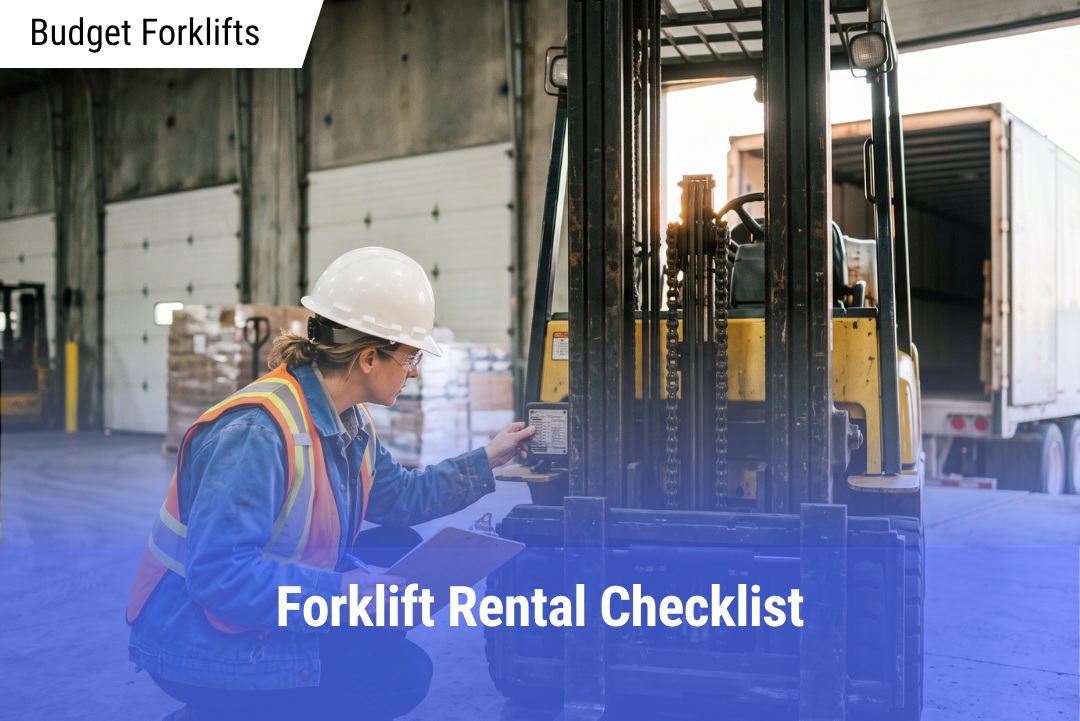
Renting moves the machine, the maintenance, and the depreciation onto the rental yard. It does not move the compliance. Once a forklift is parked on your floor and one of your people climbs into the seat, the training records, the daily inspection, and the site conditions are your responsibility, not ours.
That gap is where most rental problems start. National Safety Council Injury Facts data, drawn from Bureau of Labor Statistics reporting, counted 84 forklift-related work deaths in 2024 and 25,110 days-away, restricted, or transferred cases across 2023 and 2024. Very few of those trace back to a machine that arrived broken. Most trace back to a truck that did not suit the site, an operator who was certified on something else, or a defect nobody caught because nobody was told to look.
This checklist runs in three phases: what to settle before you call, what to verify when the truck comes off the trailer, and what to keep doing every shift until it goes back. If you want the shorter version of what goes wrong, we cover the most common forklift rental mistakes separately.
What do I need to have ready before I call a forklift rental company?
Have six things ready: heaviest load weight, load dimensions, required lift height, narrowest aisle and lowest doorway, indoor or outdoor surface, and your start and end dates. A rental yard can size a truck accurately from those six numbers and almost never from a description of the job.
The two people usually give us are the ones that matter least on their own. “Something around 5,000 pounds” ignores load center, and a load that is long or top-heavy derates the truck well below its plated capacity. “For a warehouse” tells us nothing about whether the floor is sealed concrete, broken asphalt, or gravel, which decides cushion versus pneumatic tires and often decides the entire class of truck.
Load center is the part that catches people. A forklift rated at 5,000 pounds is rated at 5,000 pounds at a standard 24 inch load center, and a deeper load shifts the balance point forward. If you have not sized a truck by load before, start with how much weight a forklift can actually carry and what the fulcrum does to your capacity before you pick a number off a spec sheet.
Then decide the power source, because it is difficult to change mid-rental. Indoor work in an occupied building generally points to electric; outdoor yard work and rough ground point to internal combustion. If you are between the two, the trade-offs are laid out in electric versus propane forklifts and electric versus diesel forklifts. If the racking is tall and the aisles are tight, the choice may not be a counterbalance truck at all, which is the comparison in reach truck versus counterbalance forklift.
Finally, settle the dates honestly. Rental pricing is banded, and a job that quietly runs three weeks on a daily rate costs far more than the same job booked correctly. The economics of that decision are worked through in long-term versus short-term forklift rental, and if the driver is a seasonal peak rather than a project, renting for seasonal demand covers how to time it.
How do I know the forklift will actually fit my site?
Capacity is rarely what fails on delivery day. Clearance is. Four published measurements decide whether a truck can do the job in your space: overall lowered height, overall raised height, free fork height, and maximum fork height.
OSHA sets these out in its critical forklift measurements guidance for powered industrial trucks, along with the failure they are meant to prevent. The worked example in that guidance is worth memorising: if a trailer opening gives 8.5 feet of clearance and the truck’s unextended mast stands at 8 feet, the truck gets in, but the operator still has to reach a double-stacked pallet. Extending the mast to reach it puts the mast through the trailer roof. OSHA describes this as a common accident, and it is entirely a measurement problem, not an operator problem.
| Measurement | What it limits | The failure it prevents |
| Overall lowered height (OALH) | Getting in: doorways, low ceilings, sprinkler lines, trailers | Striking a door header, a sprinkler head, or a light fixture on entry |
| Overall raised height (OARH) | Lifting in place: overhead obstructions once the mast extends | Punching through a trailer roof or hitting ceiling fixtures and heaters |
| Free fork height (FFH) | How high the forks rise before the mast extends | Being unable to reach a second-tier pallet inside a confined trailer |
| Maximum fork height (MFH) | Reaching the top rack or top of the stack | Ordering a truck that cannot service your highest storage level |
Measure the site rather than estimating it. Lowest doorway, lowest sprinkler line, trailer opening height, narrowest aisle, top beam height on the racking. Five numbers, ten minutes with a tape measure and a laser. A truck that does not fit is not a swap, it is a second delivery charge and a lost day, and that is the single most common reason we end up sending a second truck to a site. If you are sizing for a warehouse rather than a one-off job, how to choose the right forklift for your warehouse walks the same measurements in more depth.
Attachments belong in this conversation too, not after it. A fork positioner, a clamp, or a rotator changes both the truck’s capacity and its dimensions, and it has to be specified up front so the rated capacity you are quoted is the capacity you will actually have. The case for one is covered in the benefits of a forklift fork positioner.
Do I need a license or certification to rent a forklift?
There is no such thing as a forklift license. Under OSHA’s powered industrial truck standard, 29 CFR 1910.178, the employer must train, evaluate, and certify each operator as competent before that person operates a truck, and the employer’s own certification record is the legal document.
That record has four required elements: the operator’s name, the date of the training, the date of the evaluation, and the identity of the person who performed the training or evaluation. A wallet card from a training vendor is not the requirement. The employer’s certification is.
The standard also requires that each operator’s performance be re-evaluated at least once every three years. Rental yards are not the authority on any of this, and a rental company confirming that your operators are certified does not transfer the obligation. Nobody can rent their way out of 1910.178.
Asking for a licence is by some distance the most common misunderstanding we hear on rental calls, and it is understandable, because most competing guidance on the subject says “license” too. The practical answer is that the person operating the machine needs a current employer certification covering the type of truck being delivered, and you should have that in hand before the truck arrives, not after.
My operators are already certified. Does a rental change anything?
Often yes, and this is the clause renters miss. OSHA’s powered industrial truck standard requires refresher training when an operator is assigned to a different type of truck, and separately when a condition in the workplace changes in a way that could affect safe operation. A rental frequently triggers both.
Certification is type-specific and site-specific by design. An operator certified on your sit-down cushion-tire counterbalance is not automatically covered for a rented reach truck, an order picker, or a rough terrain machine. The controls differ, the stability behaviour differs, and the visibility differs. If the rental is a like-for-like replacement while your own unit is in the shop, the refresher obligation may be light. If the rental is a different class of truck brought in for a specific job, it is not.
The workplace trigger matters just as much on short rentals. Bringing a truck into a yard, onto a ramp, or into an area with pedestrian traffic it does not normally see is a change in conditions. Document the refresher and the evaluation the same way you documented the original: name, dates, evaluator.
What if the operator comes from a staffing agency?
You do not inherit the agency’s paperwork and walk away. OSHA’s Temporary Worker Initiative Bulletin No. 7 treats the staffing agency and the host employer as joint employers, and it places specific duties on the host.
Under that bulletin, the agency is generally responsible for generic powered industrial truck training, while the host employer, meaning you, is in the best position to provide site-specific training and to conduct the workplace evaluation. Even when the agency supplies operators it describes as trained, the host must verify that training, deliver site-specific instruction on the particular trucks and conditions present, and evaluate each operator’s competency before work begins. OSHA is explicit that neither party sheds its obligations under the OSH Act by pushing them into a contract with the other.
Two further points from the same bulletin. You do not have to hold the training records yourself, but you must know where they are and they must be accessible to a compliance officer during an inspection. And it is a violation of federal law under 29 CFR Part 570 for anyone under 18 to operate a forklift, temporary worker or not.
What should I inspect before I sign the delivery ticket?
Run two passes: a visual check with the key off, then an operational check with the engine running. OSHA’s pre-operation inspection guidance sets out both, and the delivery ticket is the right moment to run them, because that signature is where pre-existing damage stops being the rental yard’s and starts being yours.
Key-off visual pass, per OSHA’s list:
- Fluid levels: oil, water, and hydraulic fluid
- Leaks, cracks, or visible damage, including hydraulic hoses and mast chains. Never put a hand inside the mast; use a stick to check chain tension
- Tire condition and pressure, including cuts and gouges
- Fork condition, including the heel and the top clip retaining pin
- Load backrest extension and finger guards
- Safety decals and nameplates present and legible
- Operator manual on the truck and legible
- Operator compartment clear of grease and debris
- All safety devices functioning, including the seat belt
Engine-running operational pass: accelerator linkage, inch control if fitted, brakes, steering, forward and reverse drive, tilt forward and back, hoist and lowering, attachment control, horn, lights, back-up alarm if fitted, and the hour meter. Unusual noises or vibration are defects, not quirks.
One item on that list is the rental-specific one, and it is the one people skip. OSHA requires the operator to confirm that the information on the nameplate matches the model, the serial numbers, and the attachments fitted. On a rental, that check catches a swapped data plate, an attachment that is not reflected in the plated capacity, or a truck that is simply not the unit on your paperwork. If you are not sure what you are reading, how to read a forklift data plate breaks the plate down field by field.
Photograph everything before you sign. Tires, forks, mast, seat, counterweight, hour meter reading, and the data plate. Tires and forks are where damage disputes concentrate at the end of a rental, and a timestamped photo at delivery settles the argument in about thirty seconds. Worn tires in particular are easy to mistake for normal at delivery and expensive to be charged for at return, so it is worth knowing when forklift tires actually need replacing before you accept them as acceptable.
If the truck is electric, note the battery condition and the hour meter along with everything else, and confirm what charger comes with it and what state of charge is expected on return. Battery charge-backs are a real line item, and the underlying issues are covered in what causes forklift battery failures and how long a forklift battery lasts.
Who is responsible for the daily inspection once the forklift is on my site?
You are. OSHA requires that industrial trucks be examined before being placed in service and at least daily, and that trucks used around the clock be examined after each shift. Defects found must be reported and corrected immediately.
The standard is unambiguous about what happens next: a truck that is not in safe operating condition is removed from service, and repairs are made only by authorised personnel. On a rental that means calling the yard, not working through the problem until the job is done. Specific removal triggers in the standard include a leak in the fuel system, exhaust emitting sparks or flames, and any part running above its normal operating temperature.
In practice this is a five minute routine and a sheet of paper. Assign it to the operator, keep the completed sheets for the duration of the rental, and give the rental yard a call the moment something fails the check. Downtime reported on day one is a service call. The same fault reported on the last day is a damage claim.
What should I ask about the rental agreement itself?
Ask about six line items, not the day rate: hour caps, delivery and pickup charges each way, fuel or charging, damage waiver versus your own liability cover, wear-and-tear exclusions, and return condition.
Hour caps. Most rental terms define a day, a week, and a month in engine hours, sized around single-shift operation. Run two shifts on a single-shift rate and the overtime hours are billed on top. Tell the yard your shift pattern up front and price it correctly; nobody enjoys that conversation at invoicing.
Delivery and pickup. These are usually separate charges per leg and scale with distance and site access. Ask for the all-in number rather than the day rate, because transport can be the largest single line on a short rental.
Fuel and charging. Propane and diesel are generally the renter’s cost, and returning a unit empty attracts a fill charge. Electric units are returned at an expected state of charge. Confirm which applies.
Damage waiver versus your own cover. Many commercial general liability policies already extend to rented equipment. Call your broker before you accept a waiver you do not need, and read what the waiver excludes before you decline one you do.
Wear and tear. Scheduled maintenance and breakdown repair sit with the rental company. Damage from misuse, impact, punctured tires, bent forks, and abused batteries generally does not. Ask explicitly where the line sits.
Return condition. Cleaning and return-condition fees are avoidable and routinely paid anyway.
If cost is the driver behind the whole decision, work through what a forklift rental actually costs and how to save money on forklift rentals before you commit. And if the same truck keeps coming back month after month, the arithmetic may have quietly stopped favouring rental, which is the comparison in new versus used forklifts and forklift financing options.
Frequently asked questions
Is fuel or propane included in a forklift rental?
Generally no. Fuel, propane cylinders, and electricity are the renter’s cost, and a unit returned empty or discharged usually attracts a fill or charge fee.
What happens if the rented forklift breaks down?
Scheduled maintenance and mechanical breakdown are the rental company’s responsibility and are normally covered in the rate. Damage caused by misuse, impact, or operator error is not, which is why the delivery inspection and daily checks matter.
Can I rent a forklift with an operator included?
Many dealers offer it, and it is often the right answer for a short job when nobody on site holds a current certification for that truck type. It costs more per hour and removes the training and evaluation burden from you.
How far in advance should I book a forklift rental?
For a common warehouse class, a few days is usually enough. For a specific capacity, mast height, attachment, or rough terrain machine, give at least a week or two, particularly during seasonal peaks when local fleets run tight.
The short version
A forklift rental goes wrong in one of three places, and all three are preventable with a tape measure and twenty minutes of paperwork.
The first is sizing. Measure the lowest doorway, the lowest sprinkler line, the trailer opening, the narrowest aisle, and the top beam height, then give those numbers to the rental yard along with your heaviest load and its dimensions. Clearance fails far more often than capacity does.
The second is certification. There is no forklift licence, only an employer certification naming the operator, the training date, the evaluation date, and the evaluator. Confirm it covers the type of truck being delivered, and treat a different class of machine or a changed work area as a refresher trigger rather than a formality. If the operator comes from an agency, you still owe the site-specific training and the workplace evaluation.
The third is documentation. Run the key-off and engine-running checks before you sign the delivery ticket, confirm the data plate matches the machine and its attachments, photograph the tires, forks, mast, seat, and hour meter, then keep a daily inspection sheet for the length of the rental. That habit settles damage disputes and keeps a small fault from becoming a last-day claim.
Get those three right and the rest is commercial: hour caps, transport, fuel, waiver, wear, and return condition. Ask for the all-in number, not the day rate. If you are still weighing whether renting is the right call at all, the case for short-term forklift rental sets out where it pays and where ownership starts to win.