One of the most common misunderstandings we encounter is operators treating the rated number stamped on a forklift as a flat weight limit. If the plate says 5,000 lbs, they assume any load under 5,000 lbs is safe to lift. It isn’t. According to OSHA’s powered industrial trucks load composition guidelines, the rated capacity applies only at a specific load center distance and lift height. Change either variable, and the safe weight changes with it. Understanding what a forklift load capacity chart is actually measuring is the difference between a compliant, incident-free operation and a tip-over waiting to happen.
If you haven’t yet decided which type of forklift fits your warehouse’s actual load profile, choosing the right forklift for your operation starts with understanding what the capacity chart is telling you about each machine’s real-world limits.
Table of Contents
What is a forklift load capacity chart?
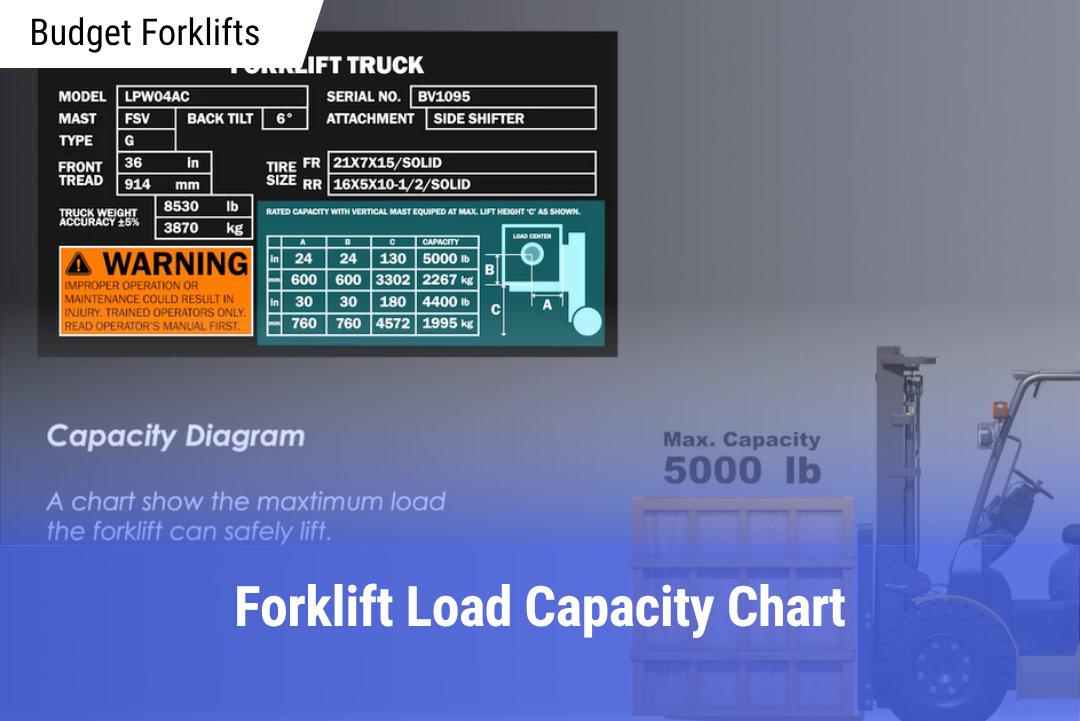
A forklift load capacity chart is a table displayed on the machine’s data plate showing the maximum safe lifting weight at each combination of load center distance and lift height. It is not a single headline number; it is a grid of conditions, and all three variables must fall within the plate’s parameters simultaneously for any lift to be within rated capacity.
The chart typically displays rows for lift heights and columns for load center distances, with each intersecting cell showing the maximum allowable weight for that exact combination. A standard 5,000 lb counterbalance forklift carries that full weight only at a 24-inch load center and at or below its baseline lift height. It’s also worth noting that the chart format varies significantly by machine type. A reach truck and a counterbalance forklift carry entirely different chart configurations even at the same nominal capacity rating, because their mast geometry and counterweight design differ fundamentally.
What does “load center” mean on a capacity chart?
Load center is the horizontal distance from the face of the forks to the center of gravity of the load being carried. The industry standard is 24 inches, based on a standard 48-inch-deep pallet where the center of gravity falls at the midpoint. When a load is longer, deeper, or unevenly distributed, the load center increases, and as load center grows, safe lifting capacity drops sharply.
OSHA explains this through the concept of load moment: weight multiplied by distance from the front axle, which acts as the pivot point. The further the load’s center of gravity sits from that pivot, the greater the tipping force. This is precisely why the forklift’s counterweight and fulcrum system are engineered around the 24-inch standard, and why moving beyond it without consulting the capacity chart can destabilize a machine that appears fully capable on paper.
| Load Center Distance | Max Safe Capacity (5,000 lb rated forklift) |
| 24 in (standard) | 5,000 lbs |
| 36 in | 3,333 lbs |
| 48 in | 2,500 lbs |
Calculated using the OSHA load moment formula: (Standard Load Center ÷ Actual Load Center) × Rated Capacity.
How do you read a forklift load capacity chart step by step?
Reading a capacity chart correctly requires four steps: determine the total weight of the load; measure the load center distance; identify the maximum lift height needed for the task; then find the cell at the intersection of that load center column and height row. If the load weight exceeds the number in that cell, the lift is outside rated capacity and must not proceed.
In practice, most operators know their load weight but skip step two: they never measure load center distance before the lift. This is the gap where incidents happen. A 4,800 lb load positioned at a 36-inch load center on a “5,000 lb” forklift actually exceeds that truck’s safe capacity at that distance by more than 1,400 lbs. The rated number on the plate is the best-case figure under ideal conditions. To understand the full picture of how much weight a forklift can actually carry under real working conditions, the chart, not the headline number, is what operators must consult before every non-standard lift.
When evaluating a pre-owned unit, confirm the data plate is present, legible, and matches the machine’s serial number. This check belongs on your list of questions to ask before buying a used forklift.
How do you calculate safe capacity when your load center is non-standard?
When a load’s center of gravity does not fall at the standard 24-inch mark, the safe lifting weight must be recalculated before the lift proceeds. The formula established in OSHA’s load handling guidelines is:
(Standard Load Center ÷ Actual Load Center) × Rated Capacity = Maximum Safe Weight
Example: a 5,000 lb forklift handling a load with a 28-inch load center. (24 ÷ 28) × 5,000 = 4,285 lbs, nearly 715 lbs less than the rated figure. At a 36-inch load center, that same truck is limited to 3,333 lbs. At 48 inches, just 2,500 lbs. The math is straightforward, but only when operators know to run it before the lift, not after an incident. This calculation applies equally to new and pre-owned equipment, which is one more reason why comparing new vs. used forklifts must always include a careful review of the data plate alongside the hours, tires, and price.
Does lift height reduce a forklift’s capacity?
Yes. Raising a load shifts the combined center of gravity of the machine and its load upward and forward, reducing overall stability even when the load center distance is within spec. Most capacity charts include a lift height column that shows progressively lower weight limits as mast extension increases. A forklift rated at 5,000 lbs at 130 inches of mast height may be limited to 3,800 lbs at full extension of 240 inches.
This matters most in high-rack warehouse environments where operators regularly lift to maximum mast height. The height column of the capacity chart must be consulted on every elevated lift, not only when loads feel unusually heavy. This also differs by powertrain configuration. Electric vs. propane forklifts can vary in available mast heights and free-lift specifications, meaning their capacity charts will not be interchangeable even on machines with the same rated weight and load center.
Do attachments change the load capacity chart?
Yes, every attachment reduces a forklift’s rated capacity because it adds weight to the front of the machine and shifts the effective load center further from the mast. A side-shifter, paper roll clamp, or rotator each requires its own OSHA- and ANSI-mandated data plate showing the new reduced capacity for that specific machine-and-attachment combination. Operating with an attachment installed while reading the original unmodified data plate is both a compliance violation and a significant safety risk.
We regularly see this play out after purchase: a buyer adds a side-shifter without revisiting capacity documentation. A 5,000 lb forklift with a side-shifter adding 300 lbs of front-end weight, operating at a 36-inch load center, may see its real working capacity fall to under 3,000 lbs, a reduction operators don’t anticipate because they’re still referencing the original plate. If you’re renting a unit with an attachment already fitted, confirming which data plate governs the configuration before the first lift is essential. It’s one of the most overlooked forklift rental mistakes and one of the most avoidable.
What happens if you exceed the forklift load capacity chart?
Exceeding the capacity chart shifts the combined center of gravity of the machine and load outside the stability triangle (the three-point suspension zone connecting the rear axle pivot and both front wheels), at which point the forklift will tip forward or laterally with little or no warning. According to forklift safety data from certified training authorities, tip-overs account for nearly 25% of all forklift accidents, and the National Safety Council documents 79 forklift-related fatalities in a single year alongside approximately 34,900 nonfatal injuries annually.
Overloading doesn’t only risk an immediate tip-over. It accelerates damage to the mast, hydraulic cylinder, drive axle, and frame in ways that may not surface until well into the machine’s working life. Whether purchased or rented, understanding the average lifespan of a forklift and how chronic overloading shortens it is part of the full operating cost picture, and a reason to treat the capacity chart as a hard limit, not a guideline.
Where can I find the load capacity chart on my forklift?
The load capacity chart is part of the forklift’s data plate, which 29 CFR 1910.178, OSHA’s governing standard for powered industrial trucks, requires to be mounted in a legible, visible location on the machine at all times. The plate is typically found on the instrument panel, mast upright, or overhead guard post. A forklift with a missing, damaged, or unreadable data plate is a compliance violation under federal regulation, and the machine should not be operated until the manufacturer or an authorized dealer replaces it with a unit-specific plate.
For a complete walkthrough of every field on the plate, covering rated capacity, load center, lift height, machine weight, tire specifications, and attachment information, see our full guide to reading a forklift data plate.
Frequently Asked Questions
What is the standard load center for a forklift?
The standard load center for most counterbalance forklifts rated under 30,000 lbs is 24 inches, based on a 48-inch-deep pallet with evenly distributed weight. Forklifts rated above 30,000 lbs typically use a 36- or 48-inch standard load center.
Can I use a load capacity chart from a different forklift model?
No. Capacity charts are specific to each machine’s serial number, counterweight, mast geometry, and hydraulic specifications. Using a chart from a different model (even one with the same nominal rated capacity) can result in dangerous overloading without triggering any visible warning.
How often should a forklift data plate be replaced?
The data plate must be replaced immediately if it becomes damaged, faded, corroded, or illegible. There is no scheduled replacement interval; condition governs when replacement is required. Always source the replacement plate from the original manufacturer to ensure it matches the unit’s exact serial number and specifications.
What is a load moment and why does it matter?
Load moment is the product of the load’s weight multiplied by its horizontal distance from the front axle pivot point. The capacity chart is essentially a tool for ensuring the load moment of any proposed lift does not exceed the machine’s maximum allowable load moment, the physical threshold beyond which the forklift becomes unstable.
Conclusion
A forklift load capacity chart is one of the most important safety documents on your job site, and also one of the most misread. The rated capacity number is a starting point, not a guarantee. Once you account for load center distance, lift height, and any attachments on the machine, the real safe working limit is almost always lower than what the headline figure suggests.
The operators and facilities that avoid incidents are the ones who treat the chart as a required lookup, not a formality. Measure the load center before non-standard lifts, run the OSHA formula when loads are deep or irregularly shaped, check the height column before every elevated pick, and confirm the correct data plate is in place whenever an attachment is swapped in or out.
Whether you are buying, renting, or already operating a forklift, understanding the capacity chart is foundational. If you are still deciding on the right machine for your operation, reviewing how to choose the right forklift for your warehouse alongside the capacity specifications will help you match equipment to your actual load requirements from day one.