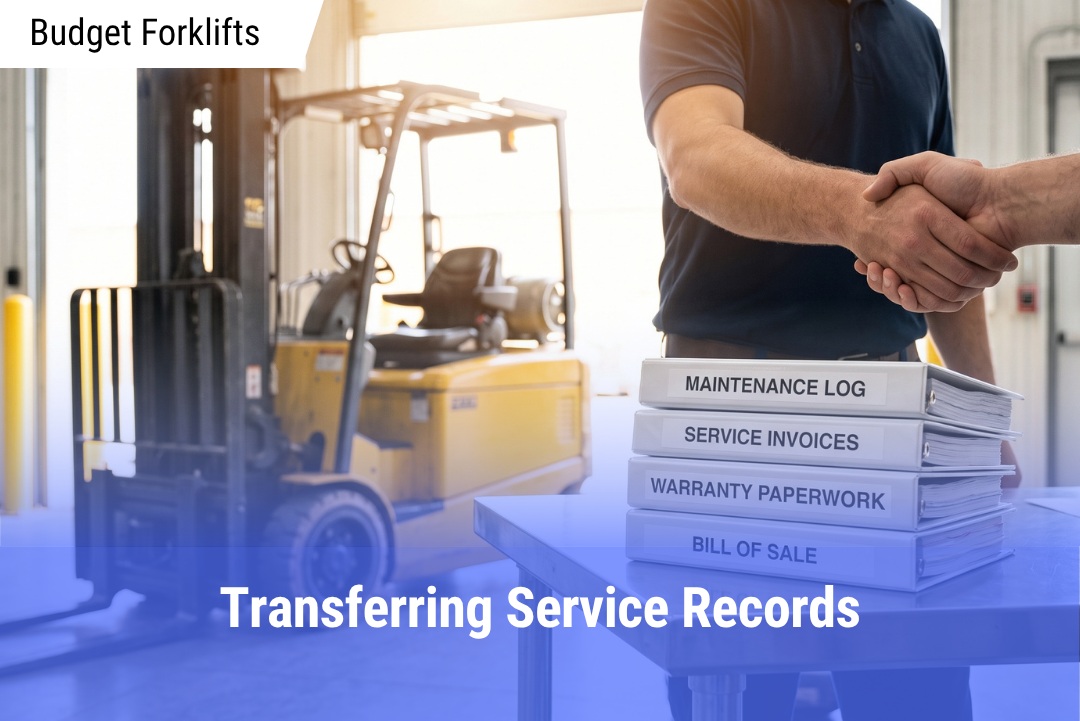
Selling a forklift is not just a handshake and a hauled-away machine. The paperwork that goes with it, especially the service records, is what tells the next owner whether they are buying a well-kept asset or an unknown risk. Here is exactly what should change hands, what legally cannot, and how to handle the sale when your records are not perfect.
Table of Contents
What Service Records Should You Hand Over When You Sell a Forklift?
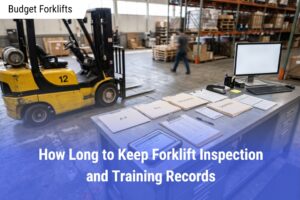
The core packet is five items: the maintenance log, dealer service invoices, parts and repair receipts, any remaining warranty paperwork, and the bill of sale. Handing all five over together, rather than promising to “email them later,” is what actually closes a sale at a fair price. Buyers who are serious will cross-check the maintenance log against the hour meter before they finalize anything, so it helps to have that log organized by date and hour reading rather than as a loose stack of receipts. If the forklift has been through a trade-in evaluation, a lease, or a period of rental use, include that history too, since a gap in ownership is one of the first things a cautious buyer will ask about. Dealers who move used equipment on a regular basis generally find that a complete packet, presented at the first showing rather than after an offer, shortens negotiation and reduces the number of buyers who walk away to “think about it.” It also helps to look at the sale from the other side of the table, since a buyer working through their own list of questions before buying a used forklift is essentially asking for the same packet in a different order. Complete records also give a buyer a way to judge where the machine actually sits within its expected working lifespan, rather than guessing off the hour meter alone. Before listing the machine, it is worth pulling the serial number and confirming it matches every document in the packet. A mismatched serial number, even an honest typo from years earlier, is enough to stall a sale while both parties sort out what the data plate actually says about the unit.Do OSHA Inspection and Training Records Transfer to the New Owner?
No. Maintenance and service history follow the machine, but OSHA daily pre-shift inspection logs and operator training or certification records belong to the employer and the operator, not the forklift itself. OSHA requires that a powered industrial truck be examined before it is placed in service each shift, and that inspection record is tied to whichever company is running the machine at the time, not to the equipment’s ownership history. This distinction trips up a lot of first-time sellers, who assume that handing over a binder of everything they have will satisfy the buyer’s compliance needs. It will not, and it should not. The buyer’s own safety program has to generate its own pre-shift logs and its own operator certifications the moment the forklift starts running under their roof. What the seller can and should hand over is everything about the machine’s mechanical condition, which is the half of the paper trail that genuinely does travel with the sale.| Travels with the forklift | Stays with the seller/employer |
| Maintenance and repair log | Daily OSHA pre-shift inspection logs |
| Dealer service invoices | Operator training and certification records |
| Parts and warranty paperwork | Workplace evaluation records |
| Bill of sale and serial number record | The employer’s overall safety program documentation |