Get Budget Forklifts Now. Call Us Today! 708-358-6555

Transferring Service Records When You Sell a Forklift

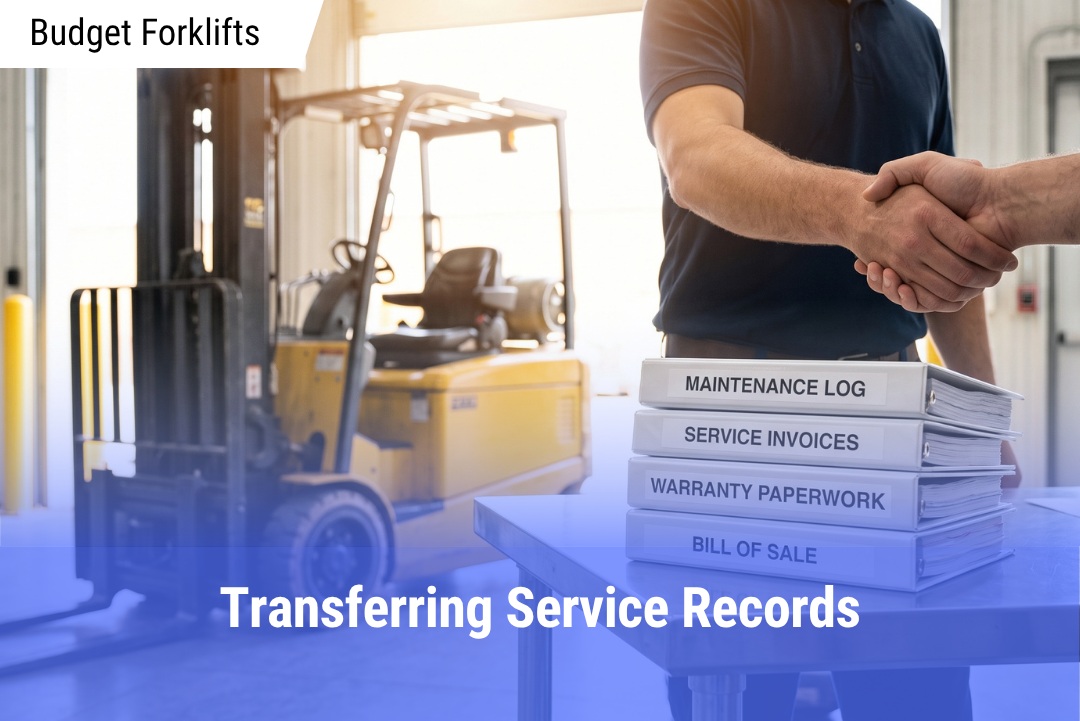
Two people shaking hands over a complete packet of used forklift maintenance records, service invoices, and a bill of sale, finalizing a transaction in a warehouse with a yellow forklift in the background.

Selling a forklift is not just a handshake and a hauled-away machine. The paperwork that goes with it, especially the service records, is what tells the next owner whether they are buying a well-kept asset or an unknown risk. Here is exactly what should change hands, what legally cannot, and how to handle the sale when your records are not perfect.

Table of Contents

What Service Records Should You Hand Over When You Sell a Forklift?

The core packet is five items: the maintenance log, dealer service invoices, parts and repair receipts, any remaining warranty paperwork, and the bill of sale. Handing all five over together, rather than promising to “email them later,” is what actually closes a sale at a fair price. Buyers who are serious will cross-check the maintenance log against the hour meter before they finalize anything, so it helps to have that log organized by date and hour reading rather than as a loose stack of receipts. If the forklift has been through a trade-in evaluation, a lease, or a period of rental use, include that history too, since a gap in ownership is one of the first things a cautious buyer will ask about. Dealers who move used equipment on a regular basis generally find that a complete packet, presented at the first showing rather than after an offer, shortens negotiation and reduces the number of buyers who walk away to “think about it.” It also helps to look at the sale from the other side of the table, since a buyer working through their own list of questions before buying a used forklift is essentially asking for the same packet in a different order. Complete records also give a buyer a way to judge where the machine actually sits within its expected working lifespan, rather than guessing off the hour meter alone. Before listing the machine, it is worth pulling the serial number and confirming it matches every document in the packet. A mismatched serial number, even an honest typo from years earlier, is enough to stall a sale while both parties sort out what the data plate actually says about the unit.

Do OSHA Inspection and Training Records Transfer to the New Owner?

No. Maintenance and service history follow the machine, but OSHA daily pre-shift inspection logs and operator training or certification records belong to the employer and the operator, not the forklift itself. OSHA requires that a powered industrial truck be examined before it is placed in service each shift, and that inspection record is tied to whichever company is running the machine at the time, not to the equipment’s ownership history. This distinction trips up a lot of first-time sellers, who assume that handing over a binder of everything they have will satisfy the buyer’s compliance needs. It will not, and it should not. The buyer’s own safety program has to generate its own pre-shift logs and its own operator certifications the moment the forklift starts running under their roof. What the seller can and should hand over is everything about the machine’s mechanical condition, which is the half of the paper trail that genuinely does travel with the sale.
Travels with the forklift Stays with the seller/employer
Maintenance and repair log Daily OSHA pre-shift inspection logs
Dealer service invoices Operator training and certification records
Parts and warranty paperwork Workplace evaluation records
Bill of sale and serial number record The employer’s overall safety program documentation

What If You Do Not Have Complete Maintenance Records?

Gaps get bridged three ways: request duplicate invoices from whichever dealer or shop did the work, disclose the gap honestly rather than papering over it, and schedule a pre-sale inspection against the manufacturer’s recommended maintenance schedule, which is the same schedule the ANSI/ITSDF B56.1 standard points back to for safe operation and upkeep. In practice, most service gaps are not missing work, just missing paper. A shop that services a forklift on and off over several years often has the records sitting in its own system even if the owner never kept a personal copy, so a phone call before listing the machine can fill in more of the log than most sellers expect. Where a true gap exists and no records can be recovered, an independent pre-sale inspection that checks the items closest to safety, brakes, forks, mast chains, tire wear, and hydraulics, does more to reassure a buyer than an apology ever will. It also gives the seller a defensible answer when a buyer asks pointed questions during a walkaround, rather than a shrug. If the machine has changed battery condition or power source at some point in its life, that is worth flagging separately, since battery history is often tracked apart from the general maintenance log and buyers evaluating how much life is left in the battery will ask for it directly.

Does a Forklift Need a Bill of Sale Like a Title?

Forklifts are not titled the way cars and trucks are, since they are classified as industrial equipment rather than road vehicles. In place of a title, a bill of sale, the serial number record, and the maintenance history together function as the practical proof of ownership and condition that a buyer, a lender, or an insurer will ask to see. That makes the bill of sale more important for a forklift sale than it might be for a titled vehicle, because it is doing more of the legal work on its own. It should list the make, model, serial number, sale price, date, and the condition of the unit at the time of sale, and it should be signed by both parties before the machine changes hands. Buyers financing the purchase, including those using forklift financing rather than paying outright, will often need this document for their lender before funds release, so having it ready at the time of sale avoids a delay that has nothing to do with the machine itself.

Frequently Asked Questions

Do I need a bill of sale to sell a forklift? Yes. Since forklifts are not titled like road vehicles, the bill of sale is the primary legal record of the transaction and should list the serial number, sale price, and condition at the time of sale. How long should I keep forklift maintenance records after selling it? Keep a copy for at least a few years after the sale, since maintenance history can matter for warranty disputes, tax records, or questions that come up if the buyer resells the machine again later. Can I sell a forklift without its operator manual? You can, but it weakens the sale. The manual documents the manufacturer’s service schedule and safe operating limits, and a buyer without it has to track down a replacement before they can fully verify the machine’s history. Should I disclose known mechanical issues when handing over records? Yes. Disclosing a known issue, even a minor one, alongside otherwise complete records builds more trust than a clean-looking file that turns out to have gaps once the buyer’s technician inspects the machine.

Conclusion

A forklift sale moves faster and holds its price better when the records are handed over as a complete, organized packet rather than assembled after the fact. Keep the mechanical history with the machine, leave the compliance paperwork with your own operation, and be upfront about any gaps rather than letting a buyer’s technician find them first. That combination, more than anything else in the listing, is what turns a hesitant buyer into a closed sale.

Share:

More Posts

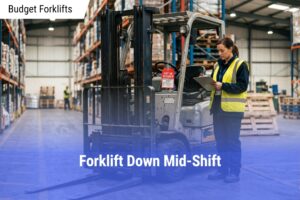
Warehouse supervisor in a high-visibility vest inspecting a counterbalance forklift with a red out-of-service tag on the steering wheel.

Forklift down mid shift: what to do in the first hour

When a forklift breaks down mid-shift, stop it out of traffic, lower the forks, neutralize the controls, shut off the power and set the brake. Then tag it out, report it immediately, and decide within the hour whether to repair it, swap in another truck or rent a replacement.

Send Us A Message