
Blog Post
When a Walkie Stacker Does the Job of a Sit-Down Forklift (and When It Doesn't)
| | 11 min read
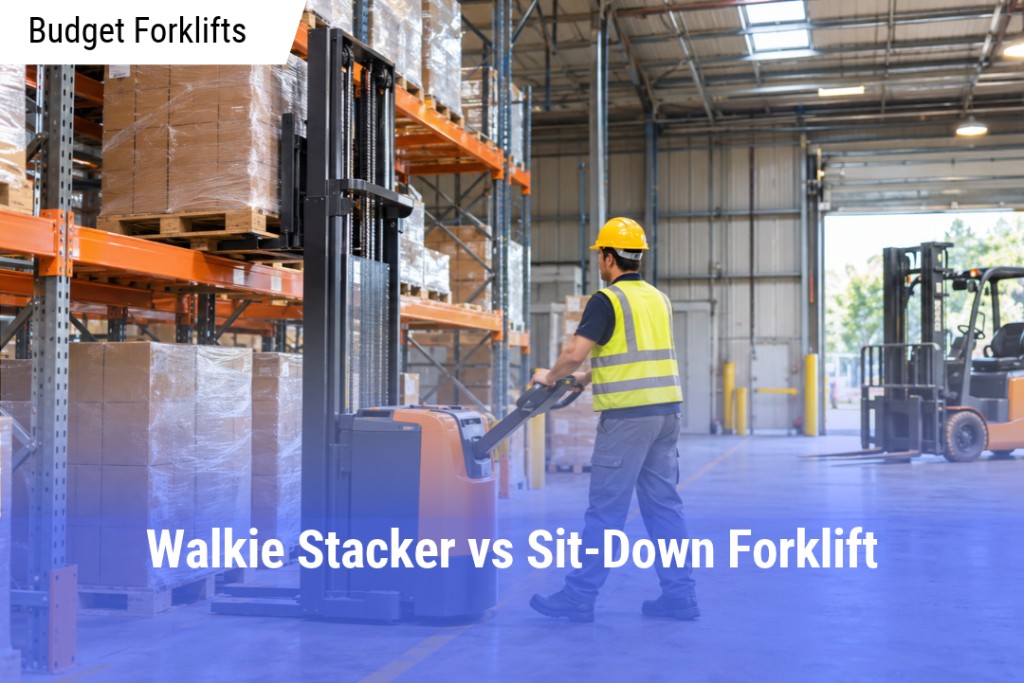
See when a walkie stacker can replace a sit-down forklift: travel distance, aisle width, lift height, OSHA training rules, and used costs.
Plenty of warehouses buy a sit-down forklift for work that never needed one. If your pallets travel a short distance, your aisles are tight, and your top beam sits at a moderate height, a walkie stacker can usually cover the job for far less money and far less floor space.
The hard part is knowing where that line sits. Below are the thresholds we use when customers ask which truck belongs on their floor, a side-by-side decision table, and the training rule most walkie buyers get wrong.
Can a walkie stacker replace a sit-down forklift?
Often, yes. A walkie stacker can replace a sit-down forklift for indoor pallet work with short trips, loads of roughly 3,000 lb or less at height, moderate rack heights, and single-shift volume. It cannot replace one for trailer loading, ramps, outdoor yards, or long runs across a large building.
The pattern we see most often is a small distribution or light manufacturing operation running one sit-down truck for everything: receiving, put-away, staging, and replenishment. When we walk the floor with the owner, most of that truck's hours turn out to be short moves inside one zone, lifting pallets to the second or third rack level. A walkie stacker handles that work in a narrower aisle, on a smaller battery, with fewer moving parts to maintain.
The sit-down usually earns its keep in one place only: the dock. That is why the setup we recommend most is a split fleet. Walkie stackers work the aisles, and one sit-down (owned, or brought in when you are renting a forklift for seasonal demand) handles trailers and heavy inbound loads.
The answer flips to "no" when the walkie would spend the shift walking instead of lifting. Long hauls, steady high volume, and anything that crosses a dock plate belong on a rider truck.
What is the difference between a walkie stacker and a sit-down forklift?
A sit-down forklift is a rider truck the operator drives from a seat, built for heavier loads, faster travel, and longer runs. A walkie stacker is a battery-powered truck the operator steers on foot from a tiller handle, built for compact pallet stacking at walking pace.
OSHA draws the same line. Under OSHA's powered industrial truck classes, sit-down electric counterbalanced trucks fall in Class I, while walkie stackers sit in Class III, electric motor hand trucks, alongside walkie pallet jacks. Gas and LP sit-downs land in Classes IV and V, which is part of why fuel choice matters indoors (see our electric vs propane forklift breakdown).
"Walkie stacker" also covers three different machines, and picking the wrong one causes most of the disappointment we hear about.
Straddle walkie stacker
Two base legs run along the outside of the pallet, which keeps the truck stable without a heavy counterweight. Straddle units fit the narrowest aisles, but the legs need clearance under the bottom rack beam and the pallet has to fit between them.
Counterbalanced walkie stacker
No front legs at all. A rear counterweight balances the load the same way a full-size forklift does, so it handles closed-bottom pallets, skids, and wide loads that a straddle unit cannot. The trade-off is length: plan on roughly 9 feet of aisle for a right-angle stack.
Reach walkie stacker
A pantograph or reach mechanism pushes the forks forward into the rack while the legs stay outside it. Reach walkies suit racking without floor clearance for legs, and they share the logic covered in our reach truck vs counterbalance forklift guide on a smaller scale.
When does a walkie stacker make more sense than a sit-down?
A walkie stacker makes more sense when one-way trips stay under about 150 feet, volume stays under roughly 15 to 20 pallet moves an hour, aisles run 7 to 9 feet, and the work stays indoors on smooth concrete. Outside those limits, a sit-down usually moves each pallet more cheaply.
These are the starting points we use on customer walkthroughs. They are not hard rules, but when an operation falls on the wrong side of three or more rows, we steer the buyer toward a rider truck.
| Factor | Walkie stacker fits | Sit-down forklift fits |
|---|---|---|
| One-way travel per trip | Under about 150 ft | Over about 150 ft, or across the building |
| Pallet moves per hour | Under roughly 15 to 20 | A steady 20 or more |
| Shifts per day | One shift, or a light second | Two or three busy shifts |
| Load at lift height | Up to about 3,000 lb (confirm on the data plate) | 3,000 to 5,000 lb and up |
| Top beam height | Roughly 8 to 15 ft, depending on mast | Higher racking, or heavy loads at height |
| Aisle for a right-angle stack | About 7 to 9 ft | About 11 to 13 ft |
| Floor surface | Smooth, level indoor concrete | Indoor, plus rougher surfaces with the right tires |
| Dock and trailer work | Ground-level loading only | Trailers, dock plates, and ramps |
| Outdoor use | Not recommended | Yes, with pneumatic tires |
Travel distance is the row that decides most cases. Loaded walkies move at walking pace, around 2.5 to 3 mph, so a 300-foot round trip repeated all day turns your operator into a long-distance walker. Past that point, labor and fatigue cost more than the walkie saves on the purchase.
Floor condition is the row buyers skip. Walkies carry the load on small polyurethane load wheels, so cracked joints, expansion gaps, and patched concrete hit them harder than a sit-down on larger tires. Before ordering, check whether your warehouse floor slab is in shape for concentrated wheel loads.
Do you need forklift certification to run a walkie stacker?
Yes. A powered walkie stacker counts as a motorized hand truck under OSHA's powered industrial truck standard, so every operator needs formal training, a practical evaluation in your workplace, and a performance evaluation at least once every three years.
Some sales material claims certain walkie models need no operator certification. For powered units used at US workplaces, that claim does not hold up. OSHA's powered industrial truck standard (29 CFR 1910.178) lists motorized hand trucks in its scope, and its training section applies to them the same way it applies to a sit-down rider. Only manual, hand-pumped stackers with no drive or lift motor fall outside it.
Sit-down training also does not carry over automatically. The standard requires refresher training when an operator is assigned to a different type of truck, so a driver certified on a Class I sit-down still needs walkie-specific instruction and a hands-on evaluation before running a Class III stacker.
We see that gap all the time when a customer adds walkies to a fleet of sit-downs. The drivers know forklifts, so everyone assumes they are covered. Walkie hazards are different, though: walking backward with the tiller, getting pinned between the handle and a rack, and feet near the chassis when turning. Cover those topics, sign off the evaluation, and store it with your other forklift inspection and training records.
How high and how heavy can a walkie stacker go?
Most powered walkie stackers are rated between about 2,000 and 4,000 lb, with lift heights from roughly 8 feet up to about 15 feet on taller masts. Rated capacity drops as the mast extends, so the number that matters is the capacity at your top beam.
The headline capacity on a spec sheet is measured at a low lift height and a standard 24-inch load center. Raise the forks to the top of a three-stage mast and the allowed weight can drop well below that number. The only reliable answer is the truck's own plate, so learn how to read a forklift data plate before you compare quotes.
The mistake we run into most often is a buyer who sees "3,000 lb" on a listing, then plans to stack 2,500-lb pallets on the top beam. On many walkies, that load is fine at the second level and over the limit at the third. Longer pallets make it worse, because they push the load center past 24 inches. The same physics that governs how much weight a forklift can carry applies here, with less counterweight to work with.
Tall masts in narrow aisles also raise the odds of clipping a rack. If a walkie ever strikes a rack upright, treat it as seriously as a sit-down strike and follow a clear rack upright damage and evacuation plan.
Where does a walkie stacker fall short?
A walkie stacker falls short on trailers, steep dock plates and ramps, rough or wet floors, outdoor yards, and high-volume multi-shift work. Small wheels, low ground clearance, and walking-pace speed turn those jobs into slow, tiring, and riskier moves.
Trailers are the clearest limit. Dock plate transitions and trailer floors punish small load wheels, and an operator walking ahead of or behind a loaded truck on an incline has little room to react. Loading from inside a trailer is sit-down territory, and even then the trailer and dock setup has to be right, as covered in our guide on driving a forklift into a trailer safely.
Multi-shift work is the quieter limit. A walkie's smaller battery can cover one shift of moderate use, but two hard shifts usually mean a spare battery, opportunity charging, or a switch in chemistry. If you are stretching a walkie across shifts, compare lithium-ion vs lead-acid forklift batteries before deciding the walkie is the problem.
On safety, a walkie's lower lift heights mean less exposure to falling loads than tall rider work. The injuries shift toward feet, legs, and pinch points instead, which is why walkie-specific training matters as much as sit-down training.
What does a walkie stacker cost compared with a sit-down forklift?
A used powered walkie stacker typically costs about $6,000 to $20,000 depending on age, hours, mast height, and battery, often around half the price of a comparable used electric sit-down. Running costs are lower too, thanks to a smaller battery, fewer components, and less tire wear.
Battery condition drives used walkie value more than anything else. A clean truck with a tired battery is not a bargain once you price a replacement. When we inspect a used walkie, we check battery age and charge acceptance first, then the drive unit, the mast chains, and the load wheels. Our list of questions to ask when buying a used forklift applies to walkies almost line for line.
If you are not sure a walkie will keep up, rent one for a few weeks before you buy. Running it on your real floor, with your real pallets, settles the travel-distance and volume questions faster than any spec sheet. Our breakdown of forklift rental cost shows what a short trial typically runs.
How do you decide between them for your floor?
Measure five things: aisle width, top beam height, pallet type and weight, trips per hour with their distance, and any dock or trailer work. If all five land on the walkie side of the table above, a walkie stacker will do the job of a sit-down.
- Measure your tightest aisle after racking is set, not the drawing.
- Find your top beam height and the heaviest pallet that goes there.
- Check pallet type and width, since closed-bottom or wide pallets point to a counterbalanced walkie.
- Count trips and distance for a typical hour on your busiest shift.
- List every dock, ramp, and trailer move, because those usually stay on a sit-down.
For the wider picture across every truck type, our guide to choosing the right forklift for your warehouse walks through the same measurements for rider and narrow-aisle trucks.
Frequently asked questions
Is a walkie stacker considered a forklift?
For compliance purposes, yes. OSHA classifies a powered walkie stacker as a Class III powered industrial truck, so the same training and evaluation rules apply.
Can a walkie stacker load a truck?
It can load a trailer from ground level or onto a flatbed it can reach, but it is a poor fit for driving into trailers over dock plates. Small wheels and low ground clearance make those transitions slow and risky, so most operations keep that work on a sit-down.
How long does a walkie stacker battery last?
A healthy battery usually covers one shift of moderate stacking work. Heavy use, high lifts, and cold storage shorten that, and lithium-ion with opportunity charging is the common fix for longer days.
Is a walkie stacker safer than a sit-down forklift?
Neither is safe by default. Walkies lift lower and travel slower, which cuts some risks, but they add foot, leg, and pinch-point hazards that need their own training.
Conclusion
A walkie stacker does the job of a sit-down forklift more often than most buyers expect. On short indoor runs, in 7- to 9-foot aisles, with moderate loads at moderate heights, it stacks the same pallets for less money, less space, and less upkeep.
The sit-down still wins on the dock, on long hauls, and on heavy multi-shift volume. The smartest setup is usually a mix: walkies in the aisles and a rider truck where trailers and heavy loads come in. Treat walkie operators like forklift operators when it comes to training. If you want a second opinion on your floor, send us your aisle widths, rack heights, and pallet counts, and we will tell you which truck fits.
Related articles
Blog Post
Renting a Forklift for Seasonal Demand: The Smart Way to Handle Peak Seasons
For seasonal demand, renting is almost always the winner because it eliminates storage costs during the slow months. That is why renting a forklift for seasonal demand is the secret weapon for smart warehouse managers and business owners. This guide shows you exactly how renting solves your capacity problems without the heavy price tag of […]
February 11, 2026
Blog Post
Electric vs Propane Forklift: Choosing the Right Power for Your Fleet
Choosing between an electric vs propane forklift is one of the most critical decisions a warehouse manager or business owner will make. This choice directly impacts your daily productivity, long-term operational costs, and the health and safety of your workforce. Both machines are designed to lift heavy materials, but their power sources dictate where and […]
March 1, 2026
Blog Post
Reach Truck vs. Counterbalance Forklift: Choosing the Right Equipment for Your Warehouse
Choosing the right material handling equipment is one of the most important decisions for any warehouse or distribution center. When you’re moving heavy pallets, the right machine saves you time, prevents accidents, and helps you maximize your storage space. Many business owners get stuck deciding between the two most popular options: the reach truck and […]
February 19, 2026