
Blog Post
Dead Forklift Battery: Disposal Rules, Core Credit and What Your Old Battery Is Worth
| | 14 min read
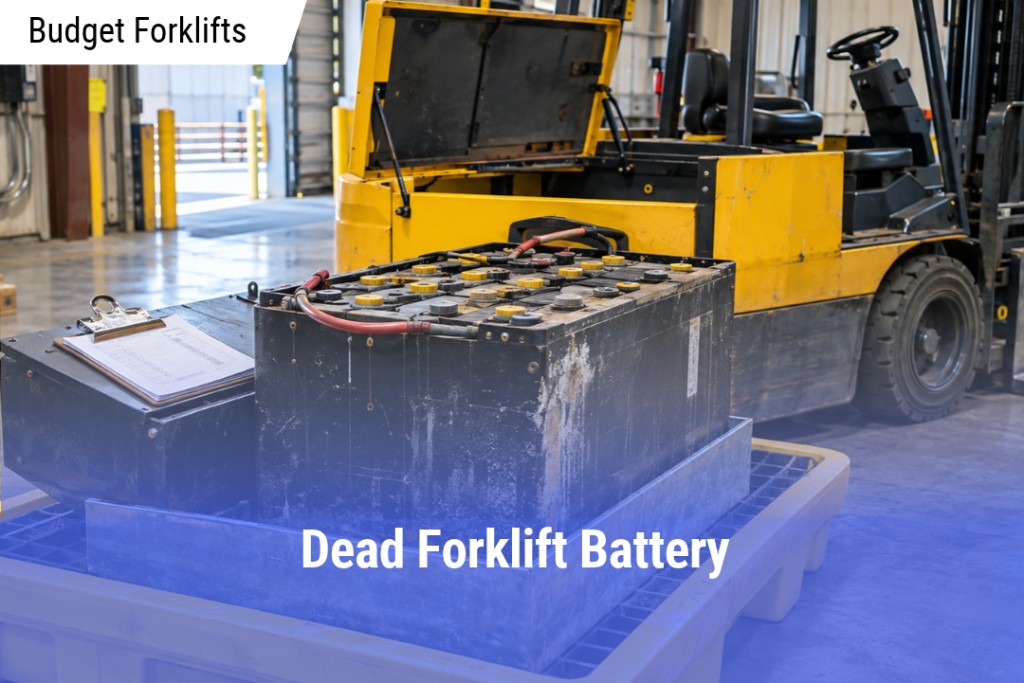
A dead forklift battery can't go in the trash, but its lead is worth money. Learn the EPA and Illinois disposal rules and how to claim your core credit.
Quick answer: A dead lead-acid forklift battery cannot go in a dumpster, landfill or curbside recycling bin, because the lead inside makes it hazardous waste once you discard it. Hand it to a dealer or recycler and you earn a core credit or scrap payment based on weight, often a few hundred dollars in late 2026.
A scene we run into constantly on trade-ins: a battery that quit two winters ago is still parked on a pallet in the back corner of a warehouse. It takes up floor space, it worries whoever does the safety walk, and the owner assumes getting rid of it will cost money. In most cases it costs nothing, and the battery pays you back. Below are the disposal rules that apply, how the core credit is worked out, and what a dead battery is realistically worth in late 2026.
Key takeaways
- Lead-acid forklift batteries are hazardous waste once discarded, but recycling them under EPA's streamlined rules avoids most of the paperwork.
- Illinois bans lead-acid batteries from landfills, incinerators and curbside recycling.
- Core credit on a forklift battery follows its weight and the scrap lead price, not a flat deposit like a car battery.
- At fall 2026 yard prices of roughly 12 to 22 cents a pound, a 2,000 lb battery is worth about $240 to $440.
- Lithium-ion packs follow different rules and do not earn a lead-based core credit.
Is a dead forklift battery hazardous waste?
Yes. A spent lead-acid forklift battery generally fails the federal toxicity test for lead, so it becomes hazardous waste the moment you decide to discard it. Businesses avoid the full hazardous waste rules by sending it to recycling under one of two streamlined EPA options.
The first option is EPA's universal waste rules for batteries in 40 CFR Part 273. Universal waste does not need a hazardous waste manifest and does not count toward your generator size category, which keeps a single battery swap from turning your shop into a regulated hazardous waste generator. The second option is the lead-acid reclamation standard in 40 CFR Part 266, Subpart G, written mainly for batteries headed back to a smelter or regenerator. EPA's own guidance notes that a lead-acid battery managed under Subpart G is not universal waste, so a business follows one path or the other, not both.
For most warehouse owners the practical difference is small: either path lets the battery go to a dealer, battery distributor or recycler without a hazardous waste hauler. What neither path allows is a release. A forklift battery is mostly lead plates and sulfuric acid inside a steel tray, and a cracked case leaking electrolyte is an acid spill that needs immediate cleanup. If that has already happened, follow the steps for a battery acid spill in the charging area before you worry about credit.
Can you throw a forklift battery in the dumpster or landfill?
No. Illinois law bars anyone from knowingly putting a lead-acid battery in a landfill-bound container, a municipal landfill, an incinerator or a hauler's recycling bin, and a knowing violation is a petty offense with a $100 fine. Federal hazardous waste rules forbid dumping it too.
The Illinois battery disposal law (415 ILCS 5/22.23) also requires anyone who sells lead-acid batteries at retail or wholesale to accept used ones for recycling, one for each new battery sold, and to deliver them only to a wholesaler, manufacturer, recycling facility that takes lead-acid batteries, or permitted secondary lead smelter. Since January 2020 it has also been illegal to toss a lead-acid battery in with the mixed recyclables a hauler collects.
One detail most guides skip: the statute defines a lead-acid battery as one "intended for use in motor vehicles," and its list of motor vehicles names cars, vans, trucks, tractors, motorcycles and motorboats. Forklifts are not on that list. Read literally, the retailer take-back duty may not cover an industrial forklift battery, although in practice many battery sellers accept them anyway. That gap does not open a door to the dumpster, because the federal hazardous waste rules above apply to an industrial battery regardless of how Illinois words its definition.
We are a forklift dealer, not a law firm. Use the rules here as a starting point and confirm anything unusual, such as a damaged battery or a large quantity, with your state environmental agency.
What is a core credit on a forklift battery?
A core credit is the value of your old battery taken off the price of its replacement, because the old battery's lead goes back into the recycling loop. Illinois lets battery sellers either give a recycling credit when you return an old battery or charge a fee when you don't.
That fee-or-credit choice comes straight from the same statute, which allows a seller to offer a recycling credit for returned batteries at the time of a new purchase. On a car battery the "core" is a flat deposit of a few dozen dollars printed on the shelf tag. A forklift battery is a different animal: it can weigh anywhere from several hundred pounds on a walkie to well over 3,000 pounds on a large sit-down truck, so a flat number would shortchange somebody.
When we take a battery in on a swap, the credit is built from two numbers: the battery's weight, read from the tag on the tray or put on a scale, and the scrap lead market at the time. That is how most industrial battery dealers handle it. A few things knock the credit down: a cracked case, missing or jumpered-out cells, or acid that has been drained or dumped. Ask for the core credit as its own line on the invoice, with the weight and rate shown, so you can compare one quote against another.
How much is a dead forklift battery worth?
A dead lead-acid forklift battery is worth its weight times the scrap price per pound. Fall 2026 yard prices ran roughly 12 to 22 cents a pound for whole forklift batteries, so a 2,000 lb battery brings about $240 to $440.
The per-pound rate tracks the price of refined lead, which traded near 85 cents a pound in the fall of 2026. A battery pays only a fraction of that because the weight also includes acid, the steel tray, plastic and separators. Lead is one of the steadier base metals, so the value of your battery is unlikely to swing much from one month to the next.
Use the battery's tag weight and the table below for a quick estimate. Weights are typical ranges; your battery's tag is the number that counts.
| Battery voltage (typical truck) | Typical weight | At $0.12/lb | At $0.18/lb | At $0.22/lb |
|---|---|---|---|---|
| 24V (walkies, pallet jacks, small stackers) | 600 to 1,600 lb | $72 to $192 | $108 to $288 | $132 to $352 |
| 36V (stand-ups, reach trucks, 3-wheel sit-downs) | 1,500 to 2,900 lb | $180 to $348 | $270 to $522 | $330 to $638 |
| 48V (4-wheel sit-down counterbalance) | 1,800 to 3,500 lb | $216 to $420 | $324 to $630 | $396 to $770 |
| 80V (large-capacity electric trucks) | 3,000 to 4,500 lb | $360 to $540 | $540 to $810 | $660 to $990 |
Can't find the battery tag? The truck itself tells you the minimum battery weight it was designed around, so learn to read the forklift data plate and use that figure as a floor. On the trade-ins we see, an ordinary 36-volt warehouse battery usually lands in the low to middle hundreds of dollars, which matches the table. It will not pay for a new battery, but it is real money off the invoice.
Core credit vs. scrap yard: which pays more?
For one or two batteries, a dealer core credit usually beats a walk-in scrap yard, because the dealer handles removal and credits the battery against a purchase. A yard pays only its posted per-pound price, and some yards refuse industrial batteries entirely.
Posted yard prices for forklift batteries vary widely from one yard to the next, and the low end of the range is where most walk-in sellers end up. Then there is the haul: a 2,000 lb battery needs a forklift or battery hoist to lift it, a truck or trailer rated for the weight, and bracing so it rides upright. Add an hour of labor and fuel, and a yard check of a few hundred dollars shrinks quickly.
We regularly hear from buyers who strapped a battery onto a trailer, drove it to a yard, and were either turned away or offered less than they expected, then brought it to us instead. Yards make sense when you have volume, such as a full pallet or a truckload of batteries from a fleet changeover, because per-pound offers improve with quantity and some yards will pick up. For a single dead battery in a working warehouse, letting the dealer pull it during a battery or truck swap is usually the cleaner deal. If you are replacing the whole truck, browse our used forklifts for sale and ask for the old battery's value to come off the price.
How should you store and ship a dead battery before recycling?
Store a dead battery upright, intact and on an acid-resistant surface away from floor drains, then get it moved on time. Universal waste can be stored for up to one year, and Illinois sellers who accept used batteries cannot hold them longer than 90 days.
The one-year storage limit for universal waste comes with a labeling requirement, so mark the battery as a used or waste battery with the date you pulled it from service. Watch your totals as well. EPA splits handlers at 5,000 kilograms, about 11,000 pounds, accumulated on site. Four or five large 48-volt batteries can cross that line, and a large quantity handler has extra duties. Battery sellers in Illinois face a tighter clock: the statute's 90-day limit on accumulated used batteries applies to anyone who accepts them for recycling.
A battery headed for recycling does not need maintenance. Keep the vent caps on and do not add water or acid; regular watering a forklift battery is for batteries that are still in service. For transport, federal hazmat rules for wet batteries (49 CFR 173.159) include a highway exception for intact batteries that are braced upright, have their terminals protected against short circuits, and ride without other hazardous materials. Damaged or leaking batteries need leakproof packaging, which is one more reason to let a dealer or recycler collect them.
Are lithium forklift batteries disposed of differently?
Yes. EPA recommends that businesses manage used lithium-ion batteries as universal waste, and federal hazmat rules for lithium batteries apply whenever they ship. Lithium packs also do not earn a lead-based core credit, so their recycling value depends on chemistry and condition.
The same EPA universal waste program covers lithium batteries, but the handling is stricter in practice because a damaged lithium pack can overheat and catch fire. Keep a dead lithium pack out of the sun and away from combustibles, never stack anything on it, and isolate any pack with a swollen case, a burnt smell or crash damage. EPA has also announced work on universal waste standards written specifically for lithium batteries, so expect the rules to tighten.
The cleanest route for a lithium forklift pack is back through the manufacturer, the dealer who sold it, or a recycler that handles industrial lithium. Do not let a scrap yard treat it like a lead battery. If you are weighing a switch, our comparison of lithium-ion vs lead-acid forklift batteries covers end-of-life cost alongside purchase price.
Is the battery actually dead? Check before you scrap
Test the charger, cables and individual cells before you scrap anything, because a "dead" battery is sometimes a charger fault or one weak cell. If you do replace it, the new battery must meet the minimum weight on the truck's data plate, because the battery is part of the counterweight.
A fair share of the "dead" batteries that come through our yard turn out to have a failed charger, a burned connector or one or two bad cells rather than a worn-out pack. A battery shop can check specific gravity and voltage cell by cell, and replacing a couple of cells costs far less than a new battery. Knowing what causes forklift battery failures helps you tell a fixable fault from a battery that has simply reached the end of its cycles.
Age is the other clue. A well-kept lead-acid battery typically delivers around 1,000 to 1,500 charge cycles, which works out to about five years of single-shift work, so check how long a forklift battery lasts against your own pack's date code. A battery in the middle of its life with low runtime may be a candidate for forklift battery regeneration, while a ten-year-old battery is almost always a core. If the truck is down while you decide, a short-term forklift rental keeps the dock moving.
Should you replace the battery or replace the forklift?
Compare the price of a new battery with the value of the truck it goes into. A replacement 48V lead-acid battery runs roughly $3,500 to $5,000 in 2026, and on an older, high-hour truck that can be more than the forklift itself is worth.
Lithium replacements for the same truck typically start around $8,000 and climb past $20,000 for large packs, which rarely makes sense on an aging chassis. Before buying any battery, look at the truck's hours, mast and hydraulic condition, and its average lifespan of a forklift in your kind of work. A new battery in a worn truck just moves the next big repair bill a few months down the road.
On older electric trucks, we often walk buyers through that math, and many decide to put the battery money toward a used truck that already has a healthy battery, with the old battery's core value going toward the purchase. Our new vs used forklift comparison lays out where each option makes sense. Whichever way you go, a solid forklift battery maintenance routine is what keeps the next battery from ending up in the corner early.
Frequently asked questions
Do I have to buy a new battery to get a core credit?
A core credit is normally tied to a replacement purchase, though many dealers and recyclers will also buy a dead industrial battery outright at a scrap-based price. Ask for the offer in writing with the weight and per-pound rate shown.
Will a cracked or leaking battery still get credit?
Often yes, at a reduced rate, because the lead is still recoverable, but the battery must be contained and shipped under stricter packaging rules. Set it in a leakproof tray and treat any electrolyte on the floor as an acid spill.
Can I haul a dead forklift battery myself?
You can, if your vehicle and trailer are rated for the weight and the battery rides braced upright with its terminals covered and no other hazardous materials aboard. Many dealers pull the old battery during a swap, which removes the lifting and loading risk entirely.
What paperwork should I keep after recycling a forklift battery?
Keep the receipt or bill of lading showing the battery went to a dealer, recycler or smelter, with its weight and the date. File it alongside your other equipment paperwork, using the same approach you follow for forklift inspection and training records.
Conclusion
A dead forklift battery is not trash and not a liability you have to pay to remove. It is regulated hazardous waste that becomes a few hundred dollars of credit once it goes back through the recycling chain the right way. Keep it upright and contained, move it within the storage limits, get the weight and per-pound rate in writing, and make sure the battery is truly finished before you give it up.
If your battery has quit and you are deciding between a new battery and a different truck, call us at 708-358-6555. We will look at the numbers with you, including what your old battery is worth toward the next one.
Related articles
Blog Post
Battery Acid Spill in the Charging Area: Immediate Steps for the First 30 Minutes
Battery acid spill in the charging area? Follow these immediate steps to protect workers, neutralize the acid, and check the forklift before reuse.
November 11, 2026
Blog Post
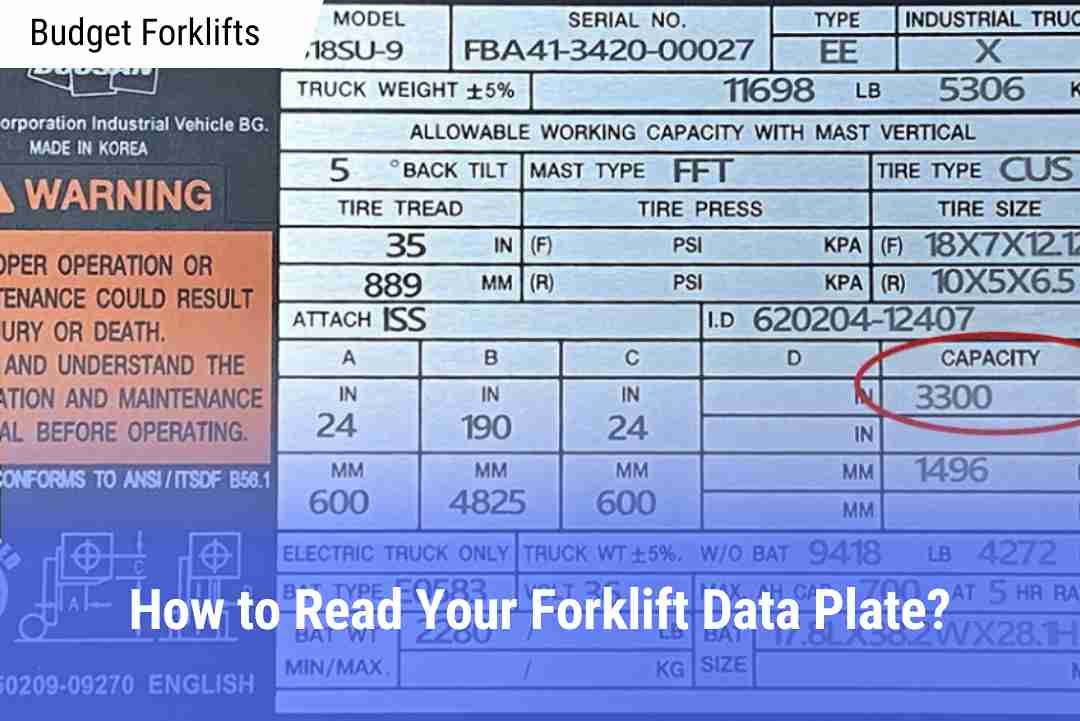
How to Read a Forklift Data Plate: A Safety Guide
A forklift data plate is the metal tag that tells you exactly how much your machine can safely lift, and under what conditions. It is required on every powered industrial truck, and reading it is the only way to know your real lifting limits before you pick up a load. Table of Contents Also called […]
February 2, 2026
Blog Post
How to Water a Forklift Battery
Watering is the cheapest maintenance task in the battery room and the one most likely to be done wrong. Almost every guide online gives a different fill level, and at least one of those numbers will overfill your cells. This guide uses the fill references the battery manufacturers actually print, plus the safety conditions federal […]
August 22, 2026