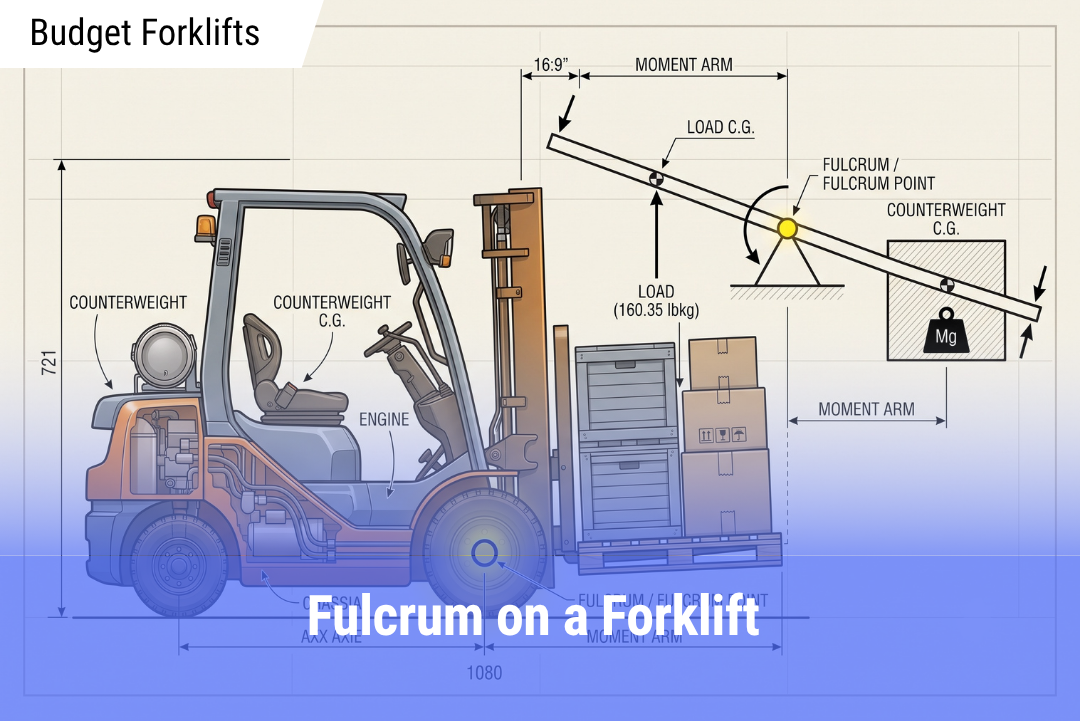
The fulcrum on a forklift is the pivot point the machine balances on, and OSHA defines the fulcrum as the truck’s axis of rotation when it tips over. In everyday terms, that axis is the line where the front wheels meet the ground.
A counterbalance forklift works like a see-saw. The load on the forks sits on one side of the fulcrum, and the heavy counterweight cast into the rear frame sits on the other. As long as the counterweight side pushes down harder than the load side, the machine stays planted and the rear wheels keep steering authority.
Most forklift guides stop at the front axle and leave it there. The OSHA definition matters because it is written for tipping in any direction, not just forward, and that distinction changes where the fulcrum actually is depending on how the machine loses balance.
We handle a steady flow of used counterbalance trucks, and the fulcrum concept is the first thing we explain to first-time buyers, because every capacity number on a data plate is built on it. A buyer who understands the balance point reads spec sheets differently from that day forward.
Where is the fulcrum located on a forklift?
For forward tipping, the fulcrum sits at the front axle, specifically the contact line between the front tires and the floor. For a sideways tip, the axis of rotation shifts to an imaginary line running from one front wheel back to the pivot pin in the center of the steer axle.
That second axis exists because nearly all counterbalanced forklifts ride on a three-point suspension. The steer axle attaches to the frame through a single center pivot pin, so the machine is supported at three points even when it has four wheels. Connecting those three points draws the stability triangle that operator training is built around.
The practical takeaway is that a forklift has more than one way to fall and more than one fulcrum to fall around. Overloading tips it forward around the front axle. A fast turn with an elevated load tips it sideways around the diagonal axis, which is a shorter, less forgiving lever.
Why doesn’t a forklift tip over when lifting heavy loads?
A forklift stays upright because the counterweight behind the fulcrum creates a vehicle moment larger than the load moment in front of it. The moment on each side is simply weight multiplied by its distance from the fulcrum, and the machine side must always win.
A typical counterbalance forklift weighs roughly three times what it can lift, and almost all of that mass is deliberately placed behind the front axle. When the load moment creeps past the vehicle moment, the rear wheels lighten, steering fades, and the truck begins to rotate forward around the front tires.
The margin for error is not academic. Overturns are the leading cause of forklift fatalities in the United States, accounting for about 25 percent of forklift-related deaths, with roughly 100 workers killed and 20,000 seriously injured in forklift incidents each year.
That is why every unit that comes through our yard gets staged and moved with the forks low and the mast tilted back, even for a 50-foot reposition between rows. The habit costs nothing, and it keeps the combined center of gravity deep inside the stability triangle where the fulcrum never comes into play.
How does the load center affect the fulcrum and capacity?
The load center is the horizontal distance from the vertical face of the forks to the load’s center of gravity, and it acts as the load’s lever arm over the fulcrum. Trucks rated at 30,000 pounds or less almost always carry a 24-inch load center rating, which matches the middle of a standard 48-inch pallet.
Move the center of gravity farther from the fork face and the same weight produces a bigger load moment. The counterweight has not changed, so the only thing that can give is capacity. This is the single most misunderstood line on a forklift data plate.
We see it constantly when buyers compare two used trucks on rated capacity alone. A 5,000-pound truck rated at a 24-inch load center is not a 5,000-pound truck when the freight is 60-inch crates, and we walk every buyer through how much weight a forklift can carry with their actual loads before recommending a unit, because the plate number only applies at the plate’s load center. Matching capacity, load center, and aisle layout together is the core of choosing the right forklift for your warehouse.
Here is how capacity falls away as the load center grows, using a 3,000-pound truck rated at 24 inches:
| Actual load center | Maximum load moment | Safe load weight |
| 24 inches (rated) | 72,000 inch-pounds | 3,000 lbs |
| 30 inches | 72,000 inch-pounds | 2,400 lbs |
| 36 inches | 72,000 inch-pounds | 2,000 lbs |
| 48 inches | 72,000 inch-pounds | 1,500 lbs |
How do you calculate a forklift’s safe load using the fulcrum principle?
Multiply the rated capacity by the rated load center to get the maximum load moment, then divide that moment by your actual load center. The result is the heaviest load the truck can safely handle at that distance from the fork face.
OSHA publishes this exact method with a worked example: a 3,000-pound capacity truck with a 24-inch load center has a maximum load moment of 72,000 inch-pounds, so a 60-inch-long load with a 30-inch load center tops out at 2,400 pounds on that same truck.
The calculation is conservative by design. The true tipping distance is measured from the front wheels, not the fork face, so working from the load center always leaves a safety cushion. That cushion shrinks fast, though, once you add attachments, since a clamp or rotator both weighs something and pushes the load farther from the fulcrum, which is why any attachment should come with an updated data plate.
If the math ever says a load is borderline, treat borderline as no. Carry the load low, tilt the mast back, and split the load or bring in a higher-capacity unit rather than betting the counterweight wins. For a one-off heavy lift, a short-term forklift rental is far cheaper than a tipped truck.
FAQ
Is the fulcrum the same as the load center?
No. The fulcrum is the pivot line the truck rotates around when it tips, while the load center is the distance from the fork face to the load’s center of gravity, which determines how much leverage the load has over that fulcrum.
Can the fulcrum on a forklift move?
The forward-tip fulcrum stays at the front axle, but the effective axis of rotation changes with the direction of tip. A lateral tip rotates around the line between a front wheel and the steer axle pivot pin instead.
What happens if the load moment exceeds the vehicle moment?
The rear wheels unload first, so steering goes light or disappears before the truck visibly tips. If the load moment greatly exceeds the vehicle moment, the truck rotates forward around the front wheels and comes down on the mast.
Does an attachment change the fulcrum?
The fulcrum stays where it is, but an attachment adds weight ahead of it and pushes the load farther from it, so both effects cut capacity. The manufacturer should re-rate the truck and issue a new data plate whenever an attachment is installed.
What should you check on a used forklift to protect its balance?
On a used forklift, the parts that guard the fulcrum are the front tires, the steer axle pivot, the counterweight, and the data plate, and all four should be inspected before money changes hands. A truck can run perfectly and still be compromised at its balance point.
Front tires carry the entire combined weight of truck and load when the machine works near capacity, so heavy wear, chunking, or mismatched tire heights across the front axle change how the fulcrum line sits on the floor. Worn press-on cushion tires are one of the most common corrections we make before a unit leaves our lot, precisely because they sit at the fulcrum. Knowing when to replace forklift tires is as much a stability decision as a maintenance one.
The steer axle pivot pin deserves a look for the opposite reason. Sloppy bushings at that center pivot let the rear of the truck rock, which effectively softens one corner of the stability triangle during turns.
The counterweight and data plate round out the check. Look for cracked or previously repaired counterweight castings and for missing mounting bolts, and walk away from any truck whose data plate is missing, repainted over, or does not match the attachments fitted. Every trade-in we take gets its plate verified against the serial number before resale, because a capacity rating you cannot read is a capacity rating you do not have.
Before you commit to any unit, run through the top questions to ask when purchasing a used forklift so the fulcrum hardware gets the same scrutiny as the engine hours. If you are still weighing whether a pre-owned truck is the right call at all, our new vs used forklift comparison breaks down where the value sits, and the average lifespan of a forklift tells you how many working years those balance components have left in them.