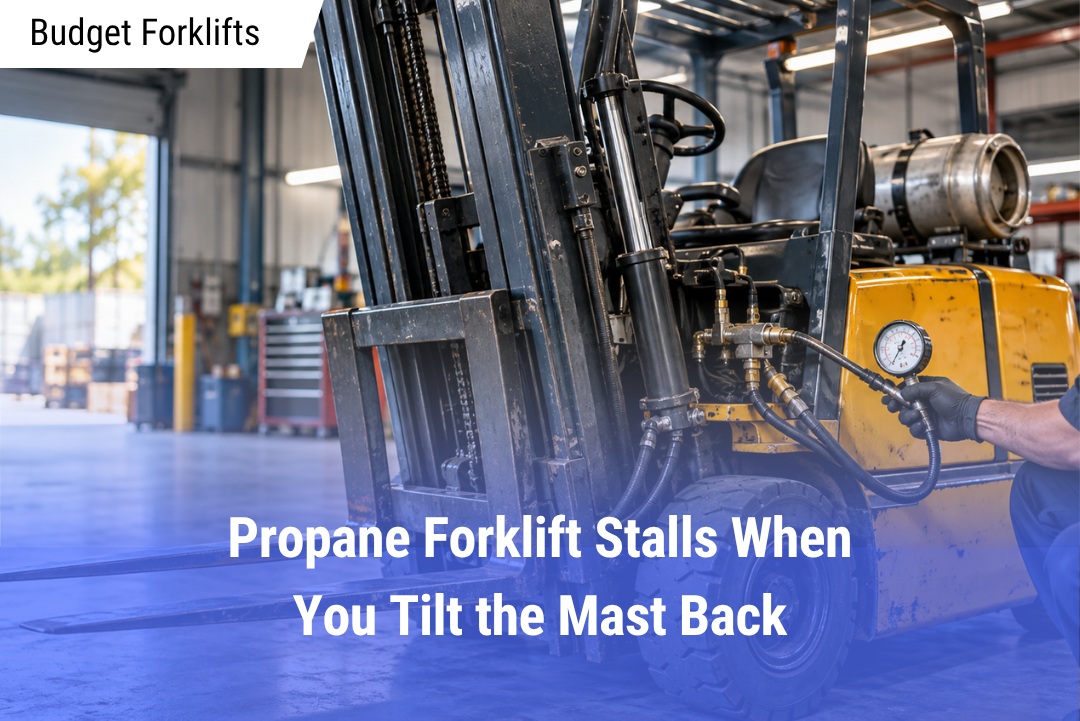
A propane forklift that stalls when you tilt the mast back is usually running out of engine torque at idle. Holding tilt-back at the end of its stroke pushes the hydraulic pump to relief pressure, and a low idle, a failed idle-up, a weak LPG fuel supply, or a relief valve set above spec turns that normal load into a stall.
The complaint almost always arrives the same way: the truck drives fine, lifts fine, and then dies the moment the operator pulls the tilt lever all the way back. Operators learn to feather the gas pedal to keep it alive, and the underlying fault gets worse for weeks. Below is what is actually happening inside the truck, a 60-second test any operator can run, and the fixes that separate a quick adjustment from a real repair.
Table of Contents
Why does a propane forklift stall when you tilt the mast back?
Holding tilt-back at the end of its stroke forces the engine-driven hydraulic pump against the relief valve, which is the heaviest load the pump can put on the engine. At idle, a propane engine often lacks the torque to carry that peak load, so RPM collapses and the engine dies.
On an internal combustion forklift, the same engine that drives the wheels also spins the hydraulic pump for lift, tilt, side shift, and usually steering. When the tilt cylinders reach their mechanical stop, oil has nowhere to go, pressure climbs to the relief setting, and the pump demands close to its maximum input power.
Tilt is more prone to stalling than lift for a design reason. A lift truck patent filed with the European Patent Office explains that tilt and side-shift circuits reach relief pressure quickly because they share a pump sized for full-speed lifting, and at engine idle the engine will often stall as soon as relief pressure is reached. Lifting usually happens with the operator already on the pedal, while tilting back is often done at idle, just after picking up a load or before travel.
From the service side, the pattern is consistent: a truck that stalls on tilt-back is almost never broken in the tilt cylinders themselves. The tilt function is simply the first place a marginal engine, fuel system, or idle setting gets exposed.
Is it normal for the engine to bog down when the mast hits full tilt?
A brief, audible dip in RPM at full tilt is normal on a healthy propane forklift. A stall, a near stall, or an engine that shakes and struggles to recover is not normal and points to a weak engine, a low idle, or a hydraulic system demanding more than it should.
Think of the dip as the engine picking up a heavy bag. A healthy engine sags for a moment and recovers while the lever is still held. When the sag keeps going until the engine quits, something on the engine side has lost margin or something on the hydraulic side is asking for too much.
Many older trucks develop the problem gradually. The engine first stumbles only when cold, then on every tilt-back, then on full steering lock at idle as well. Catching it at the stumble stage is what keeps the repair small, which is why a tilt-back check belongs on your fuel forklift preventive maintenance checklist.
How can an operator tell if it is an engine problem or a hydraulic problem?
Run the 60-second throttle test: tilt back to the stop at idle, then repeat with light pressure on the accelerator. If the engine survives with a little throttle, the cause is on the engine side (idle speed, idle-up, or fuel); if it still stalls with throttle, suspect relief pressure, the pump, or a seriously weak engine.
The 60-second throttle test
Engine warm, operator seated and belted, parking brake set, direction lever in neutral, no load on the forks, area clear.
| 1 | Raise the forks a few inches off the floor. At idle, pull the tilt lever back until the mast stops, and hold for no more than 1 to 2 seconds. Note whether the engine dips and recovers, nearly stalls, or dies. |
| 2 | Restart if needed. Hold light, steady pressure on the accelerator and repeat the same tilt-back. Note the result. |
| 3 | At idle, turn the steering wheel to full lock and hold briefly. Note whether it stalls the same way tilt-back did. |
| 4 | Report all three results to your technician in writing. Those three answers cut diagnostic time more than any description of “it keeps dying.” |
Reading the results is straightforward. Stalls only at idle but survives with throttle means the engine has power but is not being given enough RPM when hydraulics engage, so check idle speed and the idle-up system first. Stalls even with throttle means the hydraulic load is abnormally high or the engine is badly down on power. Stalls on both tilt and full steering lock at idle usually means the engine or propane supply is weak, because two different circuits are exposing the same shortage.
The most common mistake we see is the workaround itself. An operator who feathers the pedal on every tilt-back is effectively masking the test result every shift, and the truck arrives at the shop with a regulator or ignition fault that has been quietly getting worse. The quick checks in our DIY forklift maintenance guide are safe for operators; anything past fluid levels, filters, and tank handling belongs with a technician.
What propane fuel problems cause stalling under hydraulic load?
Any fault that limits how much propane vapor reaches the engine can let the truck idle normally but starve the moment hydraulic load rises. The usual suspects are a near-empty or misaligned LPG tank, a tripped excess-flow valve, a clogged fuel filter, a regulator or vaporizer that cannot keep up, and vacuum leaks at the mixer.
Work through them in order of cost, starting with what the operator can check:
- Tank level and position. Forklift cylinders feed liquid propane through a pickup tube, so the tank must sit on its locating pin with the pickup in the liquid. A tank installed rotated, or one running close to empty, can deliver enough fuel to idle but not enough to carry a load. Swap in a full, correctly seated tank before anything else.
- Tank service valve. Opening the valve fast can trip the excess-flow valve and restrict flow. Close it, then reopen it slowly all the way.
- Fuel filter and lock-off. Debris and heavy-end residue in propane collect at the filter and lock-off, starving the engine under demand.
- Regulator and vaporizer. The regulator uses engine coolant to turn liquid propane into vapor. Low coolant, a kinked coolant hose, or worn internal diaphragms reduce vapor output under load. Frost on the regulator body during work is a strong clue.
- Mixer and vacuum hoses. A cracked vacuum hose or intake boot unmeters the air-fuel mixture, causing a rough, hunting idle that falls over under any extra load.
- Ignition and air. Worn plugs, weak coil output, or a restricted air filter do not show at idle but show instantly under hydraulic load.
On used propane trucks, regulator wear and neglected fuel filters are among the most frequent finds behind a tilt-back stall, far ahead of hydraulic pump failure. When you order regulator kits or filters, pull the model and serial number from the forklift data plate first so the part matches the engine and fuel system your truck actually has, then source the correct OEM or aftermarket forklift parts.
Can a misadjusted relief valve or a bad idle-up cause the stall?
Yes. A main relief valve set above the manufacturer’s spec raises the load on the engine every time a cylinder hits its stop, and an idle-up system that no longer raises RPM when hydraulics engage leaves the engine at base idle under full pump load.
Most internal combustion forklifts include some form of idle-up: a solenoid, vacuum actuator, pressure switch, or engine computer strategy that bumps RPM when a hydraulic function is used. On many older designs, the switch that triggers it is tied to the lift spool, so lifting gets extra RPM while tilting does not. When that switch, solenoid, or wiring fails, or the base idle has drifted low, tilt-back is where the stall shows up first. On newer electronically controlled LPG engines, a stored diagnostic code often points straight to the fault.
Relief valves cause the other half of these cases. Someone raises the relief setting to squeeze more lift capacity out of an aging pump, and the truck starts stalling at the end of every tilt and lift stroke. Relief pressure must be measured by a technician with a rated gauge at the designated test port and set to the service manual figure, never higher. Debris lodged in the tilt circuit’s flow restrictor can produce the same symptom by nearly dead-heading the function early. Hydraulic faults sit high on the list of the most common forklift repairs, but for this particular symptom they come after idle and fuel checks.
Tilt-back stall diagnostic table
| Symptom | Likely cause | First check | Who handles it |
| Dies on tilt-back at idle, survives with light throttle | Base idle too low or idle-up not engaging | Idle RPM against spec; idle-up solenoid or actuator operation | Technician |
| Dies on tilt-back even with throttle | Relief valve set high or sticking; pump binding | Relief pressure at the test port | Technician |
| Dies on tilt-back and at full steering lock | Weak engine or fuel starvation under load | Fuel filter, regulator output, plugs, air filter | Technician |
| Worse as the tank empties or right after a tank change | Low tank, tank off its locating pin, tripped excess-flow valve | Full tank, correct seating, reopen valve slowly | Operator |
| Frost on the regulator, stalls after long runs | Regulator short on coolant heat or internally worn | Coolant level and hoses to the regulator | Operator checks coolant; technician repairs |
| Rough, hunting idle that falls over under any load | Vacuum leak or worn mixer diaphragm | Vacuum hoses and intake boots | Technician |
| Slow or jerky tilt with pump whine, then stall | Blocked tilt restrictor, contaminated oil, or pump wear | Hydraulic oil level and condition | Operator checks level; technician repairs |
Is it safe to keep using a forklift that stalls on tilt-back?
No. An engine that dies under hydraulic load can also die mid-turn or on a ramp, where heavy manual steering and a sudden loss of power put the operator and nearby workers at risk, and federal rules require an unsafe truck to be taken out of service until it is repaired.
OSHA’s forklift guidance states that any powered industrial truck not in safe operating condition must be removed from service, that defects found during the daily examination must be reported and corrected, and that repairs are made only by authorized personnel.
In practice, that means the operator who finds a repeatable tilt-back stall during the pre-shift check tags the truck and reports it rather than working around it with the pedal. A stall that happens while carrying a load near racking or a dock edge is the scenario that turns a fuel filter into an incident report.
If the truck is critical to the shift, a short-term forklift rental covers the gap while the repair is done properly instead of rushed.
How do you prevent tilt-back stalling on a propane forklift?
Release the tilt lever as soon as the mast reaches its stop, keep idle speed and idle-up at factory spec, and service the LPG filter, regulator, plugs, and air filter on a set schedule. Those habits remove most of the load spikes and fuel shortfalls that cause the stall.
- Train the release. The relief valve is a safety device, not a resting position. Holding any lever against its stop wastes fuel, heats the oil, and loads the engine for no work.
- Standardize tank changes. Seat every cylinder on its locating pin and open the valve slowly, every time.
- Schedule fuel system service. Replace the LPG filter and inspect the regulator at planned intervals rather than waiting for a stall.
- Log the throttle test. Add a tilt-back-at-idle check to the daily inspection so a stumble gets caught before it becomes a stall.
- Test before you buy. Tilting back at idle is one of the fastest health checks on any used LPG truck, and it belongs alongside the questions to ask when purchasing a used forklift.
Frequently asked questions
Can low hydraulic fluid make a propane forklift stall on tilt-back?
Low fluid more often causes pump whine, foaming, and slow or jerky mast movement than a clean stall. Top it up with the specified oil anyway, because aeration and contamination raise pump load and can push a marginal engine over the edge.
Should I just turn the idle up to stop the stalling?
Only if the idle has drifted below the manufacturer’s spec, and then only back to that spec. Raising idle above spec hides a failing idle-up, regulator, or ignition fault, increases fuel use, and makes the truck harder to inch precisely.
Does cold weather make tilt-back stalling worse?
Yes. Cold hydraulic oil is thicker and loads the pump harder, while a cold regulator vaporizes propane less readily, so give the truck a proper warm-up before working the mast hard.
Is it worth repairing an older propane forklift that keeps stalling?
Usually yes when the cause is idle, idle-up, fuel filter, regulator, or relief setting, since those are modest repairs compared with replacement. If the engine is worn out, weigh the rebuild against the hidden costs of cheap forklifts, compare electric vs propane forklift options for your site, or browse inspected used forklifts for sale.