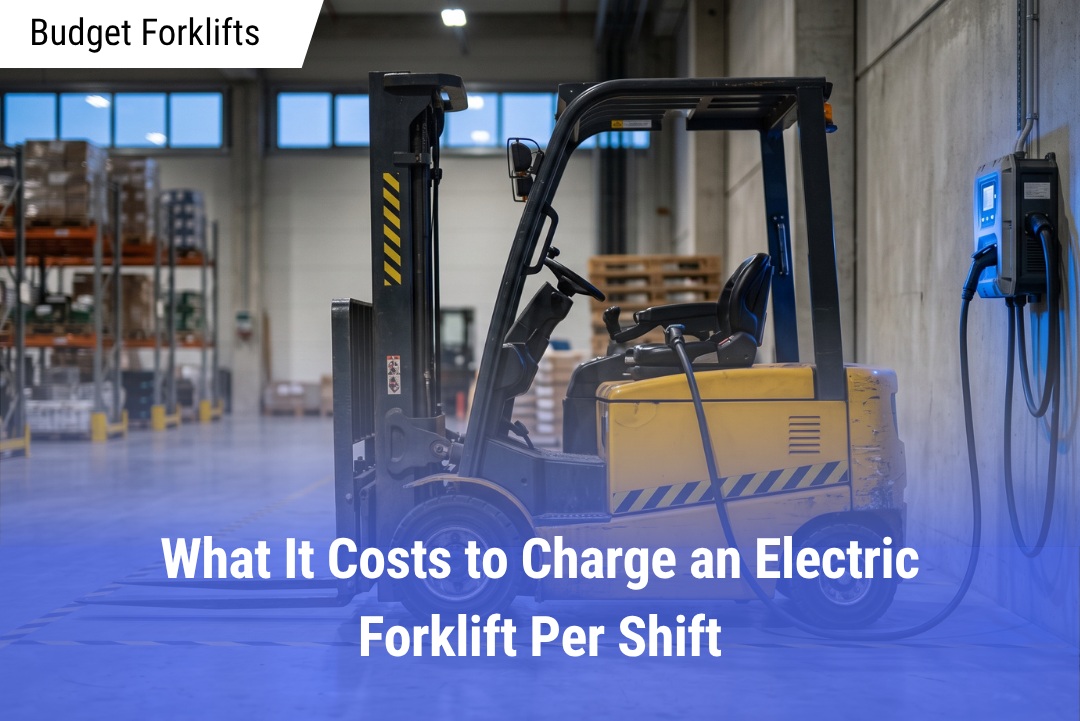
Charging a standard 48V, 750Ah lead-acid forklift costs about $3.10 to $5.80 per shift at 2026 U.S. business electricity rates. Smaller 24V and 36V trucks cost less, and demand charges can add more on top if the whole fleet plugs in at once.
Electric forklifts have a reputation for being cheap to run, and they usually are. But “cheap” is not a number you can put in a budget. Below is the actual math, built on federal electricity price data and a published state methodology for measuring forklift charging energy, plus what we see on the shop floor when trucks come through for inspection, service and resale.
Table of Contents
How much does it cost to charge an electric forklift per shift?
A typical 48V, 750Ah forklift battery pulls roughly 36 to 43 kWh from the wall to recharge after one shift, which costs about $3.10 to $5.80 at average 2026 U.S. rates. The spread comes from your electricity rate and how efficient your charger is. Pricing starts with your rate per kilowatt-hour. According to the U.S. Energy Information Administration’s Monthly Energy Review, the average price in May 2026 was 13.54 cents per kWh for commercial customers and 8.71 cents for industrial customers, taxes included. Most warehouses, distribution centers and small manufacturers pay something in that range, with plenty of local variation. Energy per shift comes from the charging methodology published by the California Air Resources Board for measuring electric forklift electricity use. It assumes one charge cycle per shift, a battery discharged to about 80%, a charger that puts back 15% to 18% more energy than was used, and charger efficiency between roughly 78% and 96% depending on the technology. Estimated charging cost per shift by battery size and charger type| Battery | Stored energy | Charger type | kWh from grid per shift | Cost at 13.54¢ (commercial) | Cost at 8.71¢ (industrial) |
| 24V / 600Ah | 14.4 kWh | High frequency | 14.2 | $1.93 | $1.24 |
| Ferro-resonant | 15.8 | $2.14 | $1.37 | ||
| SCR | 17.0 | $2.30 | $1.48 | ||
| 36V / 750Ah | 27.0 kWh | High frequency | 26.7 | $3.62 | $2.33 |
| Ferro-resonant | 29.6 | $4.00 | $2.58 | ||
| SCR | 31.9 | $4.31 | $2.78 | ||
| 48V / 750Ah | 36.0 kWh | High frequency | 35.6 | $4.82 | $3.10 |
| Ferro-resonant | 39.4 | $5.34 | $3.43 | ||
| SCR | 42.5 | $5.75 | $3.70 | ||
| 80V / 620Ah | 49.6 kWh | High frequency | 49.1 | $6.64 | $4.27 |
| Ferro-resonant | 54.3 | $7.36 | $4.73 | ||
| SCR | 58.5 | $7.92 | $5.10 |
How do you calculate forklift charging cost per shift?
Multiply the battery’s kWh rating by how deeply you discharge it and by the charger’s overcharge factor, divide by the charger’s efficiency, then multiply by your electricity rate. Five numbers, all of which you can find on your equipment or your power bill.- Find the battery’s kWh. Multiply volts by amp-hours and divide by 1,000. A 48V, 750Ah battery stores 36 kWh. Both numbers are printed on the battery tag, and the truck’s own requirements are on its data plate (see our guide on how to read a forklift data plate).
- Apply depth of discharge. Lead-acid batteries are normally run down to about 80%, so 36 kWh × 0.80 = 28.8 kWh used per shift.
- Add the overcharge. Chargers return more energy than was used to fully finish a lead-acid charge. The CARB forklift electricity methodology puts that at about 15% for ferro-resonant and high frequency chargers and about 18% for SCR units. 28.8 × 1.15 = 33.1 kWh into the battery.
- Divide by charger efficiency. A ferro-resonant charger around 84% efficient needs 33.1 ÷ 0.84 = 39.4 kWh from the wall.
- Multiply by your rate. 39.4 kWh × $0.1354 = $5.34 per shift.