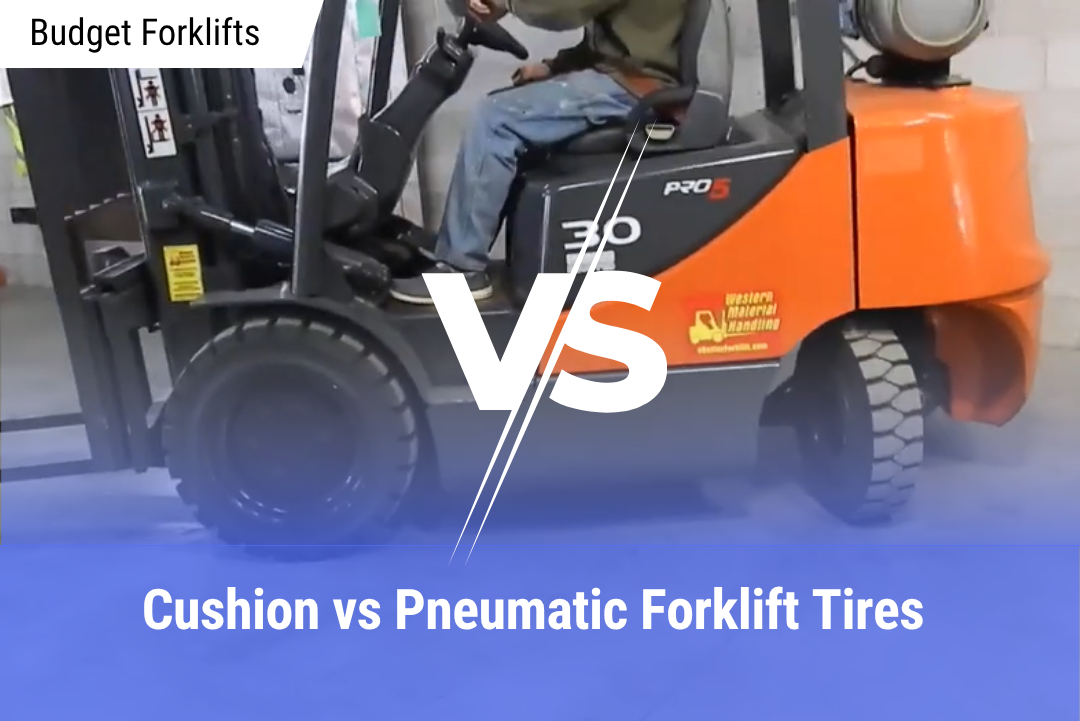
Picking the wrong forklift tire is one of the most expensive mistakes a buyer can make, and it usually does not show up until the truck is already on the floor. The tire is the only thing between a loaded forklift and the ground, so it drives handling, stability, wear, and your total cost of ownership. This guide breaks down cushion versus pneumatic forklift tires, when each one wins, and how to match the tire to the way you actually work.
Table of Contents
What is the difference between cushion and pneumatic forklift tires?
Cushion tires are solid rubber pressed onto a smooth metal band and are built for hard, flat indoor floors. Pneumatic tires are larger, sit on a wheel rim, and are either air-filled or solid rubber shaped like a truck tire for outdoor and uneven ground.
The distinction is important enough that federal safety regulators build their equipment classes around it. OSHA separates internal combustion forklifts into Class IV trucks that run solid and cushion tires for smooth surfaces and Class V trucks that run pneumatic tires for rough terrain. When a dealer or manufacturer talks about a “cushion truck” or a “pneumatic truck,” this is the split they mean.
The mounting method is the other core difference. A cushion tire is hydraulically pressed onto the wheel with no air and no rim in the usual sense, which is why cushion trucks sit lower and turn tighter. A pneumatic tire mounts on a rim like a car tire, which is why pneumatic trucks are taller, wider, and better at soaking up bumps.
What are cushion forklift tires best for?
Cushion tires are best for indoor work on smooth concrete, where their tight turning radius and low profile make them ideal for warehouses, distribution centers, and manufacturing floors. They cost less per tire, need almost no maintenance, and last a long time on clean, level surfaces.
Because the truck sits low and compact, cushion models thread through tight aisles and dock areas that a bigger machine cannot. That maneuverability is a real advantage when you are choosing the right forklift for your warehouse and floor space is at a premium. It is the same reason narrow-aisle operations often compare a reach truck versus a counterbalance forklift before committing.
Across the Chicago-area warehouses and food and beverage plants we supply, cushion tires are the default, usually in a non-marking compound that keeps black scuff streaks off finished floors. The trade-off is simple: cushion tires give you very little shock absorption, so the moment the floor stops being smooth, their strengths disappear.
What are pneumatic forklift tires best for?
Pneumatic tires are best for outdoor and mixed-surface work, where deeper tread and more ground clearance handle gravel, dirt, broken pavement, and loading docks. The extra cushioning protects both the load and the operator on rough ground, which is why lumber yards, scrap yards, and construction sites run pneumatic trucks almost exclusively.
These are the taller, heavier machines you see in Midwest material yards, and they are frequently propane or diesel powered for the added torque outdoors, a factor buyers weigh when comparing an electric versus a diesel forklift. The higher clearance is the whole point: it keeps the frame off the ground when the surface is uneven.
What is the difference between air pneumatic and solid pneumatic tires?
Air pneumatic tires are filled with compressed air like a truck tire and give the smoothest ride, while solid pneumatic tires are the same shape in solid rubber with no air, so they cannot go flat. Both mount on the same style of wheel, so many operations swap air for solid to kill downtime.
The naming trips people up constantly. A “solid pneumatic” tire is not a contradiction: the word pneumatic describes the shape and rim fitment, not the air. If your yard is full of nails, metal shavings, or broken pallets, solid pneumatic tires trade a slightly firmer ride for the fact that they will never leave a truck stranded with a flat.
Can you run a cushion-tire forklift outdoors?
You can run a cushion-tire forklift outdoors briefly on smooth asphalt, but it is not built for it and will struggle the moment the surface changes. The low ground clearance that makes cushion trucks great indoors is exactly what gets them hung up, stuck, or sliding once they leave the concrete.
This is the single most common question we field from buyers, and the honest answer surprises them. A cushion truck can usually creep across a smooth, dry lot or hardpack gravel if the driver takes it slow and avoids sharp turns. The trouble starts with soft ground, wet spots, and loose gravel, where the low frame drags and the smooth tires lose grip fast. We have watched cushion trucks bury themselves in a yard that looked perfectly firm that morning, and pulling a stuck loaded forklift out is neither quick nor cheap.
There is a safety dimension too. Uneven ground shifts a forklift’s center of gravity and works against its stability, which is governed by the fulcrum and the load stability triangle. A cushion truck outdoors gives you far less margin for that. If your work is mostly indoors with only occasional outdoor jobs, renting the right machine for those days is smarter than forcing the wrong tire. A short-term forklift rental or renting a forklift for seasonal demand covers the outdoor stretch without compromising your main truck.
Cushion vs pneumatic forklift tires: side-by-side comparison
Here is how the two constructions line up across the factors that matter most when you are speccing a truck.
| Factor | Cushion Tires | Pneumatic Tires |
| Best surface | Smooth indoor concrete and asphalt | Outdoor, gravel, dirt, uneven pavement |
| Ground clearance | Low, sits close to the floor | High, clears rough terrain |
| Turning radius | Tightest, best for narrow aisles | Wider, needs more room |
| Shock absorption | Minimal | Best, air or thick rubber cushions impact |
| Flat risk | None, no air | Air pneumatic can puncture; solid cannot |
| Maintenance | Lowest, no pressure checks | Higher, air types need pressure and repair |
| Upfront cost | Lower per tire | Higher per tire |
| OSHA truck class | Class IV | Class V |
Which forklift tire lasts longer and costs less to maintain?
Cushion tires generally last longer and cost less to maintain, but only when they stay on smooth indoor floors where they belong. Pneumatic tires carry higher upkeep, since air-filled versions need regular pressure checks and can be punctured, though they hold up far better outdoors than a cushion tire would.
Lifespan is really a function of matching the tire to the surface. A cushion tire run indoors on clean concrete can deliver years of low-drama service, while the same tire dragged across a gravel yard can be chewed up in weeks. OSHA requires operators to inspect tire condition and check pressure on air-filled tires every day as part of the pre-shift walkaround, and that daily habit is what actually protects tire life on either type. Knowing when to replace your forklift tires before they hit the wear line keeps the whole truck stable and avoids damage to the wheel. Tire choice also feeds into the average lifespan of the forklift itself, because a truck constantly fighting the wrong surface wears out faster everywhere, not just on the tires.
Can you switch from cushion to pneumatic tires on the same forklift?
No, you generally cannot switch a forklift from cushion to pneumatic tires, because the two use different frames, wheels, and mounting systems built into the machine at the factory. A cushion truck and a pneumatic truck are fundamentally different trucks, not the same truck with different tires bolted on.
Buyers ask us about this all the time, usually after realizing their indoor cushion truck cannot handle a new outdoor task. What you can change is the compound or tread within the same construction: smooth cushion to traction cushion, or air pneumatic to solid pneumatic on the same rim. Crossing between cushion and pneumatic means buying the right truck for the job. Before that purchase, it is worth checking your forklift’s data plate to confirm the exact tire type and size the machine was rated for, and asking the right questions before buying a used forklift so you do not inherit the wrong tire setup.
How do you choose the right forklift tire for your operation?
Choose your forklift tire by starting with the surface, not the price, then layering in load and space. Ask where the truck will spend most of its time, what the ground is like, how heavy the loads are, and how tight the aisles get. Those four answers point clearly to one tire type.
Here is the order our team walks buyers through:
- Surface first. Smooth indoor concrete points to cushion. Any real time outdoors or on rough ground points to pneumatic. This one factor decides most cases.
- Load weight. Confirm the capacity you need against how much weight the forklift can carry with your chosen tire, since tire type and rated capacity are linked.
- Aisle width and clearance. Tight aisles favor the compact cushion truck. Open yards with obstacles favor the taller pneumatic.
- Split-duty reality. If you are truly indoor and outdoor, a pneumatic truck is the safer all-rounder, or you keep a cushion truck indoors and rent a pneumatic for outdoor pushes.
Getting this right up front is the cleanest way to avoid the common rental and buying mistakes that leave operations stuck with a truck that fights its own floor.
Frequently Asked Questions
Are cushion or pneumatic forklift tires cheaper? Cushion tires are cheaper both upfront and to maintain, since they have no air to lose and no tubes to replace. Pneumatic tires cost more per tire and add maintenance, but they are the necessary choice for outdoor work where a cushion tire would fail early.
What OSHA class are cushion and pneumatic forklifts? Cushion and solid tire internal combustion forklifts are OSHA Class IV, and pneumatic tire internal combustion forklifts are Class V. The classes exist because each tire type is safe in a different environment, which affects operator training and equipment selection.
Do cushion forklifts work on gravel? Cushion forklifts do not work well on gravel and should be kept off it whenever possible. They can occasionally cross firm, dry hardpack at low speed, but loose, soft, or wet gravel will bog the low frame down and cause the smooth tires to lose traction.
What is a solid pneumatic tire? A solid pneumatic tire is a solid rubber tire shaped like an air pneumatic tire and mounted on the same wheel, but with no air inside, so it cannot go flat. It gives outdoor operations the durability of solid rubber with the fitment and clearance of a pneumatic tire.