Every quote for battery regeneration looks like a bargain next to a new battery invoice. The problem is that almost nobody publishes what happens after the battery goes back on the truck. We handle these batteries every week, and the honest answer is that regeneration is an excellent buy on some batteries and a waste of a purchase order on others. Below is the pricing, the capacity you can realistically expect, and the point at which you should stop spending money on a battery.
Table of Contents
How much does forklift battery regeneration cost?
Forklift battery regeneration typically costs $500 to $2,200, or roughly 25 to 40 percent of the price of a comparable new battery. A 24V pallet jack battery usually lands between $500 and $900, a 36V unit between $800 and $1,600, and a 48V unit between $1,000 and $2,200.
Most shops price the job by cell count rather than by the battery as a whole, which is why voltage moves the number so sharply. A 24V battery has 12 cells, a 36V has 18, and a 48V has 24. Each cell has to be tested, treated, and retested individually, so a bigger battery is not just a bigger price, it is more labour hours on the bench.
Two costs get left off most quotes. The first is freight, because a traction battery weighs between 1,000 and 4,000 pounds and needs a hoist at both ends. The second is the replacement cost for any cell the shop condemns during testing, which is quoted separately and can quietly double the invoice. Ask for both in writing before you approve the work.
Regeneration cost compared to your other options
The column that matters is the last one. Sticker price tells you what leaves your bank account this month. Cost per remaining year tells you which decision was correct.
| Option (48V battery) | Typical cost | Capacity you get back | Realistic remaining life | Cost per remaining year |
| Regeneration of your existing battery | $1,000 to $2,200 | 70 to 90 percent when it works, sometimes far less | 12 to 24 months | $500 to $2,200 |
| Reconditioned battery with weak cells replaced | $1,800 to $3,000 | About 80 percent of original | 2 to 4 years | $450 to $1,500 |
| New lead-acid battery, installed | $3,000 to $6,000 plus $200 to $1,000 freight and install | 100 percent | 4 to 6 years | $530 to $1,750 |
Read the bottom row and the top row together. A regeneration that lands at the bad end of its range is the most expensive option on the table, and it is the only option where you cannot tell which end you landed on until months later.
What determines the price of a regeneration job?
Three things set the price: cell count, amp-hour capacity, and where the work is legally allowed to happen. Voltage and capacity set the base labour, and transport plus handling usually adds $200 to $800 on top.
The location factor surprises people. Regeneration means opening cells, taking hydrometer readings, handling electrolyte, and running long gassing charges. Under federal rules that work has to happen in a designated battery charging area with facilities for flushing and neutralizing spilled electrolyte, fire protection, adequate ventilation for gassing batteries, and a conveyor or overhead hoist for moving the battery. Most warehouses have a charging line, not a room that meets all of that, so the battery goes to a shop and you pay to move it twice.
Amp-hour capacity matters because the whole process is time-based. A 1,000 Ah battery takes longer to discharge, treat, and recharge than a 500 Ah battery of the same voltage, and bench time is what you are actually buying. If you are unsure of your capacity rating, it is stamped on the battery tray and cross-referenced on the truck. Our guide on how to read a forklift data plate covers where to find it.
One more variable: what caused the damage. A battery that failed from chronic undercharging is a straightforward job. A battery that failed because nobody kept up with watering a forklift battery has exposed plate material, and exposed plates do not come back. The shop still charges you for the diagnosis either way.
How much capacity does regeneration actually restore?
A successful regeneration returns roughly 80 to 90 percent of original capacity. A significant share of batteries return considerably less, because sulfation is only one of the mechanisms that kills a traction battery and the others cannot be undone by any charging method.
That distinction is the whole game, and it is well documented in the electrochemistry literature rather than in vendor brochures. A 2024 peer-reviewed review in Frontiers in Batteries and Electrochemistry notes that restoration techniques succeed only some of the time, and that across the published studies many batteries recovered only a fraction of the capacity the technique promised. The same review identifies three primary failure modes in lead-acid cells: irreversible sulfation, positive active material degradation, and positive grid corrosion. Only the first responds to treatment.
In practical terms, sulfation is a chemical problem and the other two are structural problems. Pulses and controlled charging can dissolve sulfate crystals off a plate. Nothing can rebuild a grid that corrosion has eaten through, and nothing can put shed active material back onto a plate once it is sitting as sludge in the bottom of the cell. When a shop tells you the battery came back at 55 percent, that is usually what happened.
The pattern we see on the bench matches the research. Batteries that failed early from bad charging habits respond well. Batteries that simply reached the end of their working life respond poorly, no matter what the treatment costs. If yours is in the second group, how long a forklift battery lasts under normal conditions is a better planning reference than any recovery percentage.
When is forklift battery regeneration not worth the money?
Regeneration stops paying once a battery passes roughly five years of service, fails a cell on a timed load test, or shows shed material in the bottom of the tray. Past those markers you are paying to delay a replacement rather than avoid one.
The published research puts a fairly hard boundary on age. Pulse-based recovery has been shown to work on relatively new cells while failing on cells four to five years old, where sulfation had become permanent. A separate deep-cycle study capped useful recovery at batteries under three years old, and even then topped out at 80 to 90 percent of original discharge time. Those numbers line up almost exactly with what we see quoted and what we see come back through the door.
Here is where we have got it wrong ourselves. Early on, we would put a battery through the process because the customer asked for it, without insisting on the load test first. Twice we handed back a battery that tested acceptable on voltage, ran fine for three weeks, then dropped a cell and left a truck dead mid-shift. The regeneration was not wasted because the process failed. It was wasted because the battery had a structural problem that no process addresses, and we should have said so before taking the order. We now refuse the job on any battery that will not hold every cell above threshold on a timed discharge, and we tell the customer why.
It is also worth knowing what killed the battery, because the same conditions will kill the next one. The common culprits are covered in our breakdown of what causes forklift battery failures, and the habits that prevent them are in our guide to make a forklift battery last longer. Regenerating a battery in an operation that opportunity-charges at every break simply buys the same failure again.
Is regeneration cheaper than a reconditioned or new battery?
Regeneration is cheaper on the invoice and frequently more expensive per year of service. Divide the price by the months you realistically expect before you compare it to anything else.
Work an example. A $1,400 regeneration on a 48V battery that gives you 18 more months costs about $930 per year. A $4,500 new battery that runs five years costs about $900 per year, and it does it without a mid-shift failure risk and without a second freight bill. On that comparison the regeneration was not a saving at all, it was a deferral with a fee attached.
Now change one input. The same $1,400 regeneration on a two-year-old battery that failed from undercharging can easily give you three more years, which brings it to roughly $470 per year and makes it the clear winner. Same job, same price, opposite answer. Age and failure cause decide it, not the quote.
Cash flow is the other half of the decision. If the battery is going to need replacing within two years regardless, a regeneration can be the right call purely because it moves a large capital purchase into the next budget year. Worth comparing against forklift financing options before you commit, since spreading a new battery over 36 months sometimes beats paying cash for a short-term fix. If the truck itself is near end of life, the more useful comparison is new vs used forklift pricing, because there is no sense putting $2,000 into a battery for a machine you will replace next year. Our notes on the average lifespan of a forklift will tell you where yours sits.
If the battery is out of service for a week while the work is done, price the gap too. A short-term unit is usually cheaper than the lost throughput, and our forklift rental cost breakdown covers what that runs.
How long does a regenerated forklift battery last?
Expect 12 to 24 months of single-shift service from a regenerated forklift battery. Treat the warranty length as the shop’s own honest estimate of that number, because it is.
Warranty terms in this trade split roughly two ways. Shops offering six months are pricing for a quick turnaround and modest expectations. Shops offering twelve months are usually replacing condemned cells as part of the job rather than treating the whole battery as-is, and their price reflects it. Neither is dishonest, but they are different products sold under similar names, so read what the warranty actually covers. Parts-only warranties are common, which means you pay freight and labour again if a cell fails.
The variable you control after the work is done is charging discipline. A regenerated battery has less margin than a new one, so opportunity charging, deep discharges below 20 percent, and skipped equalize cycles will shorten that 12 to 24 month window fast. Fold the battery into your standing routine using our electric forklift maintenance checklist and it will reach the upper end of the range.
How do you tell if a battery is worth regenerating before you pay?
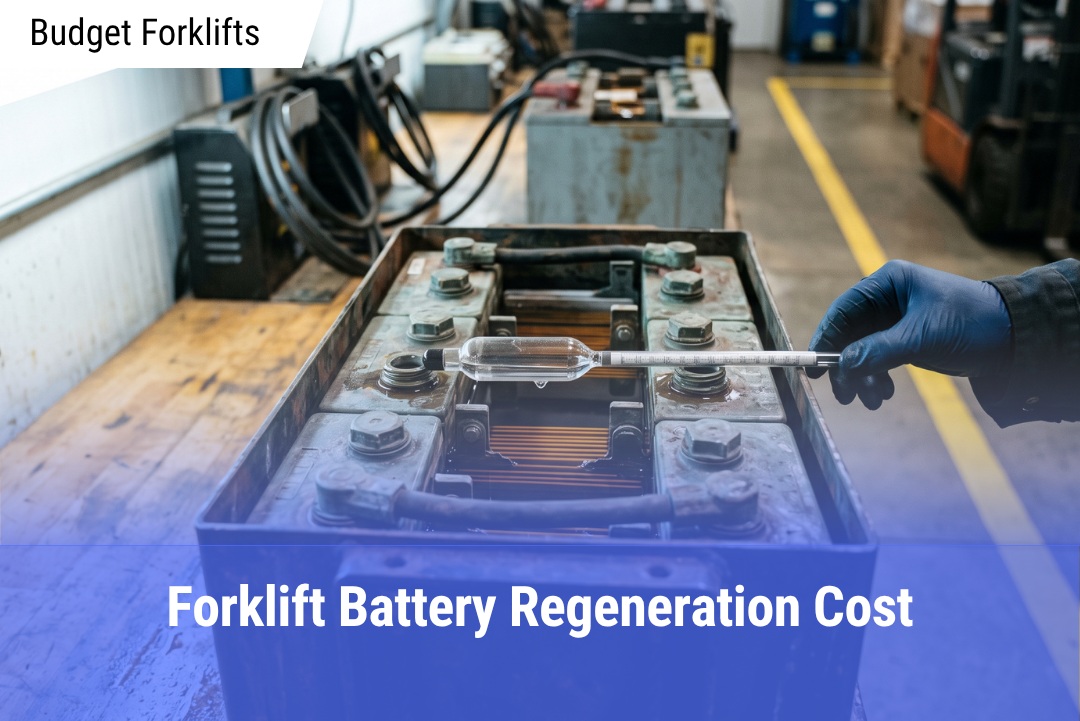
Fully charge and equalize the battery, then take a hydrometer reading on every cell and run a timed discharge test. A specific gravity spread over 0.050 between the strongest and weakest cell, or any cell falling below 1.70 volts during the test, means replace rather than regenerate.
This takes an afternoon and it is the single most valuable thing you can do before approving a quote. The sequence we use:
- Bring the battery to a full charge and run a complete equalize cycle. Readings taken on a partially charged battery are meaningless.
- Let it cool and rest for at least an hour, then take a hydrometer reading on every single cell. A healthy fully charged flooded cell reads about 1.275 to 1.290 corrected to 77 degrees Fahrenheit.
- Note the highest and lowest cell. A spread under 0.030 is normal variation. A spread over 0.050 means at least one cell has a problem that charging did not fix.
- Run a timed discharge test under load and watch individual cell voltages. Any cell that drops below 1.70 volts before the others is a condemned cell, not a sulfated one.
- Look into the cells with a light. Visible sediment or dark sludge at the bottom is shed active material, and that battery is finished regardless of what the voltage says.
If steps three, four, and five all come back clean and the battery is simply weak across the board, you have a genuine sulfation case and regeneration is very likely worth the money. If any one of them fails, put the budget toward a replacement instead.
If you are replacing anyway, this is also the moment to ask whether lead-acid is still the right chemistry for your shift pattern, which our comparison of lithium-ion vs lead-acid forklift batteries works through, or whether the truck should be a different power source entirely. Operations running two and three shifts often find the answer in our electric vs propane forklift comparison rather than in a battery invoice.
Frequently asked questions
Is it cheaper to replace individual cells instead of regenerating the whole battery?
Replacing one or two weak cells typically runs $150 to $400 per cell and makes sense when the rest of the battery tests healthy. Once you are replacing more than about a quarter of the cells, the cost approaches a reconditioned battery with none of the warranty.
Can a forklift battery that has been sitting dead for years be revived?
Rarely, and it is almost never worth paying for. Long idle periods in a discharged state produce hard crystalline sulfation alongside plate drying, and a battery in that condition usually has more value as a core trade-in than as a regeneration candidate.
Is regeneration the same thing as reconditioning?
No, though the terms get used interchangeably in quotes. Regeneration treats the existing cells with controlled or pulsed charging to dissolve sulfate, while reconditioning generally includes physically replacing cells that fail testing, which is why it costs more and carries a longer warranty.
Does a regenerated battery affect what the forklift is worth at trade-in?
It helps far less than owners expect, because any buyer will test the battery independently rather than take the paperwork at face value. A documented recent battery replacement moves a trade-in number noticeably; a regeneration receipt usually does not.
The bottom line
Forklift battery regeneration costs $500 to $2,200 and is one of the best-value services in material handling on the right battery. The right battery is under about three years old, failed from a charging or watering habit rather than from age, holds every cell above 1.70 volts under load, and shows no sediment in the tray. On that battery you will get most of your capacity back for a fraction of replacement cost.
On any other battery, the invoice is a deferral rather than a saving, and the research bears that out: the techniques only address sulfation, and sulfation is only one of the three things that kill a traction battery. Test before you buy, compare cost per remaining year rather than sticker price, and be willing to walk away from a quote that looks cheap.
If the test comes back bad, we carry new and reconditioned units in a full range of voltages and capacities, and we can arrange delivery, installation, and pickup of your old battery. Browse the current stock of industrial forklift batteries, or if you need to keep a truck moving while the decision gets made, short-term forklift rental will cover the gap.