You can pay $59 tonight, pass the quiz in an hour, print a card before bed, and still be legally barred from touching a forklift tomorrow morning.
That is not a warning about scams. Plenty of those courses are perfectly good. It is how the federal rule is built: the card is one piece of a three-piece requirement, and the piece almost nobody explains is the one that happens on the warehouse floor with somebody standing next to you.
Get that wrong and you show up to a new job thinking you are ready, then spend your first shift watching someone else drive. Get it right and you are the candidate a hiring manager can put to work in an afternoon.
This guide walks through what forklift certification actually involves, who issues it, what an online course can and cannot do for you, why OSHA shut down video evaluations in 2025, and the five events that void your training long before the three-year mark.
Table of Contents
How do you get forklift certified?
Getting forklift certified takes three things: formal instruction, hands-on practical training, and an evaluation of your performance in the actual workplace. Your employer is the party that certifies you, not the company that sold you the course.
That structure is not a best practice or an industry convention. It is written into OSHA’s forklift training standard, which requires training to consist of formal instruction, practical training, and evaluation of the operator’s performance in the workplace. All three. Complete two of them and you are not certified, no matter what document you are holding.
The word “certification” causes most of the confusion here. In the standard, certification is a record the employer creates and keeps. It has to name the operator, the training date, the evaluation date, and who performed the training or evaluation. It is a personnel file entry, not a credential issued by a government agency.
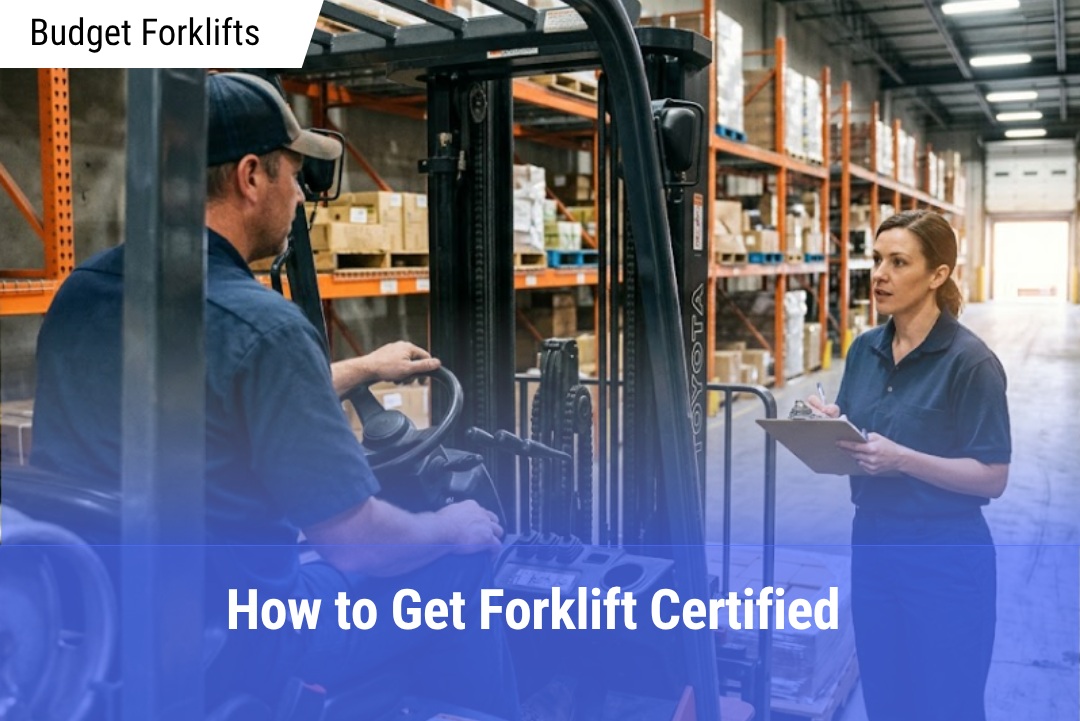
So the practical path looks like this. You complete classroom-style instruction covering the required topics. A qualified person then demonstrates the equipment and watches you run practical exercises. Finally, someone with the knowledge, training, and experience to judge competence evaluates you operating the truck you will actually use, in the environment where you will actually use it. Then your employer signs the record.
On our side of the counter, this is the step that surprises people most. Operators arrive expecting something like a driving test at a testing center. What they get instead is an evaluation on a specific machine, in a specific building, by someone who works there.
Does OSHA issue a forklift license?
No. There is no federal forklift license, no OSHA-issued card, and no national registry. OSHA writes the training requirements and enforces them against employers. It does not issue credentials to individual operators.
It also does not bless training programs. OSHA said so directly in an August 1999 letter of interpretation from its Directorate of Construction, which stated that while the agency was willing to review a submitted forklift training course, it cannot endorse or approve any product or service. That position has not changed.
This matters because “OSHA-approved forklift certification” and “OSHA-certified operator card” appear in the marketing of a large share of the courses ranking for this topic. Those phrases describe something that does not exist. A provider using them is either misunderstanding the standard or counting on you to.
The one place OSHA does authorize outside parties is its 10-hour and 30-hour Outreach Training Program, which is a different program entirely and does not cover forklift operator certification. If you see an outreach card presented as a forklift credential, that is a red flag.
None of this makes course providers useless. A good course delivers the formal instruction component properly and gives your employer a clean starting point. It just cannot deliver the whole thing, and the honest ones say so on the sales page.
Is online forklift certification legit?
Online forklift training is legitimate, but it only satisfies one of the three requirements. It covers formal instruction. It cannot provide the practical training or the workplace evaluation, which means it cannot certify you by itself.
The OSHA standard is explicit that formal instruction can take several forms, and it names interactive computer learning alongside lecture, discussion, video, and written material as acceptable. So a well-built online course is not a scam. It is one third of a process being sold as the whole process.
Here is how the three components break down:
| Requirement | What it involves | Can it be done online? | Governing paragraph |
| Formal instruction | Lecture, discussion, video, written material, or interactive computer learning covering the required topics | Yes, fully | 1910.178(l)(2)(ii) |
| Practical training | Demonstrations performed by the trainer plus hands-on exercises performed by the trainee | No, requires the physical machine | 1910.178(l)(2)(ii) |
| Workplace evaluation | A qualified person observing you operate the truck in your actual work environment | No, requires physical presence | 1910.178(l)(2)(ii) and (l)(2)(i)(A) |
Where the online-only card genuinely causes harm is at hiring. We regularly see candidates turn up for a warehouse role holding a printed certificate and assume onboarding is a formality. Their new employer then explains that the truck needs to be evaluated on site, and the operator feels misled, because in a sense they were. The certificate was real. The claim wrapped around it was not.
The useful way to think about an online course is as pre-work. It shortens the day your employer has to spend on you and it demonstrates initiative on a job application. It does not put you in the seat.
Can a trainer evaluate me over a video call?
No. In an April 2025 letter of interpretation, OSHA confirmed that direct supervision means the qualified individual observing and evaluating the operator is physically located where the practical training and evaluation take place.
The question that prompted that response was specific and modern: can an employee demonstrate competence over a live stream on a phone, tablet, or computer while a qualified evaluator watches remotely? OSHA’s Directorate of Enforcement Programs answered that the standard requires the evaluator to be there, in the location, in person.
That closes a door a lot of people assumed was open. Remote work normalized live-streamed everything, and it is reasonable to expect a video evaluation to count. It does not. If a provider offers to certify you end to end without anyone standing in your facility, the practical training and evaluation components are not being met.
The ruling cuts both ways for employers too. A multi-site operation cannot have one qualified evaluator sitting in the head office signing off on operators across six warehouses by video. Each site needs a physically present evaluator.
Can you get forklift certified without a job?
Not completely. You can finish the formal instruction on your own and you can take a hands-on course at a training center, but the workplace evaluation has to happen in the workplace where you will operate, which means you need an employer.
The standard puts the obligation on the employer to ensure each operator is competent to operate a powered industrial truck safely, as demonstrated by successful completion of the training and evaluation. Nobody else can discharge that duty for them.
This is not the dead end it looks like. Many employers hire uncertified and train in house, particularly in warehousing where volume hiring is normal. Walking in with completed classroom training and a hands-on course behind you makes you meaningfully cheaper to onboard than a candidate starting from zero, and hiring managers know it.
There is also a legitimate middle path. Training centers run practical sessions on their own equipment, which gives you real seat time and a defensible record of formal and practical training. What that session cannot do is evaluate you on your future employer’s machine in your future employer’s aisles. That final step waits for the job.
If you are choosing which equipment to learn on, learn on what your target employers run. A candidate trained on a sit-down counterbalance is a different proposition to a cold storage operation running reach trucks, and knowing reach truck vs counterbalance differences before the interview is worth more than a second certificate.
What does forklift certification training cover?
OSHA specifies the required content in three groups: truck-related topics, workplace-related topics, and the requirements of the standard itself. Employers can skip a topic only if they can show it does not apply to safe operation in their workplace.
The required training topics are long and specific. On the truck side they include controls and instrumentation, steering and maneuvering, visibility restrictions caused by the load, fork and attachment limitations, vehicle capacity, vehicle stability, any inspection the operator has to perform, refueling or battery charging, and the differences between a forklift and a car.
Several of those deserve more attention than a two-hour course tends to give them. Vehicle capacity is the obvious one. Operators are taught to read a rating but not always taught that attachments, load centers, and mast height change it, which is why reading a forklift data plate correctly and understanding forklift load capacity separates a competent operator from a certified one. The same goes for stability, which makes far more sense once you understand the forklift fulcrum.
The workplace group covers surface conditions, load composition and stability, stacking and unstacking, pedestrian traffic, narrow aisles, hazardous classified locations, ramps and sloped surfaces, and closed environments where ventilation or poor maintenance could allow carbon monoxide or diesel exhaust to build up. That last item is exactly why electric vs diesel forklifts is a training issue and not just a purchasing one, and why electric vs propane comes up in any indoor operation.
Battery handling deserves a flag. The standard treats charging and recharging as a required operator topic, and in practice it is the one most often reduced to a single slide. Operators who understand forklift battery failures and follow basic forklift battery maintenance protect a five-figure asset every shift. Daily inspection is the other underweighted item, and tires are where it usually shows, so operators should know when forklift tire replacement is due rather than reporting a problem after it becomes one.
How old do you have to be to operate a forklift?
Eighteen. The restriction comes from federal child labor law rather than from OSHA, which is why it is missed so often.
Under the Fair Labor Standards Act hazardous occupations orders, specifically 29 CFR 570.58, operating a high-lift truck is prohibited for workers under 18 in non-agricultural employment. The regulation defines high-lift truck broadly and names fork lifts, fork trucks, tiering trucks, and stacking trucks explicitly, along with skid steers and front-end loaders.
The prohibition is not limited to driving. It covers operating, tending, riding upon, working from, repairing, servicing, or disassembling the equipment, and tending includes assisting with the hoisting task. A 17-year-old cannot ride along, cannot help spot a lift, and cannot work from the forks.
There is no apprentice or student-learner exemption for this order, unlike some other hazardous occupations orders. Seasonal and summer hiring is where this trips employers up most often, since a 17-year-old warehouse hire can do almost everything else on the floor.
You do not, incidentally, need a driver’s license. Some employers require one as a matter of policy, but no federal rule ties forklift operation to a state driving credential.
How long does forklift certification last?
Three years is the outside limit, not the whole rule. An evaluation of each operator’s performance is required at least once every three years, and five separate events force refresher training sooner regardless of when the last one happened.
The five refresher triggers are: the operator has been observed operating unsafely, the operator has been involved in an accident or a near miss, an evaluation shows the operator is not operating safely, the operator is assigned to a different type of truck, or a workplace condition changes in a way that could affect safe operation.
The fourth one catches more operations than the other four combined. Moving a certified sit-down counterbalance operator onto a reach truck, an order picker, or a stand-up rider is a different type of truck, and it triggers retraining on the spot. The certificate on file does not cover it. This comes up constantly when a facility adds equipment or reorganizes racking, and it is a routine finding when someone looks closely at a training file.
The fifth trigger is the quiet one. Narrowing aisles, adding a mezzanine, changing to a different pallet type, moving into a refrigerated area, or resurfacing a yard can all qualify as a workplace change affecting safe operation. Nobody sends a calendar reminder for that. It falls to whoever is paying attention.
If you are running a mixed fleet or planning a fleet change, the training obligation should be part of the cost model, not an afterthought. Sites weighing how to choose a forklift or comparing new vs used forklifts tend to price the machine and the maintenance and forget that a truck type change puts every operator back through retraining.
Does forklift certification transfer to a new employer?
The training can carry over. The certification does not. A new employer still has to evaluate you on their equipment in their workplace and create their own certification record before you operate.
The standard allows employers to skip duplicate training. If you have already been trained in a required topic and that training suits the truck and the working conditions, it does not have to be repeated, provided you have been evaluated and found competent. That is a genuine efficiency and it is why experienced operators onboard faster.
What it does not do is let an employer accept your old card and put you to work. The evaluation is site-specific and equipment-specific by design. A card from a distribution center in one state says nothing about whether you can safely run their reach truck down their aisle past their pedestrians.
For hiring managers, the practical sequence is short. Confirm what the previous training actually covered and on which truck class. Cover any gaps, especially site hazards and any equipment type the operator has not run. Then evaluate on the machine they will use and sign the record. In most cases that is a fraction of a full training day, but it is not zero, and skipping it leaves the file non-compliant even though the operator is genuinely skilled.
The same logic applies to temporary and seasonal operators. Bringing in extra staff to cover a peak does not lower the bar, which is worth factoring in when you are already handling seasonal forklift rental and adding headcount at the same time. Two new variables, machine and operator, arriving in the same week is how peak season incidents happen.
Is getting forklift certified worth it?
For most warehouse and manufacturing workers, yes. Federal wage data counted roughly 779,000 industrial truck and tractor operators nationally, with a median wage of $21.38 an hour, or $44,470 a year, in the May 2023 survey.
The distribution is worth reading closely. The bottom ten percent sat near $16.95 an hour and the top ten percent above $28.78, so where you work matters as much as whether you are certified. Warehousing and storage was both the largest employer of these operators and paid an above-average mean, which is a reasonable argument for targeting distribution over general labor placement.
The other return is durability. The role has not been meaningfully automated out of existence, the training obligation is legally mandatory rather than optional, and every employer running powered industrial trucks has to keep certified operators on the floor. That is a stable floor under the credential in a way that many short-course certificates do not have.
Just calibrate the cost. The classroom portion is genuinely inexpensive. Paying several hundred dollars for a card that promises full certification is paying a premium for the part that cannot be delivered.
How do employers set up a compliant forklift training program?
Employers need to deliver all three training components, use trainers and evaluators who are actually qualified, and keep a certification record containing four specific data points. The obligation cannot be outsourced away, even when the training itself is.
On the qualification point, the standard requires that all operator training and evaluation be conducted by persons who have the knowledge, training, and experience to train operators and evaluate their competence. There is no certificate that confers this. It is a judgment the employer makes and has to be able to defend, which is why designating your best operator as trainer without documenting why they are qualified is a weak position.
On records, the certification requirement covers four fields: the operator’s name, the training date, the evaluation date, and the identity of the person or people who performed the training or evaluation. Most non-compliance we see is not missing training, it is missing paperwork on training that genuinely happened. A shared spreadsheet with those four columns and a scanned evaluation sheet per operator solves the majority of it.
Rented and short-term equipment is the blind spot. A truck that arrives for a two-week job still counts as a truck type, and if it is different from what your operators normally run, that is a refresher trigger. Operations that lean on short-term forklift rental should build the retraining step into the rental process itself, and anyone weighing long-term vs short-term rental should treat repeated equipment changes as a recurring training cost. It is one of the forklift rental mistakes that only surfaces during an inspection, and it belongs in the budget alongside forklift rental cost itself.
The same applies to acquisitions. Adding a used machine of an unfamiliar class means retraining, so the questions to ask when buying a used forklift should include what your operators are currently certified to run.
Frequently asked questions
Is there such a thing as an OSHA forklift card?
No. OSHA does not issue operator cards, and any card you receive comes from a training provider or your employer. The record that legally matters is the certification your employer keeps on file.
Do I need a driver’s license to operate a forklift?
Not under federal rules. Individual employers may require one as company policy, particularly if the role includes yard work or public road crossings.
Am I certified on every type of forklift?
No. Certification is tied to the truck types you were trained and evaluated on, and being assigned to a different type triggers refresher training before you operate it.
What happens if my employer lets me drive uncertified?
The employer is the party in violation, since the standard places the duty on them, and citations and penalties follow accordingly. For you, the more immediate risk is operating equipment you have not been evaluated on.
The bottom line
Forklift certification is simpler than the marketing makes it look, but it lives in a different place than most people expect. It is not a card in your wallet. It is a record in an employer’s file, backed by classroom instruction, hands-on practice, and someone qualified watching you run the actual machine in the actual building.
If you are the operator, the move is straightforward. Complete the formal instruction, get real seat time however you can, and treat the final evaluation as something that happens on the job rather than before it. Walking in with two thirds of the requirement already met is a genuine advantage, and it costs very little.
If you are the employer, the exposure is almost never the training itself. It is the four-field record nobody filled in, the rental truck nobody retrained on, and the operator quietly moved from a counterbalance to a reach truck last quarter. Those are cheap problems to fix in advance and expensive ones to explain during an inspection.
Either way, the deciding question is the same. Has a qualified person watched this operator run this truck in this building, and is it written down?